The Play's the Thing
"The Dream", "The Tempest"
American Ballet Theatre
Metropolitan Opera House
New York, New York
July 1, 2014
ABT's Shakespeare night included two works both danced to incidental music composed for the plays, Felix Mendelssohn's for "A Midsummer Night's Dream", and Jean Sibelius' for "The Tempest". Ashton's "The Dream" has turned fifty, and Ratmansky's "The Tempest" is less than a year old, but seeing them together shows that "The Dream" is timeless, while "The Tempest", despite some very fine moments and immaculate performances, seems a bit creaky.
Ashton, with John Lanchberry, worked the incidental music into a cohesive score which let him tell the quite complex story clearly and succinctly, with glorious pauses for the magical fairy dances. The ABT corps did themselves proud with the shimmering, skimming opening, with soft upper bodies and fluttering feet; they made it look easy. ABT has been dancing the ballet since 2002, and the corps has thrived on it.
ABT's previous sets and costumes, borrowed from the Royal Ballet, have been replaced this year by ones from the National Ballet of Canada. The corps and Titania are now in a slightly darker turquoise, and seem to glow. The lovers' costumes, though, are less successful, since they are all in shades of gold, rather than the distinctive colors of the earlier version. And poor Helena (Gemma Bond) is saddled with a ringletted blond wig, making her look a ditz (Carol Burnett came to mind), as if the designer felt he had to scream at the audience "This is supposed to be funny!". The lovers' choreography makes that clear with Ashton's witty and subtle musicality, and is much funnier played straight. The dancers did a fine job. Nicola Curry and Roman Zhurbin gave a slightly fatuous smugness to Hermia and Lysander, and Sterling Baca's Demetrius (pursued by Helena) found ways to make exasperation ridiculous.
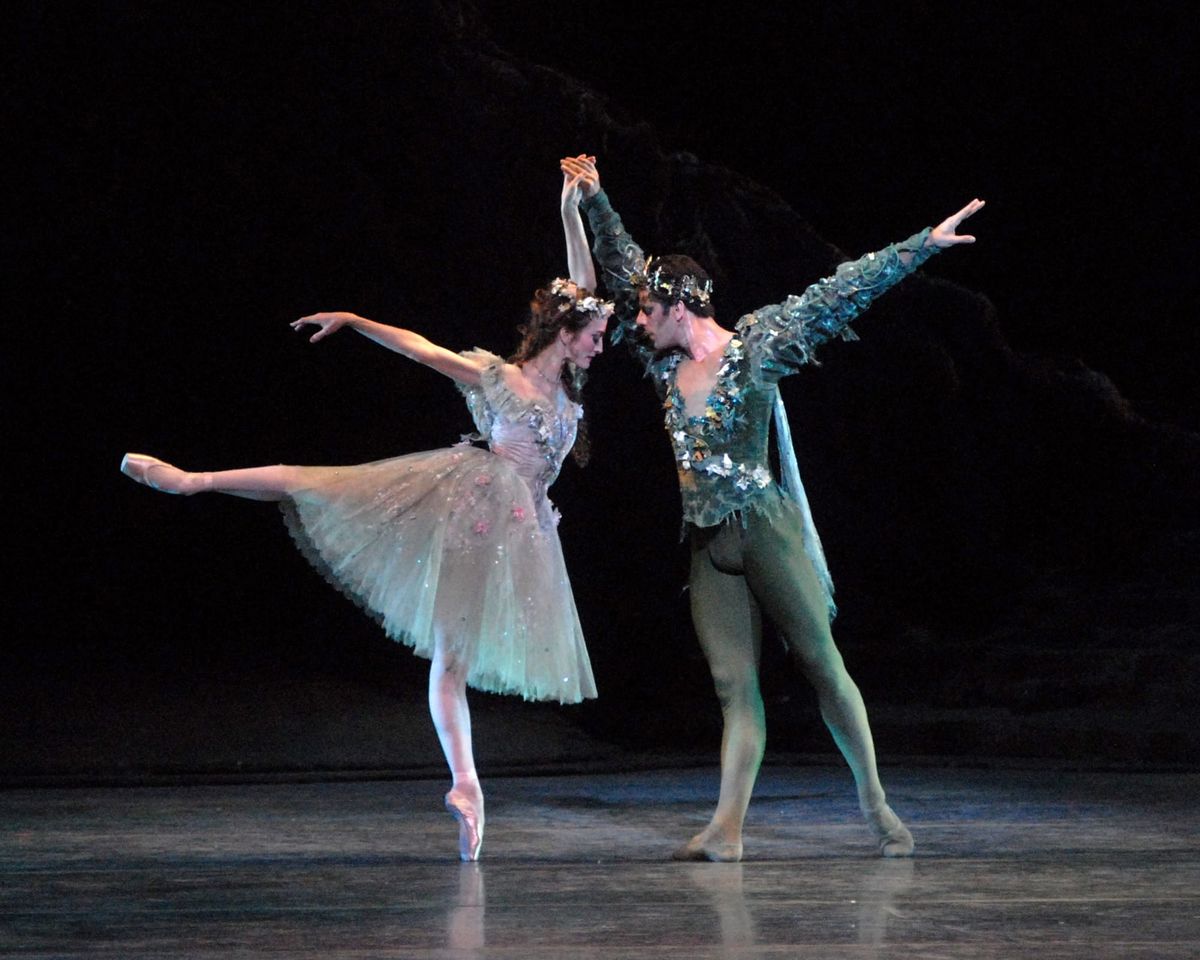
But of course, the ballet is really about Titania and Oberon, danced by Julie Kent and Marcelo Gomes. Kent, at this stage in her career, wasn't able to attack the choreography with gusto, but she danced without strain and used her upper body to sculpt some beautiful shapes, especially those melting arabesques in the pas de deux. Her Titania avoided any hint of saccharine--this was a proud, haughty, and wilful creature who never forgot she was a queen. Her rapturous awe at the first sight of Bottom was not overdone; she didn't have to signal to the audience that this all was a joke, she just let the serene music carry the message.
Gomes' warmth, generosity and humanity, ironically, make his Oberon a bit of a dramatic stretch, and the capricious, dangerous, slightly malevolent character is hard for him--it is almost impossible to imagine Gomes playing a trick on any woman. (His von Rothbart in the current "Swan Lake" is pure camp, not to be taken seriously). Nor does he have all the cool, unearthly purity of line and controlled adagio that Dowell, the original Oberon, had. But he is a charismatic performer and was wonderfully vivid in his conversations with Puck; I loved the ironic little bow he gave the sleeping Titania. The Scherzo was absolutely scintillating, and of course the final pas de deux was richly romantic.
Daniil Simkin was a sprightly Puck, an amoral bundle of energy, convinced that all humans were fools and that he could control them--and he wasn't wrong. The fight in the fog, where he sets everything right with a wave of his hand, had a wonderfully dismissive quality, as if he might, just for fun, mix things up again. Poor Bottom, Puck's other victim, was danced by Alexei Agoudine, with some killer point work. His mime scene, with it little "aw shucks" gesture as he remembers Titania, was both funny and touching, reminding the audience that those donkeys among us do dream of beautiful women. He did overdo the run off stage, making it a bit of a cartoon jog instead of the slightly eerie exit as he leaves that magical world.
Prospero and company also leave a magical world at the end of "The Tempest", but it isn't as clearly delineated as Ashton's. The notes describe the work as "a fragmented narrative as well as a meditation on some of the themes", which means that the audience needs to be familiar with the play to even begin to follow the action. And unfortunately, much of the choreography telling the story (however fragmented) looks a bit like a Classic Comic book version of Shakespeare's poetry. The dances for the magical Ariel, Caliban, and the sea dwellers, are glorious exceptions. The chorus, sea people with odd turquoise Mohawks, emerge from the sea in waves, catching the flow of the music. Ariel's music, too, had a rhythmic lilt, and Gabe Stone Shayer, with a bright red coral headdress, was a high flying marvel, combining virtuosity with pathos, as he reached forward to grasp his freedom. He exploded into the air when Prospero finally set him free. Caliban, Blaine Hoven, gets the final scene, as he is left on the island with knowledge he can never attain, tearing the book in inarticulate rage. Hoven moved with a heavy, threatening lope, but showed the glimmers of desire that Ratmansky gave him. However, the power of the final scene seems to come out of nowhere; Caliban had been just a peripheral figure until then, hovering at the edges.
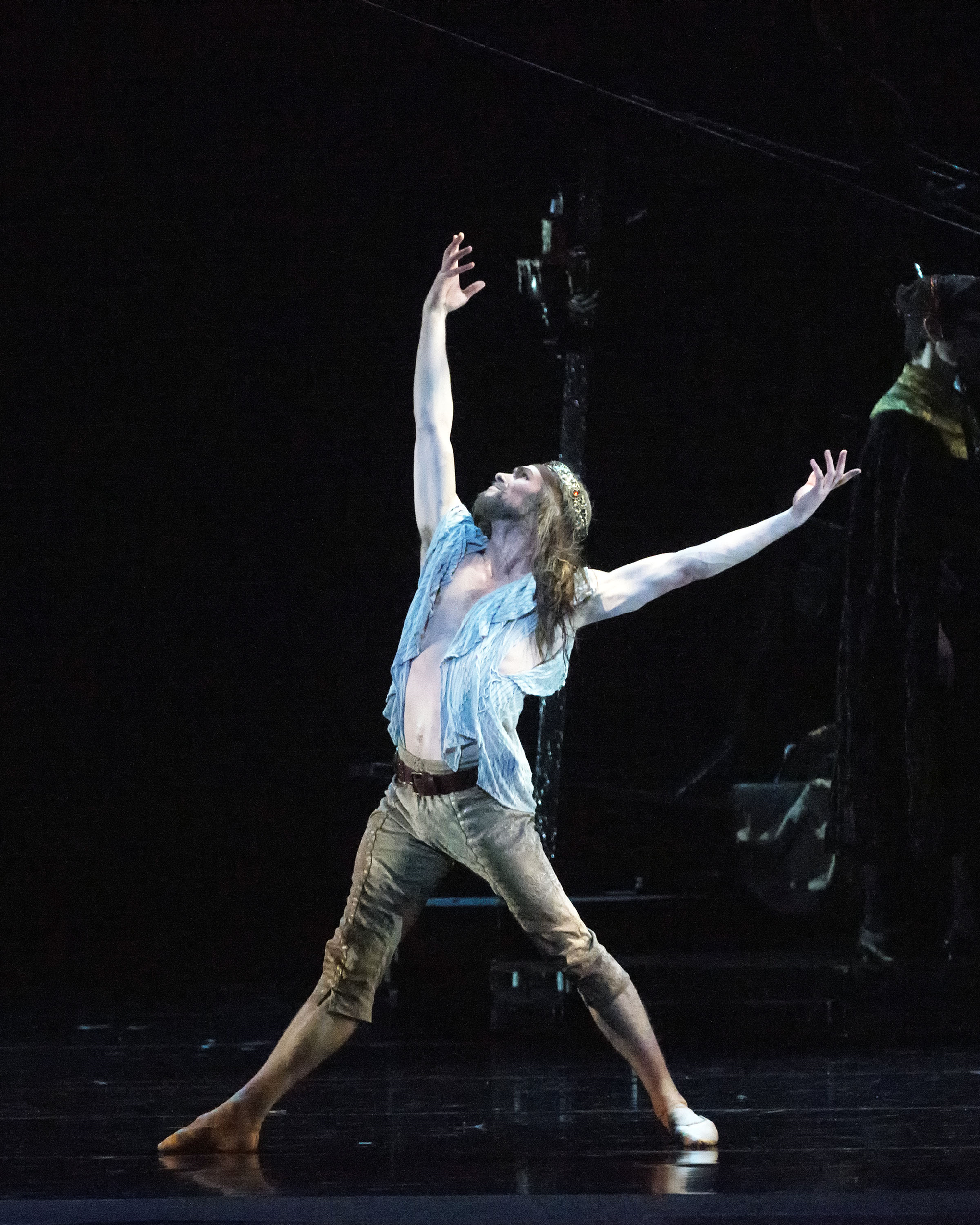
Prospero, the hero of Shakespeare's play, is the most problematic character, a bare chested, frisky hippie, much given to arabesques and temper tantrums. Quite a change from Shakespeare's powerful magician. Cory Stearns danced clearly and had a wonderful control, but the narrative was frequently muddy; the story of his betrayal looked like a game of Pass the Crown. Yuriko Kaijya, as Miranda, danced with a radiant innocence, and her rapture as she opened her arms to embrace happiness really did seem to welcome that brave new world. Jared Matthews as Ferdinand, who showed her that new world, danced with a plush amplitude--this ballet, opaque though it sometimes is, does show off the dancers.
copyright © 2014 by Mary Cargill



