The Old College Try
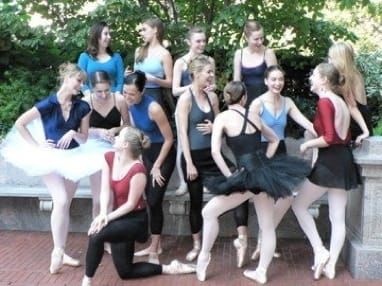
"Excursions", "Enjoy Your Rabbit", "Five Songs for Piano", "Navarasa", "Ah, Mio Cor", "Solid Ground"
Columbia Ballet Collaborative
Miller Theatre
Columbia University
New York, NY
April 9, 2010
The Columbia Ballet Collaborative, founded in 2007 by a group of Columbia students who had been professional dancers, presented six ballets by young choreographers. The Collaborative is of course, a part-time venture, but the presentation was completely professional, well-rehearsed, and elegantly danced. The choreography was of the contemporary ballet style, with a tendency towards black leotards, harsh overhead lighting, and blank looks, and unfortunately, the dances weren't as interesting as the dancers. "Excursions", by Claudia Schreier to music by Samuel Barber, which opened the evening, had many echoes of Balanchine's "The Four Temperaments", though without its solid structure or feeling of being inside the music. The dancers, though, led by guest artist Dan Friedewald, were clear and sharp, and the apparently strapless black leotards (no costume designer was credited) were beautifully cut and very flattering.
Teresa Reichlin, a full-time NYCB principal and part-time Barnard student danced Justin Peck's "Enjoy Your Rabbit" with Peck. The music was by Osso and Sufjan Stevens, music, which is, according to the invaluable Google, a genre-bending electronic sound. I guess my genre is too old to be bent, and it seemed to amble on with no structure, accompanied by choreography which looked overly complicated and emotionally blank. Reichlin was, as always, radiantly graceful and Peck a powerful and generous partner, but the combination of casual informality with a few arabesques didn't create a coherent mood. Emery Le Crone's "Five Songs for Piano", to Mendelssohn, was more involving, featuring five women in a sort of ritual mourning rite. Victoria North especially, was mesmerizing.
"Navarasa" by Lauren Birnbaum, to more Osso and Sufjan Stevens, was a larger-scale piece. The choreographer is comfortable moving dancers around the state, but, to me, the dancers looked awkward at times, with oddly swayed backs, unmotivated hints of aggression, and obviously intentional unmusical intervals of walking around. "Ah, Mio Cor" by John-Mark Owen, to Handel, had more walking; the rich and heart-stopping music doesn't need decoration.
Monique Meunier, who so many New York City Ballet goers remember with awe, choreographed the final piece "Solid Ground", and choreographically, it was certainly solid. There was structure, flavor, and an intriguing, slightly jazzy musicality. There also was Craig Hall, from the New York City Ballet, a dancer who apparently cannot be ungraceful. He appeared to be a captive, and the choreography captured the slightly plaintive undertones of the music. The glorious Victoria North was his companion/tormentor, accompanied by four other women, including Erin Duffy, who broke through his chains. There was one particularly affecting moment, when Hall approached each girl in turn, only to see her turn her head, until he reached Duffy. The cumulative effect of the gestures gradually built, until the final gentle ending; this was movement as metaphor and had a profound simplicity that some of the more knotty complications of the earlier choreography lacked.
copyright © 2010 by Mary Cargill



