The Mechanics of Being Human
"ROBOT"
Blanka Li and Dancers
BAM Howard Gilman Opera House
Brooklyn, NY
June 11, 2015
If you ever wondered what kind of future it would be where robots are ubiquitous, Blanca Li’s “ROBOT” can suggest only one answer: a funny and entertaining one. From the theme-setting opening scene, where a single dancer, Gael Rougegrez, stood on a dark stage with projections of various human and robotic forms making him at times flesh and at times machine, the Spanish-born choreographer’s show with its eight dancers, seven NAO robots and Maywa Denki’s all-mechanical orchestra, presented a 90-minute illustration of the human-machine relationships and identity, with all their quirky, funny and complicated sides.
Despite its name, “ROBOT” mostly focused on humans – in their robotic movements, their simulated creation of and preoccupation with machines and ultimately their relationships with them. It made sense of course, since as Hollywood learned long ago, when given the choice among machines, aliens and people, audiences prefer to focus on Team Human. With this show being less of an us-versus-them and more of an us-and-them proposition, the work seemed to focus on how the dynamics of our world change with our creation of machines and in part exploring and projecting the mechanical side of life.
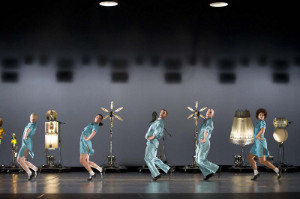
In their first appearance, the eight dancers in slight nude costumes performed slow isolated movements in line with each other, with small more fluid solos that were interspersed throughout the scene. The dancing highlighted the capacity and structure of the human body with each bend and curve of the body and the range of motion in the transitions, and the accompanying recording of a heart beat rhythm and running water suggested complementing vitality and fluidity, qualities a robot counterpart could never have. This, and a similar section toward the end of the show, provided some balance to the rest of Li’s work which otherwise had the humans frenziedly work at a machine factory (presumably creating the robots and other machines) and then interact with their creations. In many instances these interplays were infused with such enthusiasm and fascination that they bordered on hilarious fetishism; the dancers would care for a robot as though it were a child, adoringly swarm a robot en group while it sang “Besame Mucho” and flirted with a robot, among other interactions.
As interesting and amusing as this aspect was, the bulk of the work’s innovation and entertainment value -- and, ironically, human charm as well -- came from the few sections where Aldebaran Robotics company’s NAO robots, each with its own name and purportedly personality as well, took the stage.
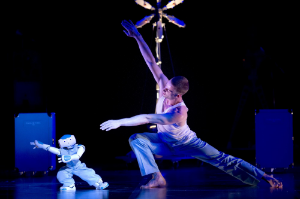
The show’s highly advanced, adorable looking 23-inch tall machines from the French robotics company are far from obscure in the robotics world. Since their creation in 2008 they’ve grown to find new roles in the human world, from educational uses, to treatment of children on the autism spectrum, to providing basic companionship (assuming you could afford the nearly $10,000 price tag). Dance, of course, is a whole different frontier, and Li’s design had the robots plié, developpé and mimic the humans’ more modern movements with remarkable synchronicity and precision until they would topple over and try to right themselves back up to the laughter and supportive cheering on of the audience.
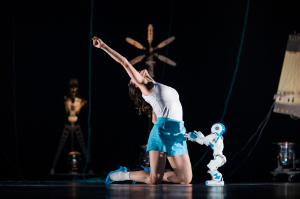
It was light, cheeky and endearing entertainment, particularly in the first scene when it happened one-on-one with a human. There, Rougegrez performed a duet of sorts with a toddler-like machine, teaching it how to walk and dance. The interaction between the two characters distinctly resembled a parenting scene, with Rougegrez patiently helping the little guy learn to walk despite many falls and then graduate to ballet moves. Though one of them lacked emotional capacity, there seemed to be a connection there, and the robot endearingly did all it could to act and be like his human caretaker, and even showed offense by shaking his head at Rougegrez diluting his attention by adding four more robots to the stage.
This and the other robot scenes that followed brought charm and cause for laughter every time the machines reappeared on the stage, whether to talk, sing or dance with the human performers, and had a distinctly different feel to the more serious humans-only sections. As a third dimension, Denki’s all-mechanical orchestra comprised of odd little machines, which when started by the dancers served as both stage décor and odd music accompaniment, added static and purely mechanical components to the show, though their significance, and musical merit, was less apparent.
With all its zany sides, what the show lacked was a singular cohesive message, but maybe that’s for the best. When toward the end the dancers again appeared in stripped down choreography against a background of scrolling letters and codes, blending with the matrix and finding themselves dancing connected to attached strings connected to the ceiling, the mindless steps could be interpreted as an unbreakable connection to technology after all the fun that came earlier. But if the point there was that the machines’ binds, once created, were inescapable, it was too serious to consider after an hour and a half of so much fun.
copyright © 2015 by Marianne Adams



