The Litmus Test
"The Sleeping Beauty"
The National Ballet of Canada
Four Seasons Centre for the Performing Arts
Toronto, Canada
March 8, 2018
This month marks the 200th birthday of the great Marius Petipa. What better way to mark the occasion than with performances of his masterpiece, "The Sleeping Beauty"? In addition to representing the zenith of the imperial Russian style, Rudolf Nureyev's 1972 production will always hold a special place in the National Ballet of Canada's repertoire. The NBoC came of age with this production, touring it widely across North America, galvanized by Nureyev's vision and star quality. It remains a grand and lavish work that the company should be proud of. It also provides a periodic checkup of the troupe's cohesiveness and mettle in this all hands on deck technically and stylistically demanding production. Any respectable classical company must be able to pull off a convincing version of this perennial classic, and the NBoC gave a fine performance here.
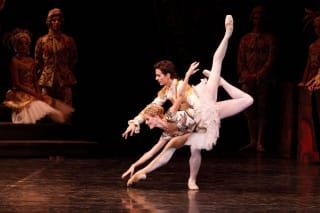
This run features some debuts for Princess Aurora and Prince Florimund, but the opening night performance went to seasoned principals, Heather Ogden and Guillaume Côté. Theirs is a harmonious and natural partnership, as they have been dancing together since the beginning of their careers. Both looked at home in their regal roles. Ogden was particularly strong in the first act. She made a sprightly entrance bounding down the stairs with excitement for her 16th birthday celebrations, and then switching gears, was serene and firmly on her leg for the entirety of the rose adage. She paused and took the time to connect with each of her four suitors. In her variation, she beamed with an innocence that indicated a pure and uncalculated goodness in her. She truly is the personification of the virtues imbued by the prologue fairies.
Côté appears on the scene in Act II, which is quite a marathon for the prince, particularly in Nureyev's staging. There were a few brief moments where he was fighting for positions in the prince's yearning extended solo that precedes the vision scene. In the coda of the grand pas de deux in Act III, the amplitude in his coupé jetés en tournant is not quite what it was in the past. However, with experience, Côté managed to pace himself intelligently throughout the performance. Instead of muscling through some challenging parts, he managed to conserve energy where he needed to, in order to keep his dancing polished and finish strongly. Also, to be fair, some of Nureyev's jam packed choreography for the Prince's variations is needlessly difficult. Even when danced with ideal technique and placement, certain steps can look awkward or inelegant. Côté was a gracious and convincing Prince who was as smitten and devoted to Aurora in Act III as he was by her vision in Act II.
In the Bluebird pas de deux, Francesco Gabriele Frola made his debut with Emma Hawes. She is just a tad too tall for him en pointe, but they each shone in their respective variations. Frola is a powerful, explosive dancer made for this type of bravura role. He uses a very deep plié to propel himself into the stratosphere and seemed to hover just above the ground on the brisé-volés. Hawes was radiant and weightless as Princess Florine.
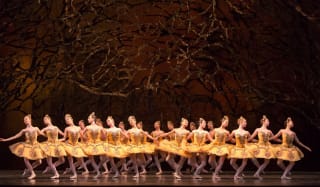
There were not a lot of standout performances amongst the prologue fairies or the Act III pas de cinq; the soloists were uniformly strong and danced well together as a group. In the character roles, Alejandra Perez-Gomez and Tanya Howard were perfect foils to one another as Carabosse and the Lilac Fairy, respectively. Overall, from the principal roles through the corps de ballet, everyone pulled his or her own weight and carried this "Sleeping Beauty" off without a hitch.
copyright © 2018 by Denise Sum