Looking for a Theme
"Continuum", "Solitude", "Bourrée Fantasque
New York City Ballet
David H. Koch Theater
New York, NY
October 7, 2026
The heart of this triple bill was the central work, Alexei Ratmansky’s searing “Solitude”, his powerfully understated reaction to wartime’s destruction. It opened with Christopher Wheeldon’s abstract exercise “Continuum”, one of his sparest and most inventive works, and ended with the rarely seen “Bourrée Fantasque”, Balanchine’s 1949 ballet buffa. The evening ricochetted between comedy and tragedy, between astringent modernism and jokey nostalgia. Even the marketing department couldn’t come up with a theme, and christened this program “Eclectic NYCB I”. There was a theme of sorts, fortunately, in the dancers, who gave gave tremendously committed and eloquent performances.
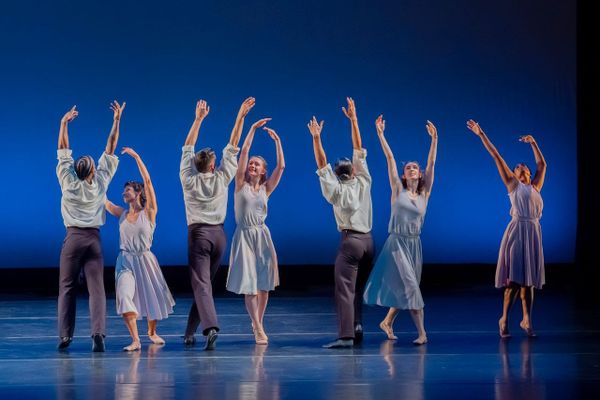
“Continuum” was originally choreographed for the San Francisco Ballet in 2002, and NYCB first danced it in the Spring of 2026. It was the second of Wheeldon’s works to the dissonant, rhythmically complicated keyboard music by the György Ligeti; it has worn its twenty-four years well. Wheeldon pared down his movement and, unlike his earlier “Polyphonia”, he wasn’t afraid of stillness and lets the odd, twisting shapes register without excessive twitching gestures. Many of these shapes do resemble those of Balanchine’s black and white Stravinsky ballets, but one of Balanchine’s most famous images—the moment in “Agon” where the ballerina stands on one leg and uses her arm to lift her back leg over her head—can be seen in photographs of Fyodor Lopukhov’s 1927 ballet “The Ice Maiden”, which Balanchine would have seen in Russia. The issue isn’t whether a movement is original, the issue is does it look organic, and Wheeldon’s images in “Continuum” emerge from the music.
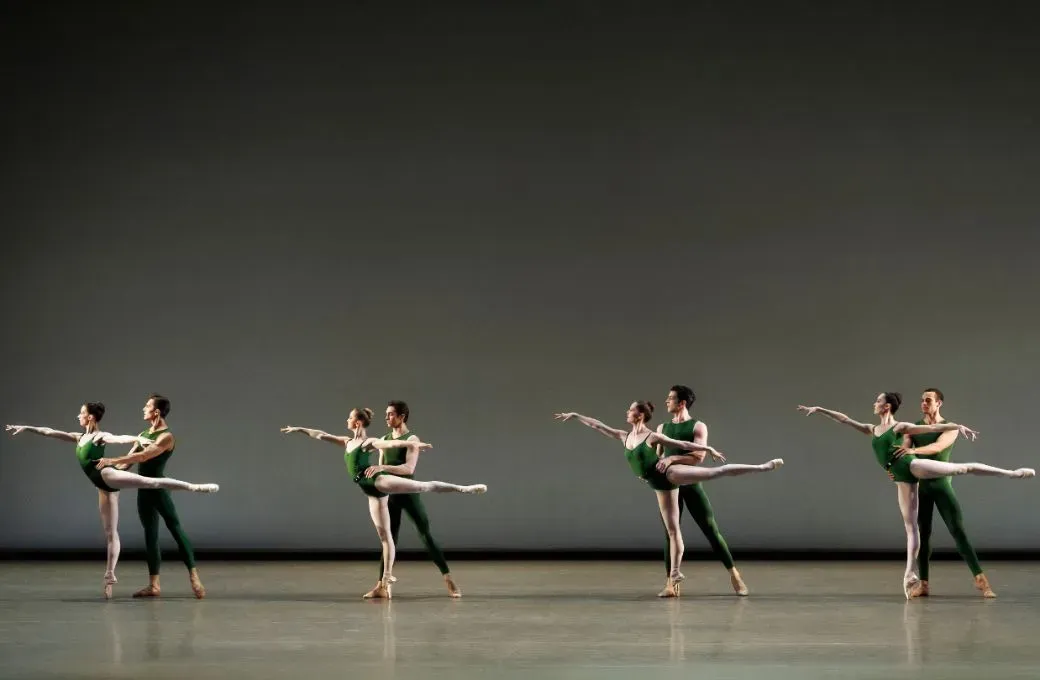
The four couples (Mira Nadon with Chun Wai Chan, India Bradley with Davide Riccardo, Emma Von Each with David Gabriel, and Unity Phelan with Gilbert Bolden III) opened and closed the work with cool, sculptural precision, often moving in harmony—the opening line of supported arabesques had a quivering serenity. Though the many solos and pas de deux were separated by blackouts, the work didn’t feel fractured; there was an odd uniformity, a certain shared tension and stylistic consistency (in addition to the many varied shapes) that held it together.
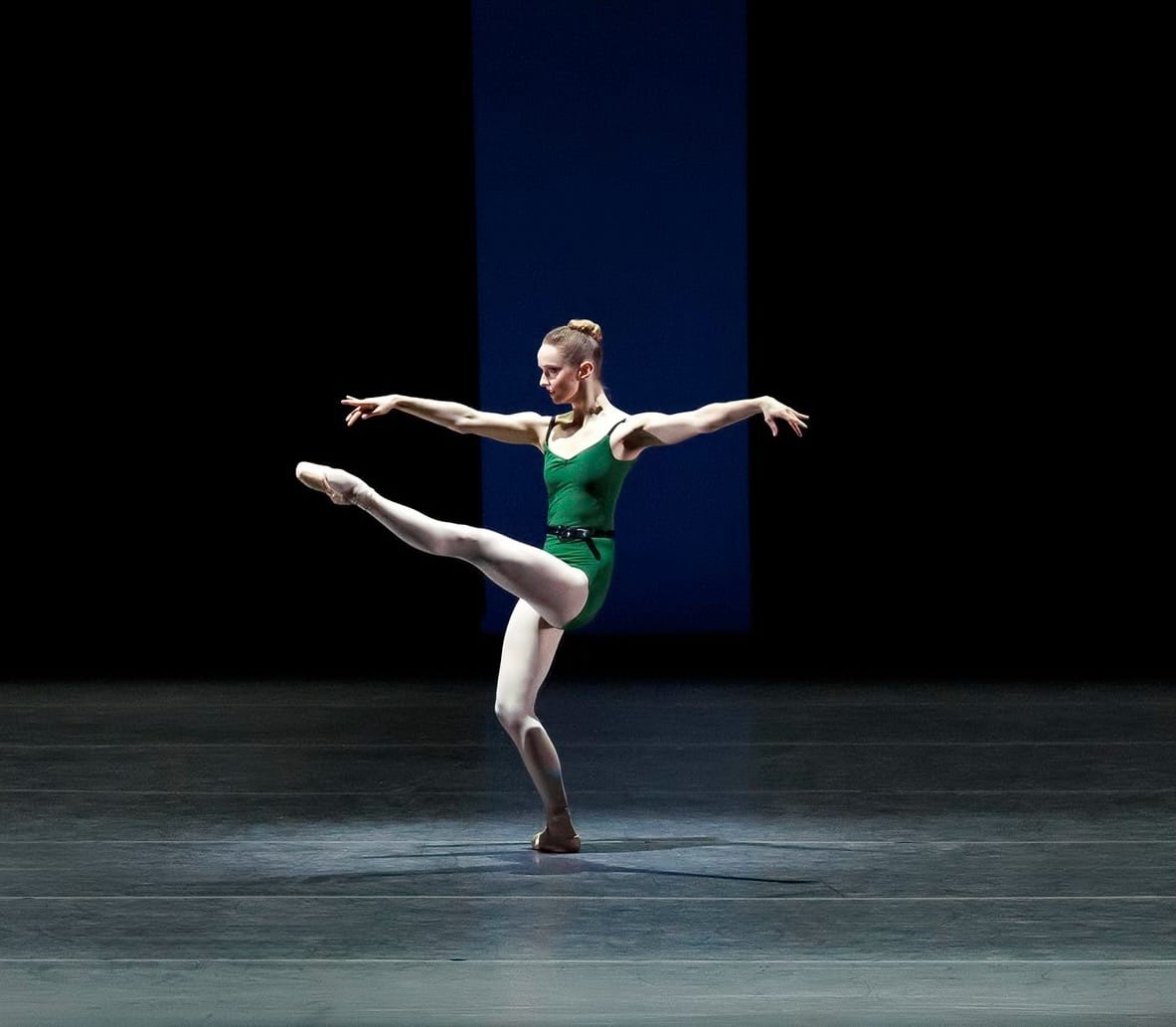
Bradley was especially effective with steady goal-post arms and slashing legs, as Riccardo posed her like a space aged Coppelia. She and Riccardo seemed to be in a box, as their flat hands hit invisible walls, a puzzle without a solution. Von Enck got a fast solo full of quick changes in direction, pauses in attitude, and immaculate fifth positions that looked like they were magnetized. A dance for the four men was a special joy; Wheeldon found unexpected and ingenious rhythms in the music, and their dance had a spiky folk flair as they circled with linked arms. The finale, with the dancers casting huge shadows on the backdrop, brought everyone together, back in their line of arabesques, as if they had come full circle.
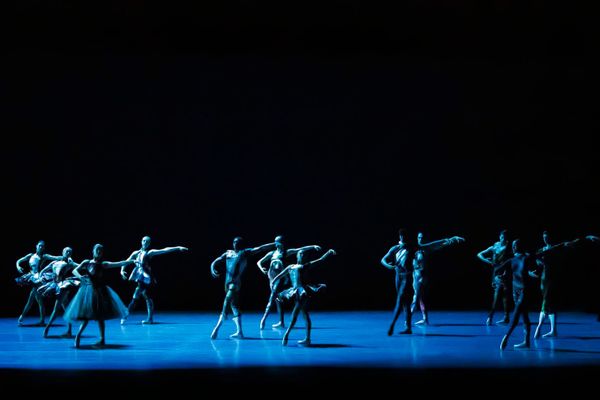
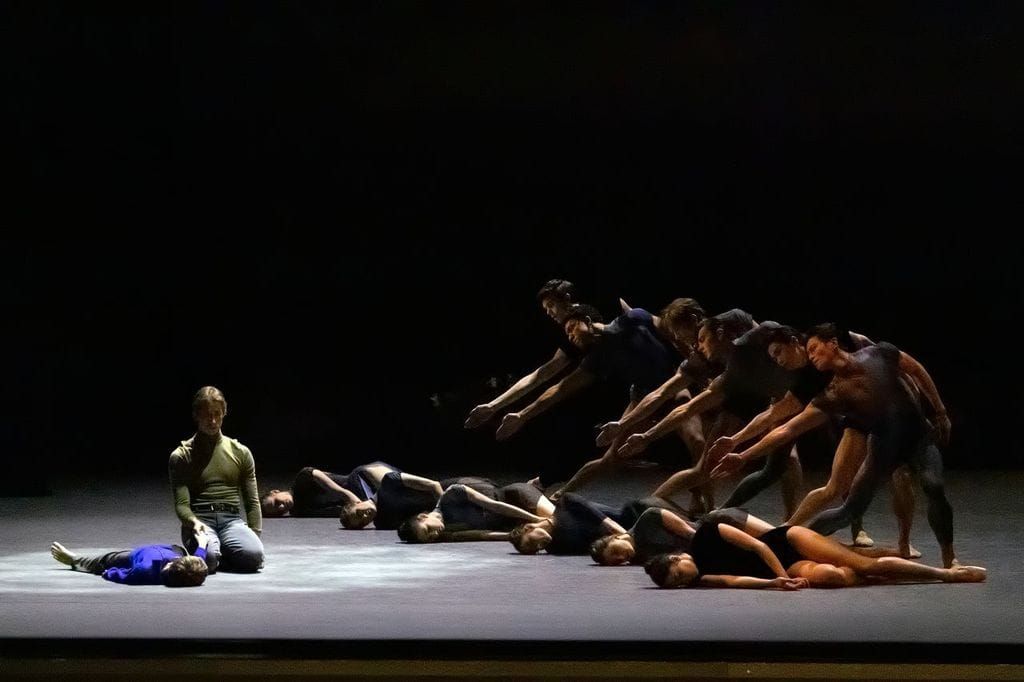
Alexei Ratmansky’s “Solitude” comes full circle as well, beginning and ending with a man (Joseph Gordon) kneeling beside his son. The work, from 2024, was inspired by a photograph of a man sitting by his young son who had been killed in the Russian invasion of Ukraine. It builds on this specific tragedy to form an abstract lament, a portrait of pain too raw for anger and too deep for tears.
In the first section, set to Mahler’s “Funeral March”, Gordon sat completely still, in a daze, while the thirteen other dancers seemed to wander through his thoughts. They moved with jagged steps, falling and rising, sometimes hovering over Gordon. Though at times they did seem like guardians, they were not dressed in angelic white, but in muddy browns, blending into the indistinct rubble in the background. There were hints of individuality, as KJ Takahashi occasionally moved with a martial gait, pairs of dancers emerged and danced together, but these moments appeared almost randomly, as if they were fleeting memories. Their specific stories may not have been spelled out, but the dancers moved with a fierce conviction, as if they themselves knew who they were.
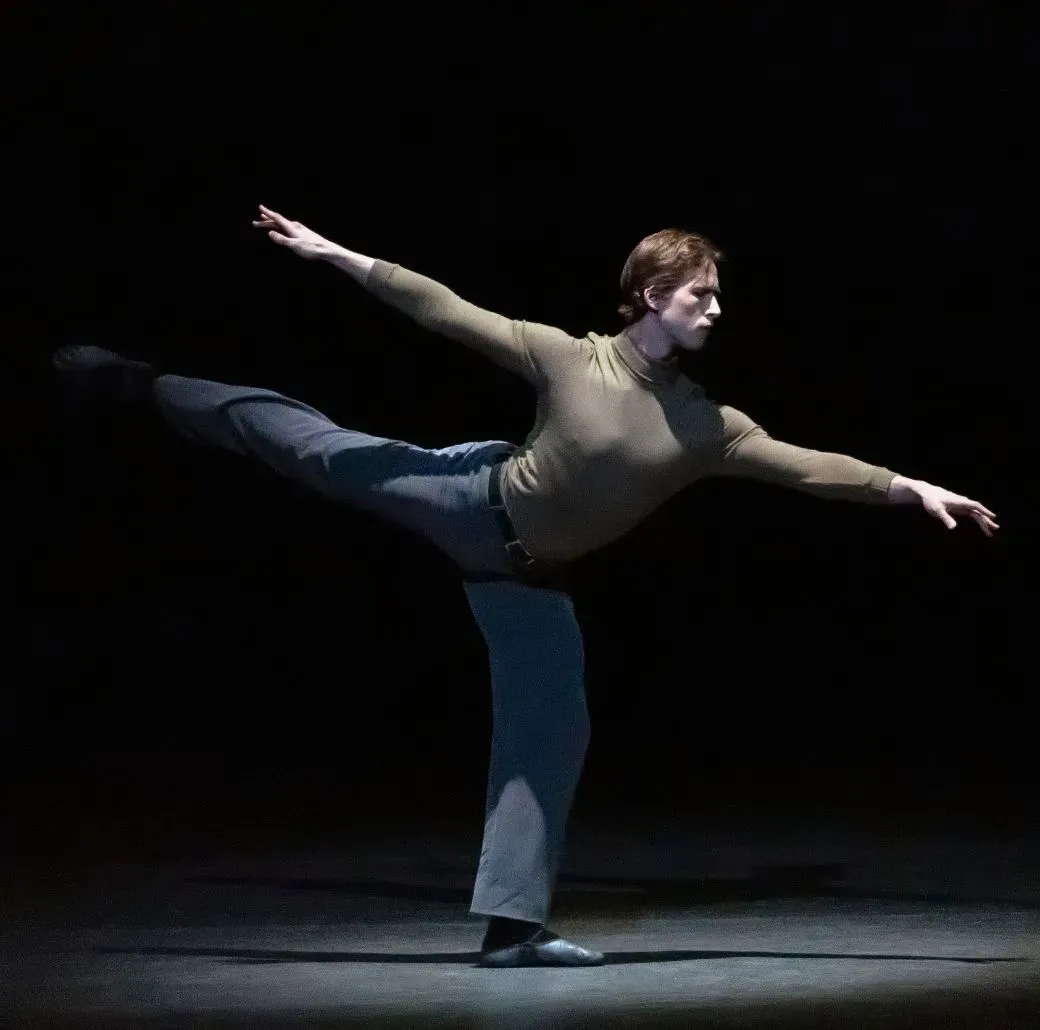
The second half used Mahler’s familiar “Adagietto”, by now almost a cliche. But Ratmansky, in a long solo for Gordon, made it seem inevitable. The music wasn’t ostentatiously danced to, nor was it floating around in the background, it seemed to merge into the man, becoming part of his soul, almost, as the spirits guided him into some never-never land where his son was. There he could do simple things, holding his hand and walking with him, just being a father, until a loud crash and a flash of light (the bomb hitting the town) and he was back to reality, sitting with the dead boy. It is a shattering experience.
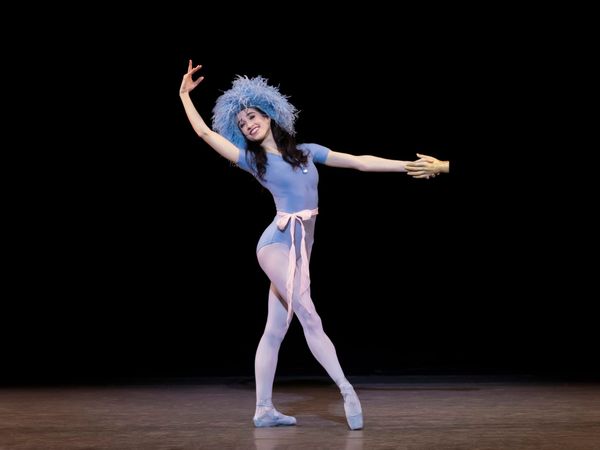
Following that performance, Balanchine’s “Bourrée Fantasque”, for all its finely crafted corps sections, charming Chabrier music, and lovely Karinska costumes, could only feel a bit shallow. In the first section, the very tall and stately Emily Kikta, dancing with the smaller powerhouse KJ Takahashi, spent a lot of time trying to one up each other. The trope of the tall woman and the shorter man was a bit obvious, jokey rather than witty, and the section did have carnival side show vibes.
This was abruptly switched with the second movement, where the low, mysterious melody seemed to summon up the dancers from “La Valse”, complete with billowy net skirts. Ruby Lister and Preston Chamblee both debuted as the couple, he an ardent pursuer and she constantly disappearing in a cloud of net. The men’s costumes, unfortunately, did look a bit dated, and the rhinestone sprinkled black leotards with the crisp little berets resembled the comic beatniks from so many 1950’s films. Chamblee did his best to look smitten, holding his hand on his heart and he partnered Lister with gracious generosity, making the series of mid-pirouette catches flow effortlessly.
Lister’s 90° arabesques were particularly lovely, showing off the sweep of her skirt as she wafted through the corps who did have the most interesting choreography as they swayed their torsos side to side in shifting little groups. The section looked like a gentle salute to the French romantic ballets with all their floating sylphs and impossible dreams, with a bit of 20th century Gallic chic.
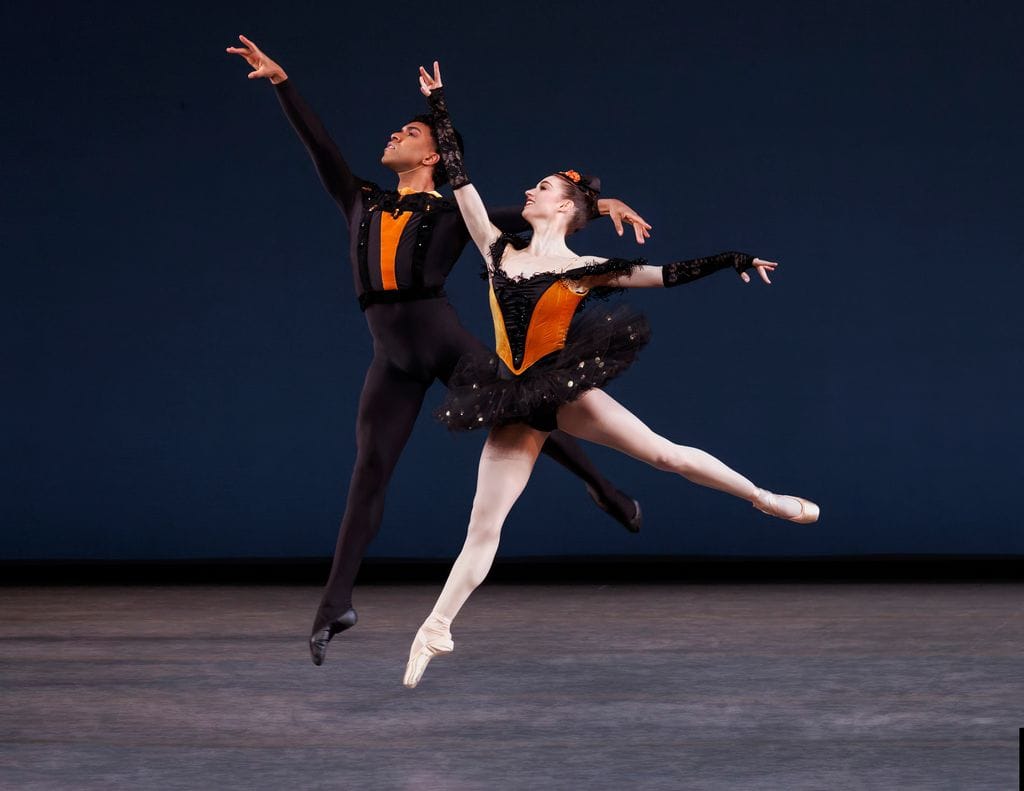
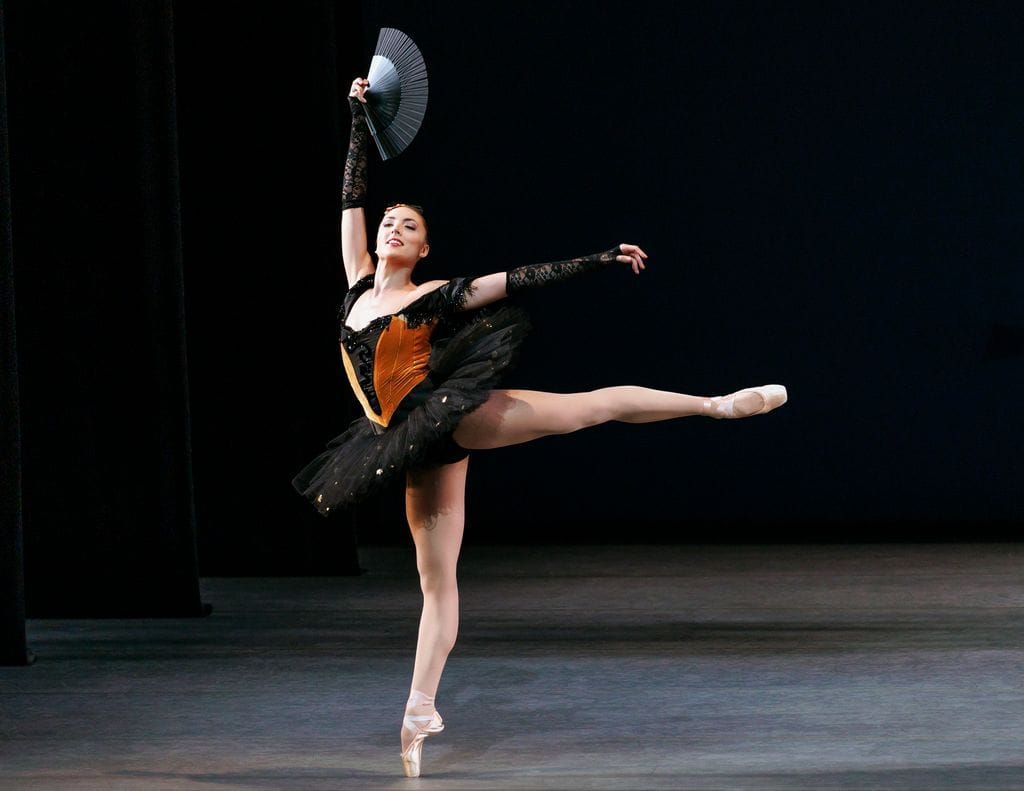
With another quick change, the finale moved to Spain, the Spain of “Don Quixote”, complete with sassy tutus and fluttering fans. Alexa Maxwell and Victor Abreu led the romp with sharp, clear jumps, and were joined by the entire cast. The corps again got the spotlight as Balanchine’s spectacular geometry had them form straight lines, which magically merged into colorful concentric circles, a bravura celebration. But the most lasting memory of the evening was the quiet picture of Gordon sitting frozen on the stage, and for all the comic hi jinx of “Bourrée Fantasque”, loss was the program’s main theme.
© 2026 Mary Cargill