The Latest from McGregor
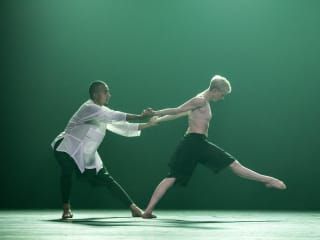
"Autobiography"
Company Wayne McGregor
Yerba Buena Center for the Arts
San Francisco, CA
March 8, 2018
“Auto- biography" by Wayne McGregor, does it tell us something about the man? No. Does it tell us something about being human? Yes. Does it tell us anything about the choreographer? Yes. His collaborators? Even more. About his dancers? YES. About a willingness to forego a trajectory? Yes. Does it work? Yes and No. A brief after-performance conversation with local dancers elicited uniform enthusiasm. Overhearing some other audience members, the reactions were decidedly mixed.
Yet “Autobiography’s” sheer moxie elicits respect. McGregor’s willingness to let the piece go wherever it takes itself and yet keep tight, very tight control of its components is admirable. It will be curious to see where this autobiography will take him next. If I understand the theory behind it, the individual parts – in collaboration with the company – were developed from specific information the choreographer gathered from his genome.
The dancers’ sheer technical expertise and the depth of their imagination often took one’s breath away. Their vocabulary is multi-lingual in the extreme with somersaults, handstands and flips, pretzel-formations and arabesques, jetés and ronds de jambs receiving equal weight. One could fill a dictionary with the sheer variety of hops, leaps, skips and runs. Dancers drop and melt, are carried overhead and passed through multiple configurations. An ensemble section might look fractured yet in the middle two performers shape themselves into perfect mirror images. And ten dancers — four women and six men — perform all of this in as gender-neutral choreography that I can remember ever having seen.
The work opens with an extraordinary sort of “Adam”-figure (Jacob O’Connell). He spells out kinetically just how extraordinary a human creature is — expressive, flexible, strong yet also vulnerable and generous. The first half of the piece devolved with a fierce frenetic athleticism that after began to feel longish. From purely theatrical point of view, this bifurcation of the piece within its time frame felt misplaced. Sometimes algorithms don’t know what they are doing.
Apparently the individual components are supposed to reflect McGregor life experiences. Perhaps. The work, however, brings to the fore the deep sense of humanity embedded in these virtuoso dancers. A male duet leaves us with the sense that these individuals, so unequal in size and temperament, complement each other perfectly. Jessica Wright and Daniela Neugebauer’s trio with James Pett impressed with its tender elasticity. An athletic duet for Rebecca Bassett-Graham and Travis Clausen-Knight seemed self-contained until it opened itself to the rest of the ensemble. At one point Fukiko Takase lowered herself into the deepest plié with outstretched arms that called up Bharatanatyam.
A section might start with three unisons that dissolved like snow in the sun; duets grow like amoebas in a Petri dish. Dancers walking along the stage’s dark periphery observe the center. I thought of judges doing their jobs. Then the troupe formed itself into chain moving downstage. Why? “Autobiography” has no narrative but every once in a while duet looked tender or like people engaged in a momentary conversation. Solos followed each other as if shot from the wings. They changed the sense of progression but I recoiled. Jilin’s score – heavy on the beat initially – opened itself up to a greater musical spectrum, even including some Bach and nature sounds. It worked well, particularly because it allowed some performers to respond closely, while others didn’t feel that need. Aitor Throup’s black and white costumes brilliantly changed the tone of the performance, looking it to me as if made their own contribution to the work. Longtime McGregor light designer Lucy Carter and Set Designer Ben Cullen Williams’ collaboration almost stole “Autobiography’s” spotlight. It was spectacular – the set rising and descending as if controlling the dancers – and imaginative. Wonderful theater. At one point the light sources concentrated themselves so much that I feared a single beam might swallow up the dancers. Fortunately, they were not.
copyright © 2018 by Rita Felciano