The Human Touch
"Dreamachine", "Eventide", "Esplanade"
Paul Taylor Dance Company
David H. Koch Theater
Lincoln Center
New York, New York
November 1, 2023
The Paul Taylor Company returned to its now traditional Fall Lincoln Center season with a mixture of modern choreographers and Taylor classics. Lauren Lovette, the former NYCB dancer, was appointed the resident choreographer in 2022, has two premieres, and the season also includes works by Ulysses Dove, Amy Hall Garner, and Larry Keigwin, It also includes live music by the Orchestra of St. Luke’s, a gift in this era of recorded music.
Music was the inspiration for Lovette’s premiere “Dreamachine”, (a revision of a work performed in California last April) named after the percussion concerto composed by Michael Daugherty for a 2014 festival focusing on Man and Machine. (A fascinating explanation by the composer of the origins of the four movements can be found here https://www.fabermusic.com/music/dreamachine.) The men and machines which inspired both the music and the choreography are Leonardo Da Vinci and his theories of flight, Rube Goldberg’s concoctions, the drawing by Fritz Kahn of an electric eel, and Vulcan, both the Roman god of fire and the half-Vulcan Mr. Spock. Lovette’s choreography is not literal, and some connections seem more tenuous than others, but the origins of her playful and inventive, if sometimes over-long, piece are intriguing.
Kristin Draucker, as the inventor, opened the work, framed by a slivery backdrop (sets and costumes were by Santo Loquasto). She seemed to be gathering her thoughts, pulling her arms into her, when a small group of people appeared, helmeted and anonymous (perhaps they were astronauts, though they looked like stormtroopers from “Star Wars”). She moved them in groups, shaping their movements with odd little shoves, until they seemed to develop minds of their own and danced wildly to slightly ominous music, forming a moveable tower and creeping after Draucker, possibly a modern take on poor Dr. Coppélius and his workshop. The movements were inventive and basically light-hearted—these were not frightening sci-fi goons, but just a friendly warning that our inventions can get out of control.
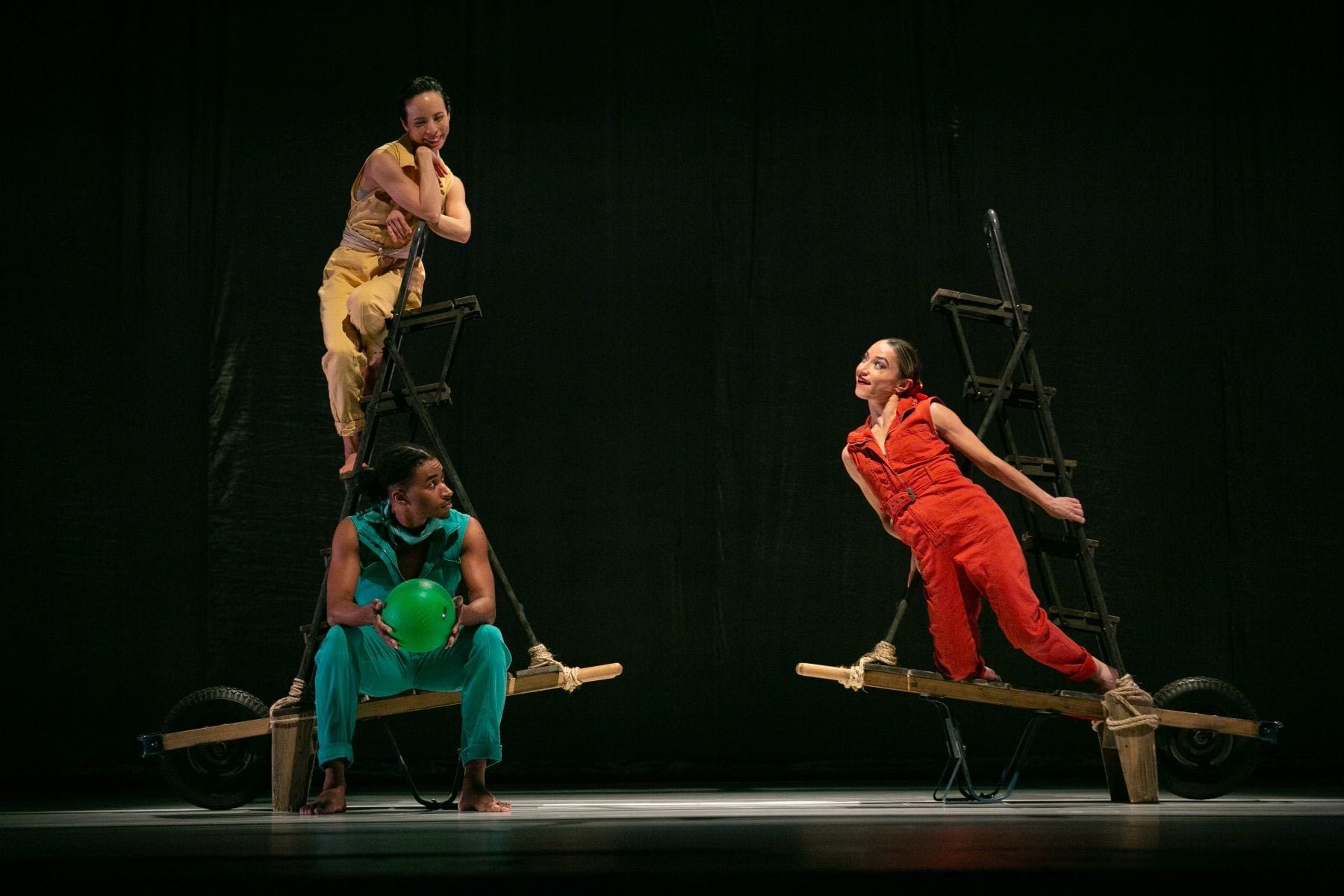
There was a lot of control in the second Rube Goldberg movement, where Lovette and her dancers seemed to be having a ball, quite literally, as several colorful ones were tossed around. The dancers, in candy-colored jump-suits, climbed up and around a couple of ladders with acrobatic, improvisational abandon (Madelyn Ho in yellow and Lisa Borres in red were especially dynamic). Lee Duveneck entered lying on a skateboard, which got tossed around and became part of the choreography. The dancing was inventive, daring, and great fun.
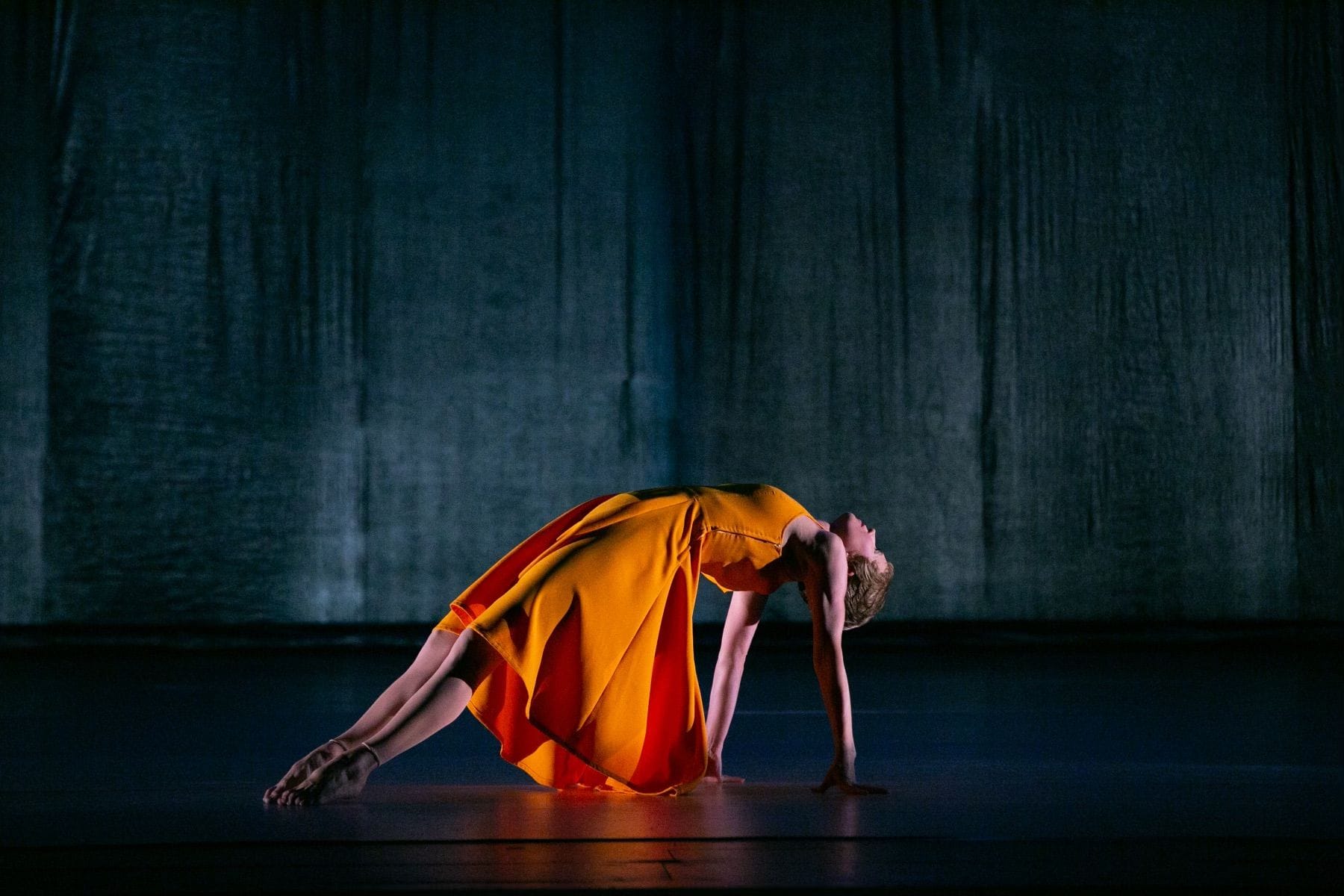
The third movement had an eerie, underwater feel, with rippling music and pale blue flourescent lighting which seemed to glow. Jessica Ferretti, in tight jeans and a crop top, seemed to float through some lovely sensuous balances with an athletic lyricism, until Kenny Corrigan, wearing tennis shoes with what appeared to be ball bearings in his heels, slid in. They had a long and rather repetitive pas de deux, and though the floating shapes were beautiful, the sliding motif ended up looking like a gimmick and when he finally slid off leaving her alone, she didn’t seem to care.
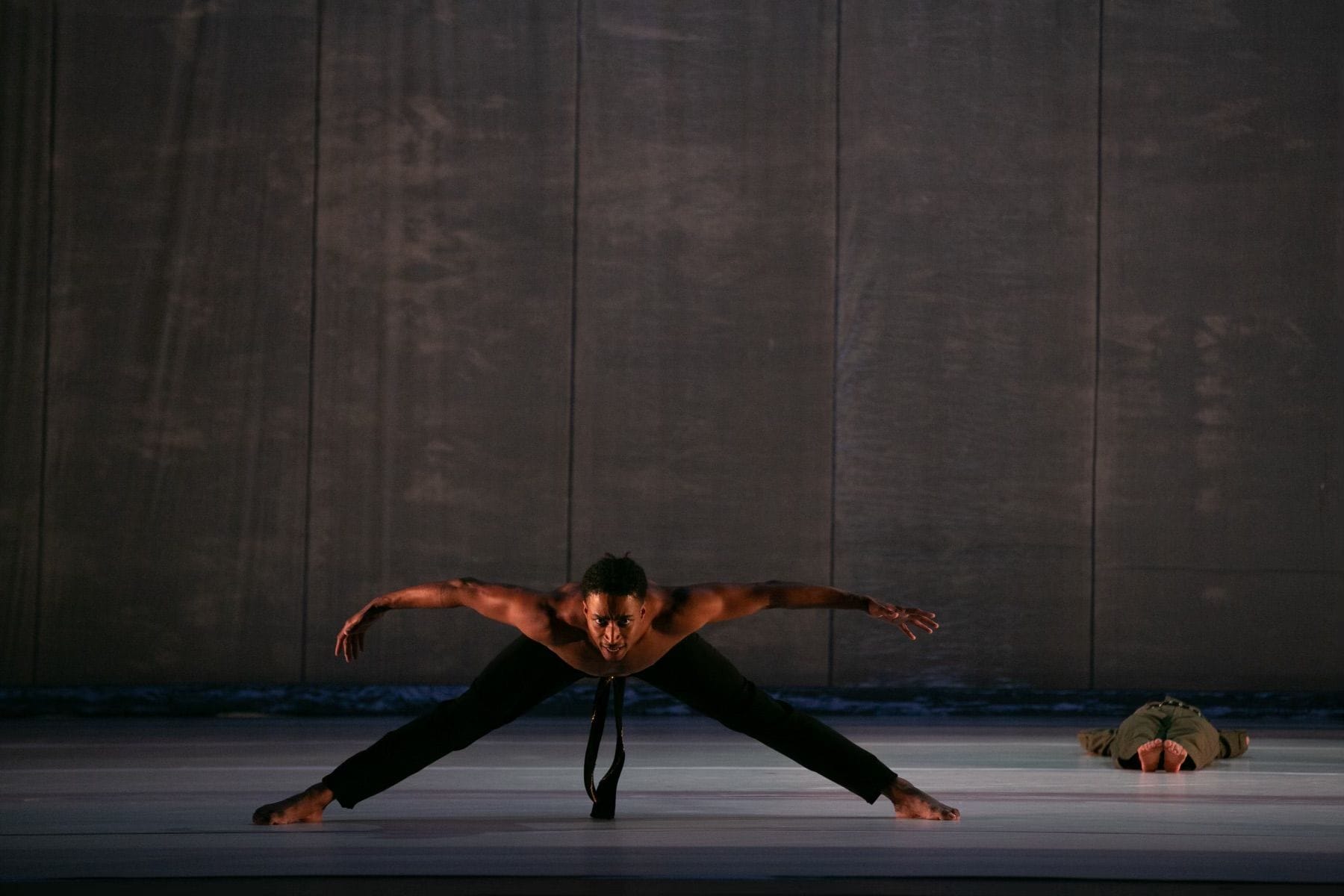
The fourth movement, led by an energetic Devon Louis, too, seemed emotionally empty. Louis opened it with a complex solo full of undulating moves and powerful jumps, which he danced with a confident daring and an air of self-absorption, almost preening in his liquid movements. This inward focus may have been intentional, since he was joined by the full cast wearing khaki jump-suits and sun glasses, which hid any expression. Since the music was inspired by the idea of the relationship between man and machines, it may be that Lovette pointing out the anonymity of an overly mechanical world, but the exuberant finale seemed celebratory, which seemed like a mixed message. There was an explosion of movement, but little variety, other than a few hints of violence and some runway strutting and the section seemed to meander. The dancers, though, gave it a fine burst of energy, but it was energy without direction.
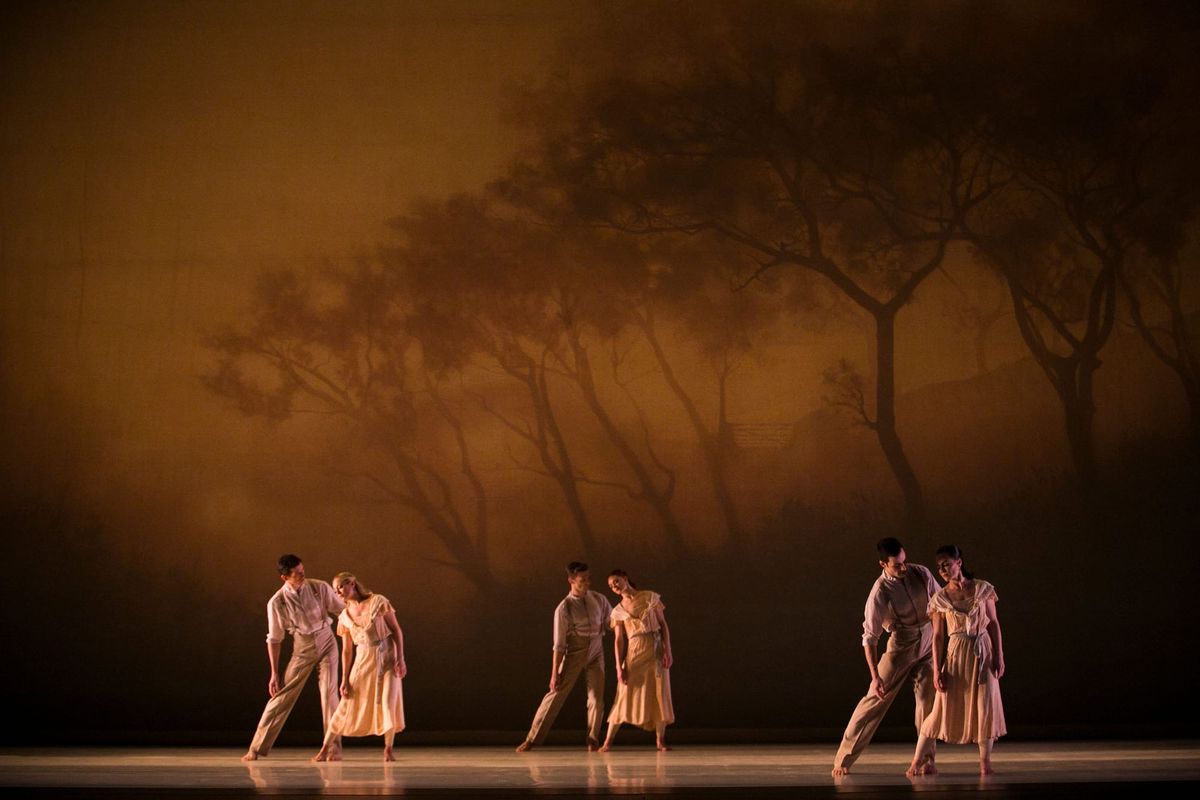
Paul Taylor’s 1997 “Eventide” was a fine contrast to Lovette’s quirky playfulness. Set to the rich, lyrical music of Ralph Vaughan Williams, quiet piece hints of the British countryside around 1900 thanks to Santo Loquasto's misty tree-filled backdrop and hints of Edwardian style in the women’s dresses. The four main couples dance varied pas de deux, with hints of stories, some happy, some sad, and one hinting at tragedy; watching it is like reading a collection of Thomas Hardy’s short stories. The main couple (Eran Bugge and Lee Duveneck) have two dances; in the first she seemed to be suffering from some hidden sorrow and in the second, she is comforting him. Both Bugge and Duveneck gave their roles a mature gravity, and their gentle understanding and trust was immensely moving.
Maria Ambrose and Kenny Corrigan danced the more ambiguous couple, with the hints of abuse and abandonment. I missed the air of smoldering danger and thoughtless cruelty that Andrew Asnes, its originator, gave the role; Corrigan seemed just too nice and looked a bit self-conscious in the swaggering entrance and almost apologetic as he left her. Ambrose, however, showed clearly the many conflicting moods of the poor girl, and her final sorrowful pose and she mimed the tears on her cheeks, had a haunting mournful power.
Lisa Borres and Alex Clayton were exuberant in their fast, happy dance, as they echoed each other’s steps in perfect harmony, and Jada Pearman and Austin Kelly gave their pas de deux a lovely folkish lilt. Both couples seemed full of youth and hope that the ghostly ending, where the cast seems to be disappearing into memory, especially poignant. Taylor let the plangent, elegiac music cast its spell, as the dancers simply walk in straight lines with a slow, measured step pausing now and then to acknowledge their partners until they all separate, as if they were returning to their graves. Simple walking has seldom been so profound and so rich.
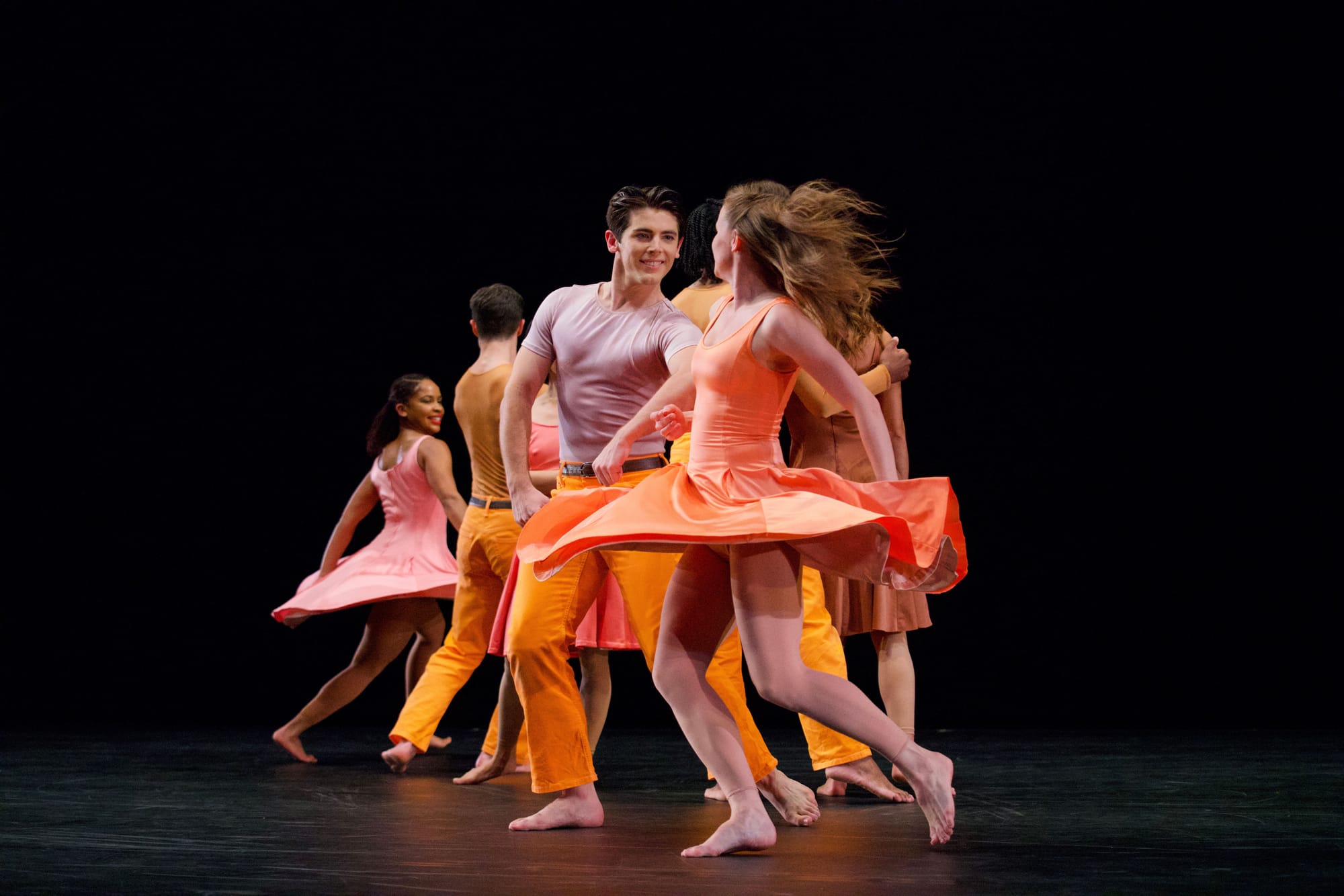
There is plenty of walking in Taylor’s “Esplanade”, as well as running and jumping. The 1975 work is one of Taylor’s surefire audience pleasers, and it never palls. The everyday moves, which morph into superhuman spins and falls (somehow the dancers seem to bounce up from the floor with no effort) combined with the formal Bach music create a magical world where all the men are strong and all the women are good-looking and the audience is better of for watching it.
The dancers all threw themselves into the choreography, especially Christina Lynch Markham who flew through her solo with a radiant power and Jada Pearman, who balanced so nonchalantly on Devon Louis’ stomach. But for all the tremendous power and excitement of the final movement, what I remember most is the final picture of Eran Bugge alone on the stage breaking the fourth wall by opening her arms to the audience in a gesture of gratitude and welcoming, a reminder that after all, the human touch is what matters.
© 2023 Mary Cargill



