The French Connection
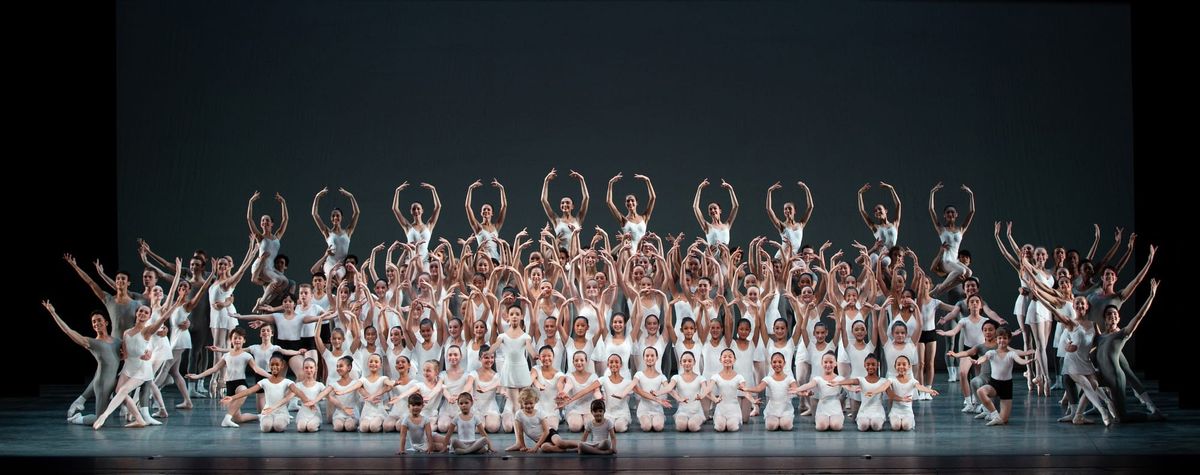
"Rondo Capriccioso", "Symphonic Variations", "Daphnis and Chloe"
American Ballet Theatre
David H. Koch Theater
New York, NY
October 20, 2016
The music for ABT's Fall gala was French and so was the main event, the American premier of Benjamin Millepied's "Daphnis and Chloe", choreographed for the Paris Opera Ballet in 2014. It was well-received in Paris, but perhaps it is a case of vive la différence, since the ballet, though strongly and enthusiastically danced, was a bit tedious. The evening started out with lots of strength and enthusiasm as the young dancers from the Jacqueline Kennedy Onassis school paraded through Alexei Ratmansky's "Rondo Capriccioso", set to bouncy dance music by Camille Saint-Saëns.
It opened simply with a young dancer (Luna Vargas-Chaffa) practicing steps, moving with a charming aplomb. An older dancer appeared behind her, as if in a mirror, and they danced together, an affectionate glimpse of her future. (Ratmansky may also have been thinking of his days in Denmark and Bournonville's mirror dance from "La Ventana".) More students poured on, doing plenty of jumps and turns, all timed perfectly to the music and none of them lingering long enough to become brash. Even the inevitable fouettés had panache, as the three dancers spun in musical harmony while men behind them leapt in counterpoint. It looked like a group celebration, not a competition.
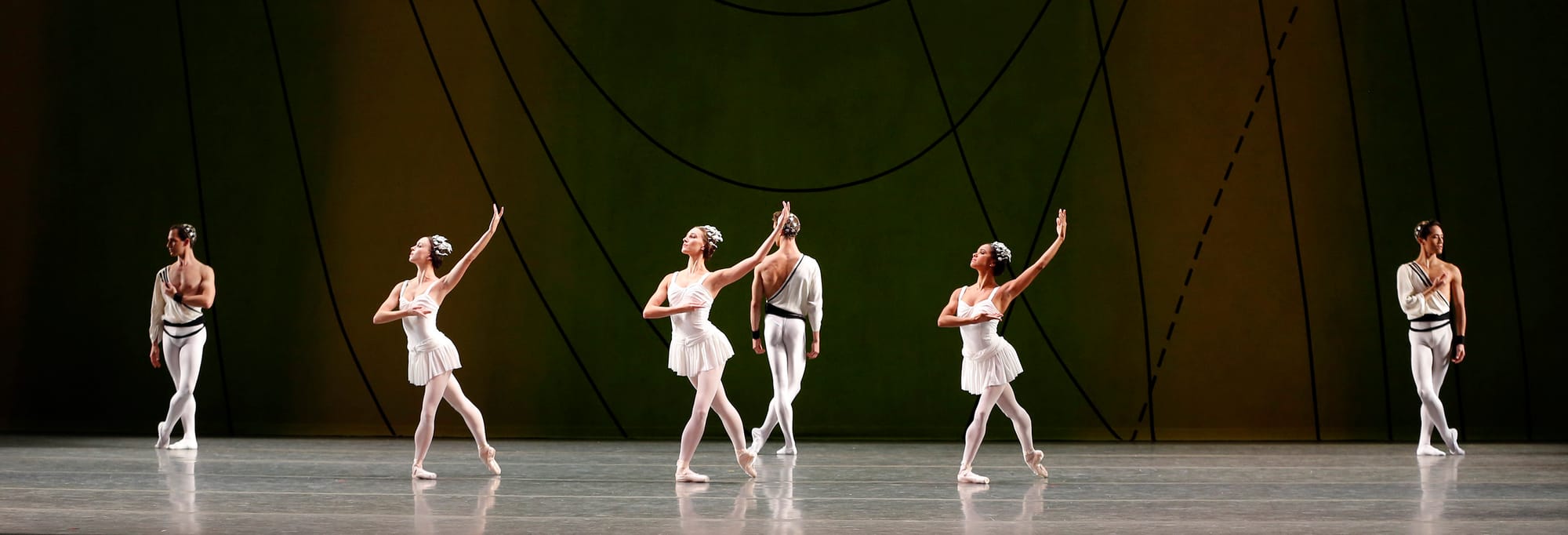
Sir Frederick Ashton's 1946 "Symphonic Variations", to music by César Franck, is the apotheosis of group celebrations, as the six dancers never leave the stage, and for all its technical complexities, the high point is a simple run around the stage as the dancers hold hands. It was Ashton's first work after the end of World War II and served as his affirmation of the power of pure dance. The six dancers wear classically inspired costumes and evoke the calm radiant harmony of Greek statues while performing some of the most rigorous dancing in the ballet world--even when standing still the body must be alert, posed in exact shapes, and musically alert, ready to pop into the next phrase.
The ABT dancers seemed a bit stiff at times, as if they were waiting for their musical cues, but had obviously worked hard on those constantly shifting shapes, and the majestic choreography was clear. Skylar Brandt's sunny ease and Jeffrey Cirio's crisp dancing stood out. Devon Teuscher, as the middle ballerina had a natural and gracious authority, while James Whiteside as her partner struggled a bit with control (there are lots of low, skimming lifts that must look effortless), but he made an honorable and generous effort at the style.
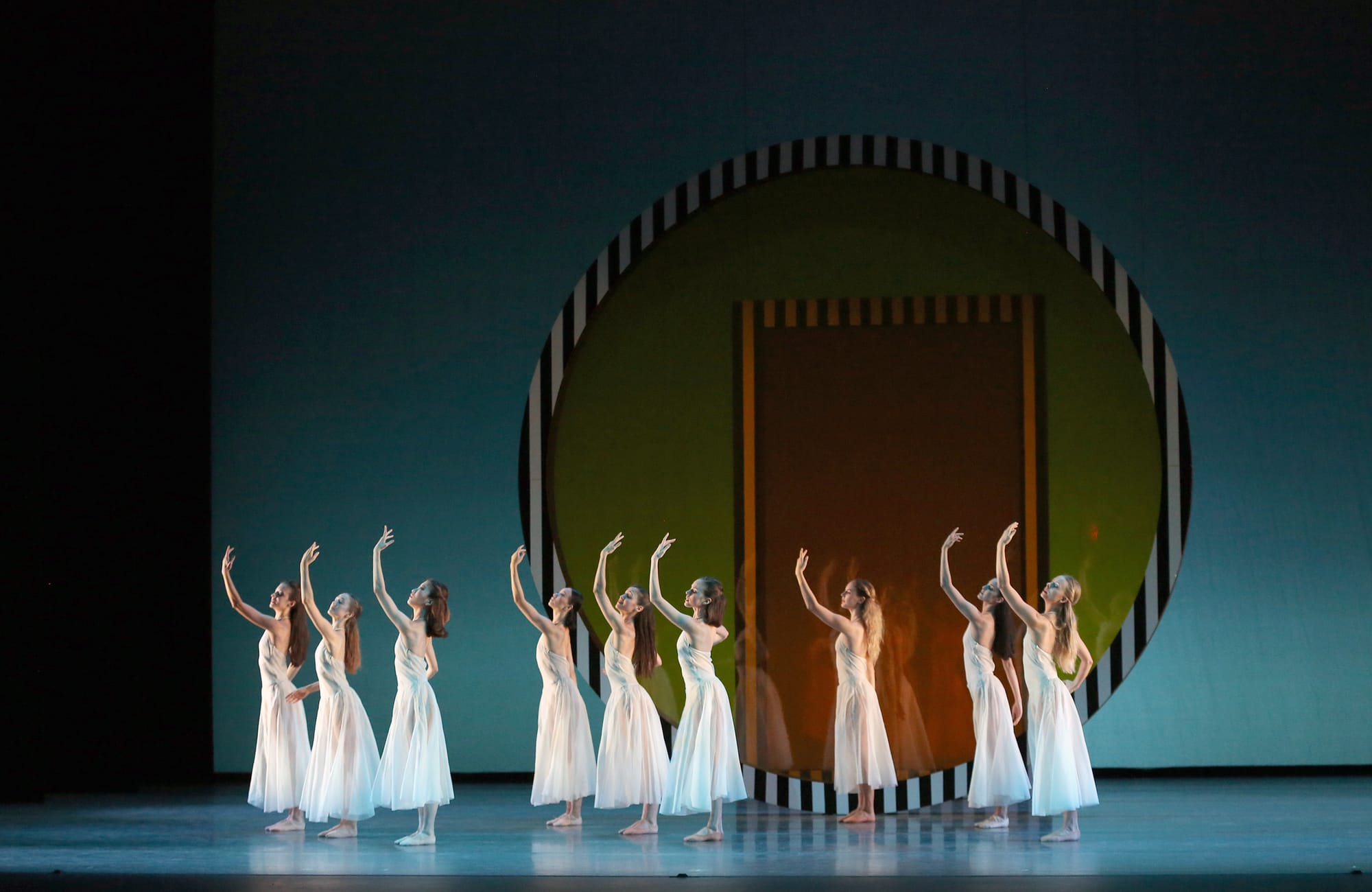
Whiteside was more at home as the high-leaping heavy in Millepied's "Daphnis and Chloe", where he got to run around in black and abduct the heroine. Maurice Ravel wrote the score for the Diaghilev company, based on the choreographer Michel Fokine's libretto which was based on a classic story of Daphnis, a Greek shepherd, his beloved Chloe, a maiden with a tendency to get kidnapped, and a god (in this case Pan) who intervenes and saves the day, much to everyone's delight. "Sylvia" tells basically the same story and has the same noble, though to modern eyes somewhat passive hero. Great artists, however, can vivify that Enlightenment ideal of a world where goodness and innocence are powerful and triumphant.
The two ballets also have gorgeous scores, though Delibes' "Sylvia" is more dance-friendly. "Daphnis and Chloe" is an hour-long impressionistic, shimmering, magical tone poem, evoking the rocky shores and hot sun of the Greek Islands and the strange powers of the ancient gods. MIllepied and his designer (Daniel Buren) went their own way, ignoring the geography of the music and setting the story in a generic Balletland with a blue backdrop and large op art shapes whose sharp, clear forms and bright colors defied the impressionistic music.
If Millepied's Daphnis (Cory Stearns) had nothing to be (Millepied dispensed with Pan altogether, so the simple pious shepherd had no one to worship) he had plenty to do, and Stearns did it all admirably, supporting Chloe (a very sweet Stella Abrera) through many pas de deux, all conveying young love's rapture. It seemed as if the choreographer told the dancers to fill up the music by seeing how many times Chloe could rush towards Daphnis and be held in a swooning backbend. This is a ballet to watch with one eye closed, concentrating on the magical story the music tells.
Copyright © 2016 by Mary Cargill



