The Bugs Are Out
"A Midsummer Night'sDream"
New York City Ballet
David H. Koch Theater
Lincoln Center
New York, New York
May 31 evening, 2025
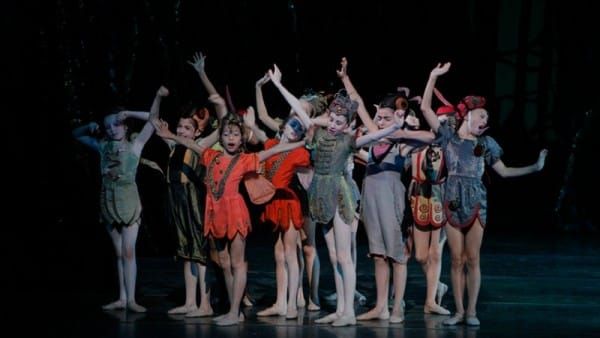
Adorable dancing bugs start and finish Balanchine’s “A Midsummer Night’s Dream”, performed by very well-trained SAB students with a minimum of cuteness. Of course there were oohs and aahs from the enthusiastic audience when they fluttered on, but they danced with a sweet-natured concentration and had no “Hi, Grandma” vibes. The rest of the cast, too, rarely let the Shakespearian comedy carry over into slapstick, and the dancers gave their roles individuality and nuance. Balanchine’s version does have some logical inconsistencies—why does Oberon repeat his mime as if the audience didn’t get it the first time, why does Titania have a luminous pas de deux with an anonymous boy-toy, and why, when the first act emphasizes the completely arbitrary and inconsistent nature of love does the second half feature an iridescent pas de deux by an unrelated couple celebrating trust, confidence, and maturity? But these questions do disappear when watching the glorious, beautiful, and often very funny work.
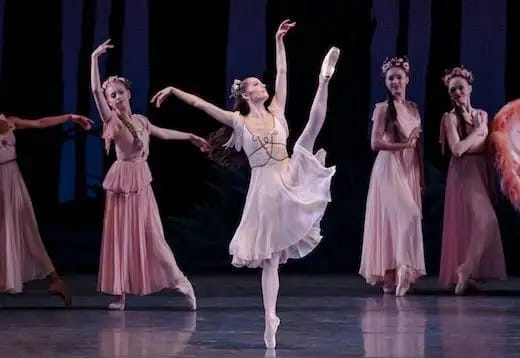
Unity Phelan and David Gabriel were the warring couple. Phelan was a creamy, somewhat petulant Titania, and had a smug little snit at that thought of giving up the changeling. Her pas de deux with the anonymous partner (a lyrically devoted Preston Chamblee) was serenely beautiful, with strongly held balances and luxurious extensions. She did seem a bit passive, as if she were just a beautiful dancer and not a Fairy Queen, though her dance with Bottom (Victor Abreu) was exceptionally vivid. She was delicately enraptured, with eyes only for her new found beau; she kept her tongue out of her cheek never slipping a wink at the audience, which made her infatuation both ridiculous and wry—she is certainly not the only one who loved a donkey and saw a prince. Abreu was a gentle, pathetic donkey, and his eager, awkward dancing made it clear that this was his dream come true. His Bottom was very funny, but it was also a donkey you wanted to hug.
David Gabriel danced his second Oberon (he had debuted the night before). He is very young (he joined the corps in 2022, but has been dancing far above his years; his pure technique and easy floating jumps have brightened many performances, but his ability to relate to his partners and to create a character or an emotion from the music and the steps elevates his dancing beyond technique. He doesn’t light up the stage, he makes it disappear, creating another world. His Oberon had a natural, unforced authority, watching over the little bugs, commanding Puck, controlling the fractious lovers, and finally getting the better of Titania. His dancing was smoother that many Oberon’s and he made the sparking little beats flow almost naturally; air seemed to be his natural habitat.
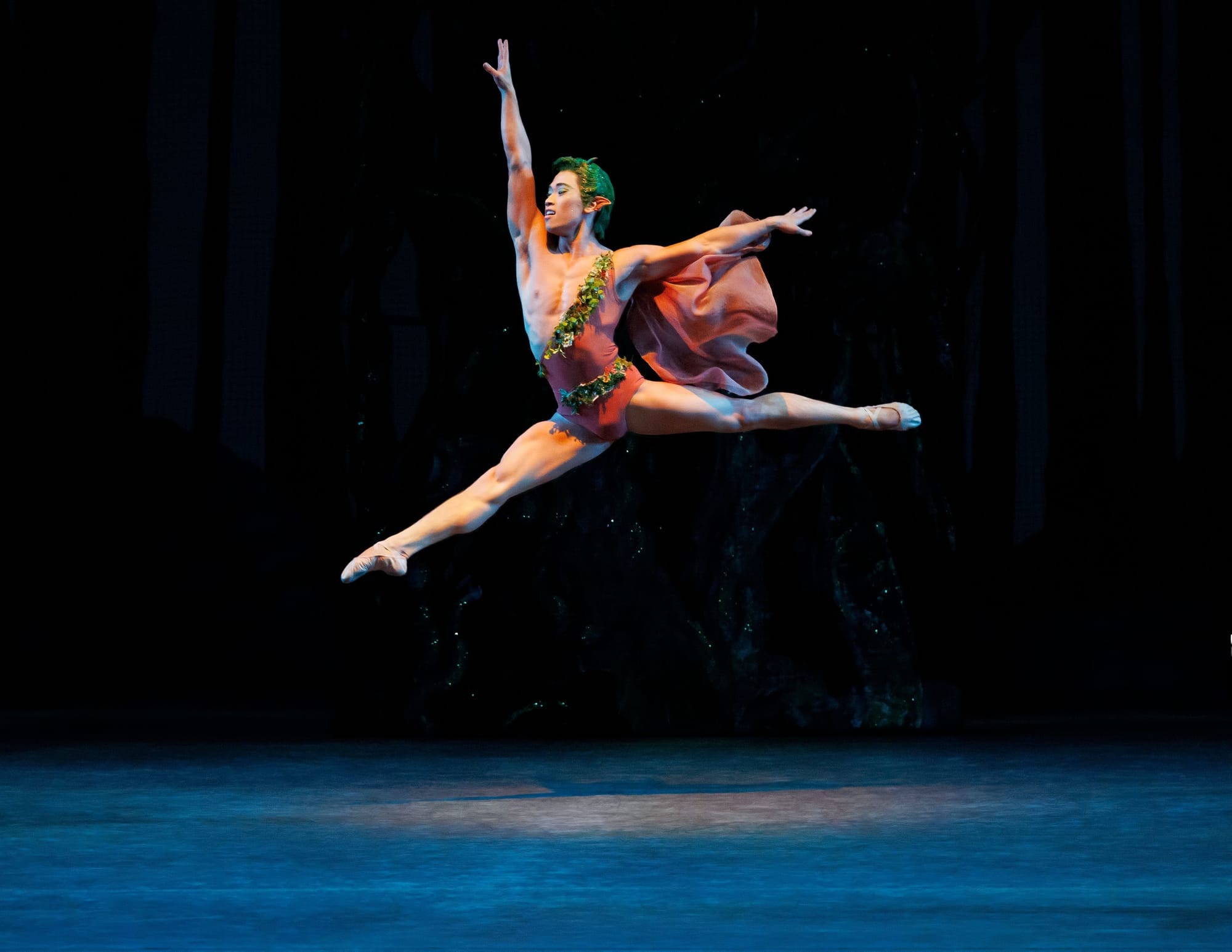
Puck lives in the air as well, and KJ Takahashi spent a lot of time there. His jumps were clear and sharp and he seemed to tingle with excitement at the thought of messing with those hapless mortals. He stressed the comic bits with a witty timing (such vibrant head shakings) though the exasperated “Look over HERE” moment verged on slapstick. His exuberant charm, though, and his joyful enthusiasm were infectious.
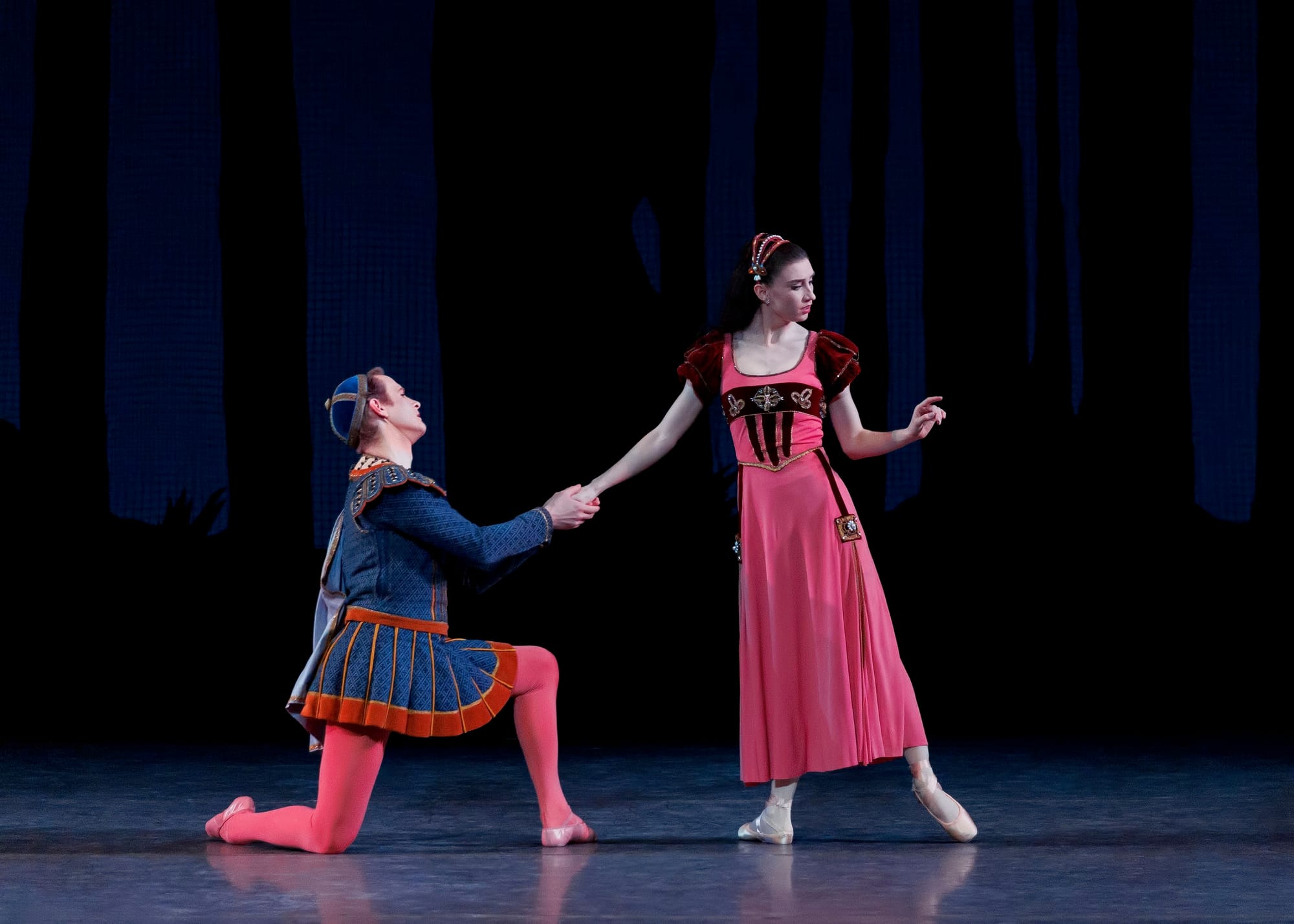
The four lovers, Alexa Maxwell with Alec Knight (Helena and Demetrius) and Sara Adams and Lars Nelson (Hermia and Lysander) were delightfully underplayed, with the jokes seeming to come unexpectedly, without any telegraphing to the audience. Certainly the disappearance of those male wigs helped make the men less anonymously goofy, but each dancer built a coherent character. Nelson looked like a big eager puppy dog stumbling around picking his flowers, and Knight’s appalled indignation at Nelson’s attempt to co-opt Helena’s love was very funny. Adams’ despairing dance, as she realized that she was abandoned in the forest was a feast of turns as if her head were spinning in confusion. Maxwell’s sad entering walk, surrounded by the unseen bugs as she plucked the leaf held by the invisible Puck to wipe away her tears, was both touching and eerie; with her usual dramatic incisiveness she made it seem as if there were really magical spirits surrounding her.
In the smaller female roles, Baily Jones was an authoritative Butterfly, using her arms softly and elegantly to ripple through the music. Mary Thomas MacKinnon was a fearless Hippolyta. She charged, apparently effortlessly, through the difficult fouetté sequence, bow held high, whipping the fog around her. She made the most of her brief appearance in the second act, dancing with her Theseus, a distinguished Charlie Klesa, with a warm graciousness.
The Athenian courtiers she was leading do a lot of toing and frowing, as the audience waits for the shimmering pas de deux, danced on an empty stage, which seems to fill up as the couple (Indiana Woodward and Jovani Furlan) begin their stately, radiant dance, so full of love and trust. Woodward’s lush upper body and intensity (she seemed to be living through the music) gave her dancing a hushed radiance as she floated in Furlan’s arms. He made the revolving arabesque seem like a magic circle. Logically, of course, it has little to do with the complicated plot of Act I, and the couple disappears before the fairies (and the bugs) return at the end, but it can be seen as the epitome of a dream, midsummer or not—a dream of perfect beauty and peace.
© 2025 Mary Cargill



