The Boys from Syracuse
"Of Love and Rage"
American Ballet Theatre
Metropolitan Opera House
Lincoln Center
New York, New York
June 20, 2022
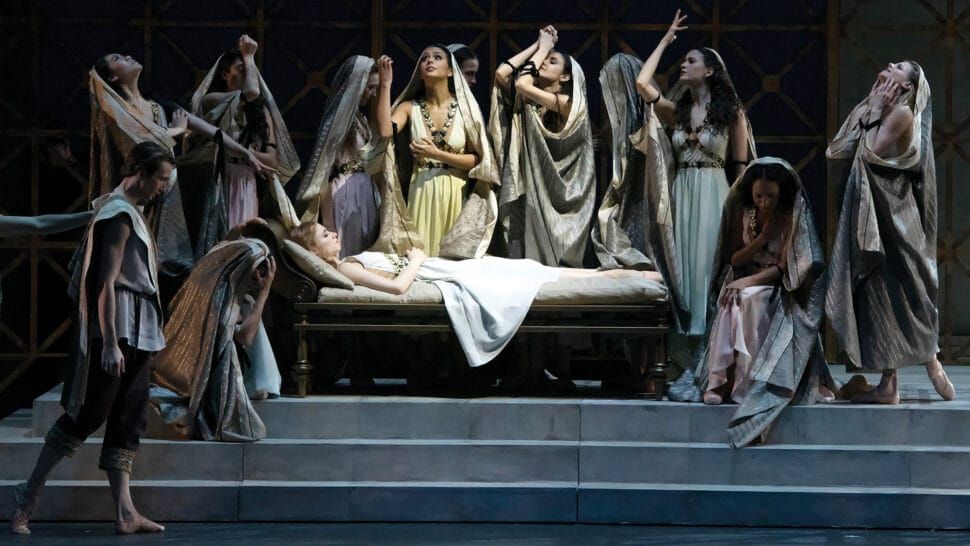
ABT's newest full-length ballet, by Alexei Ratmansky, is based on the world's oldest surviving novel, "Callirhoe" written in the First century A.D. by the Greek Chariton, described in a 1935 article as "a melodrama of no slight vigor". It is certainly not a household story, but has elements of Romeo and Juliet (including a false death) and the idea that beautiful women are prone to being kidnapped. The beautiful Callirhoe (Catherine Hurlin) and the athletic Chaereas (Aran Bell), living in the Greek colony of Syracuse, whose fathers hate each other, fall in love. Callirhoe's defeated suitors convince Chaereas that Callirhoe is unfaithful, he loses his temper, confronts her and she collapses offstage, apparently dead. (In the book he kicks her but today's heroes are a tamer lot.) The unconscious Callirhoe is buried and pirates, complete with ship, rob her tomb and kidnap her. They sell her to Dionysius (not the alcohol-flavored god, but the ruler of Miletus, in Asia Minor), danced by the impressively dignified Daniel Camargo. He is a recent widower who finds her beauty irresistible, but is also quite a decent fellow.
Chaereas and his faithful companion Polycharmus (energetically and generously danced by Andrii Ishchuk) have followed Callirhoe to Miletus, where they are captured and sold to Mithridates, the ruler of Caria (in Asia Minor), danced with threatening ferocity by Jarod Curley. Chaereas tells Mithradates his story (related in a vision scene) and Mithradates falls in love with Callirhoe and has her brought to him. He has an argument with Dionysius but agrees that the King of Babylon should resolve things, so off they all go. The King, however, also falls in love with Callirhoe and, while Egypt is revolting against Babylonian rule, absconds with her. Chaereas joins the Egyptians, leads them to victory, finds Callirhoe, begs her forgiveness, and Dionysius nobly bows out. This is just a brief summary--there are also conniving maids, a jealous wife, silver bracelets, and Callirhoe's baby. This is a lot of narrative to pack into a two-act ballet, and the details are not always clear.
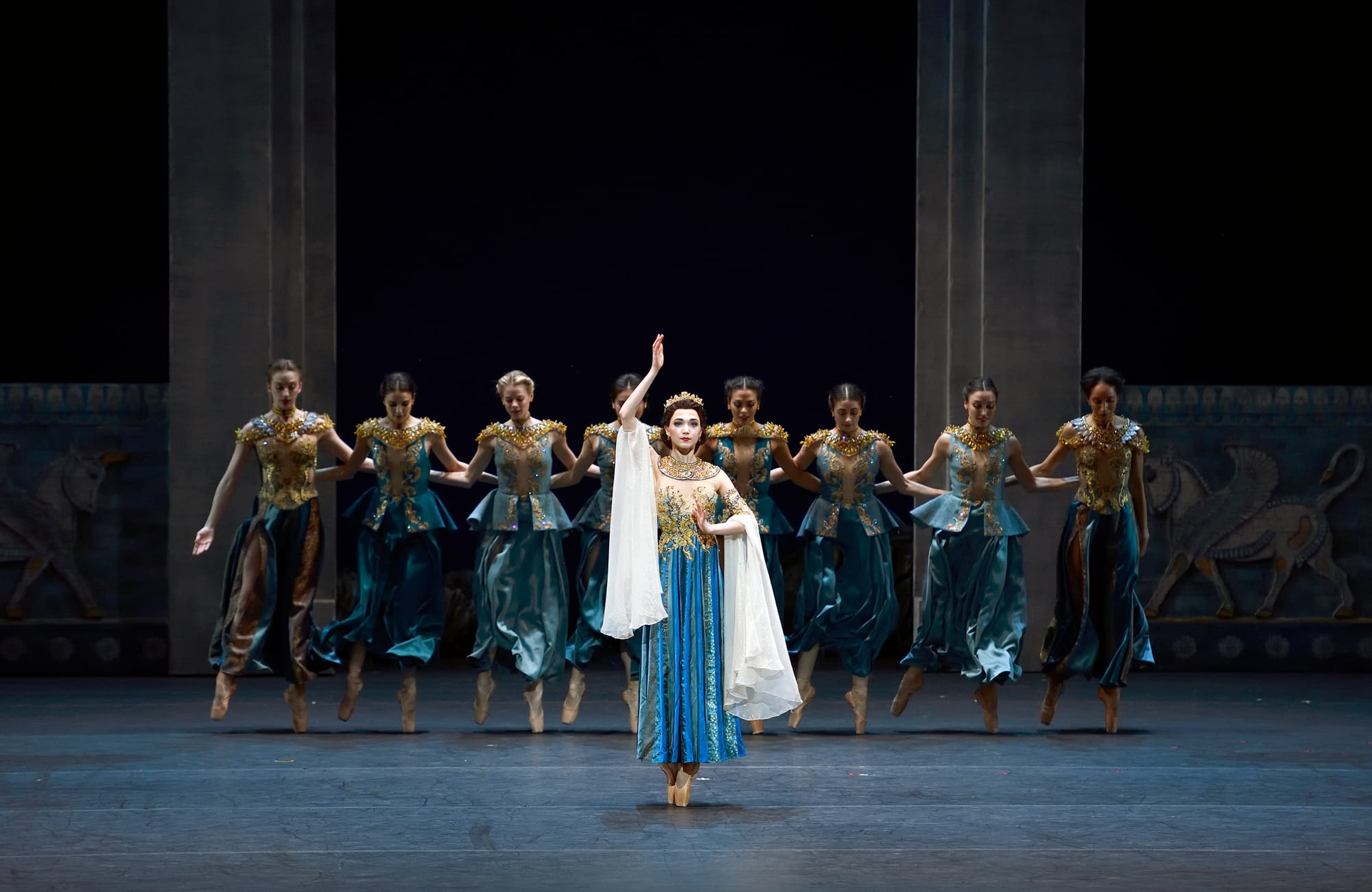
The score Ratmansky chose, a reworking by Philip Feeney of Aram Khachaturian's 1930s Soviet ballet "Gayane" (about treachery in an Armenian collective farm) is full of lyrical melodies and muscular folk tunes, and helps set the mood and focus the action. So do the costumes by Jean-Marc Puissant, especially the delicately hued Grecian tunics worn by the female corps. The turquoise spangled Babylonian outfits, though, made it look like Las Vegas had originated on the Euphrates. Puissant's sets were suggestive rather than archaeologically solid, with wide vistas of Aegean blue, various painted scrims, and a few brilliantly effective props, which make the many scene changes seamless, as the ballet moves from Syracuse to Asia Minor then to Babylon.
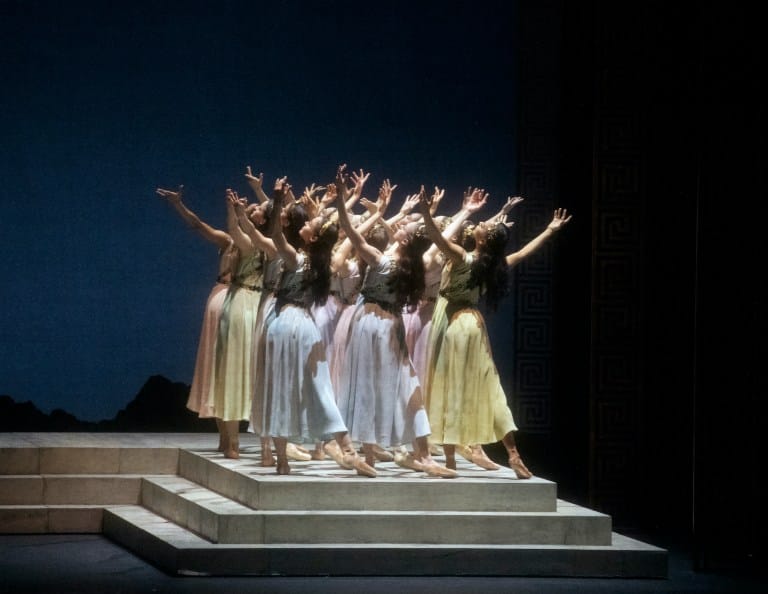
There is little mime, so the story is told, not always clearly, through movement. The first act is the most successful, with the ladies of Syracuse forming a Greek chorus, reinforcing and sometimes commenting on the story. Their choreography is luminous, as Ratmansky has them flow into sculptural shapes, breaking into little groups, weaving their arms in true Isadora style. The male corps, especially the boys from Syracuse, form distinctive and arresting shapes, looking like groups of athletes from a Greek vase as they toss their invisible discuses.
The second act does get a bit repetitive, not to say confusing, as groups of guards from both Mithradates' and the King of Babylon's courts dance a series of folk-inflected jumps while their leaders fall for Callirhoe. While at Mithradates' court, he and Dionysius argue over Callirhoe, apparently saying "My jump is higher than yours", and "So what, my footwork is faster". They then head off to Babylon to let the King adjudicate. (Mithradates' head guard mimes the traditional "king" gesture, but "adjudicate" is a bit harder to convey.). Once in Babylon they repeat their argument at some length, only to be interrupted by Khachaturian's Saber Dance, as the Egyptian army, with some extremely athletic leaps and spins, takes over the spotlight.
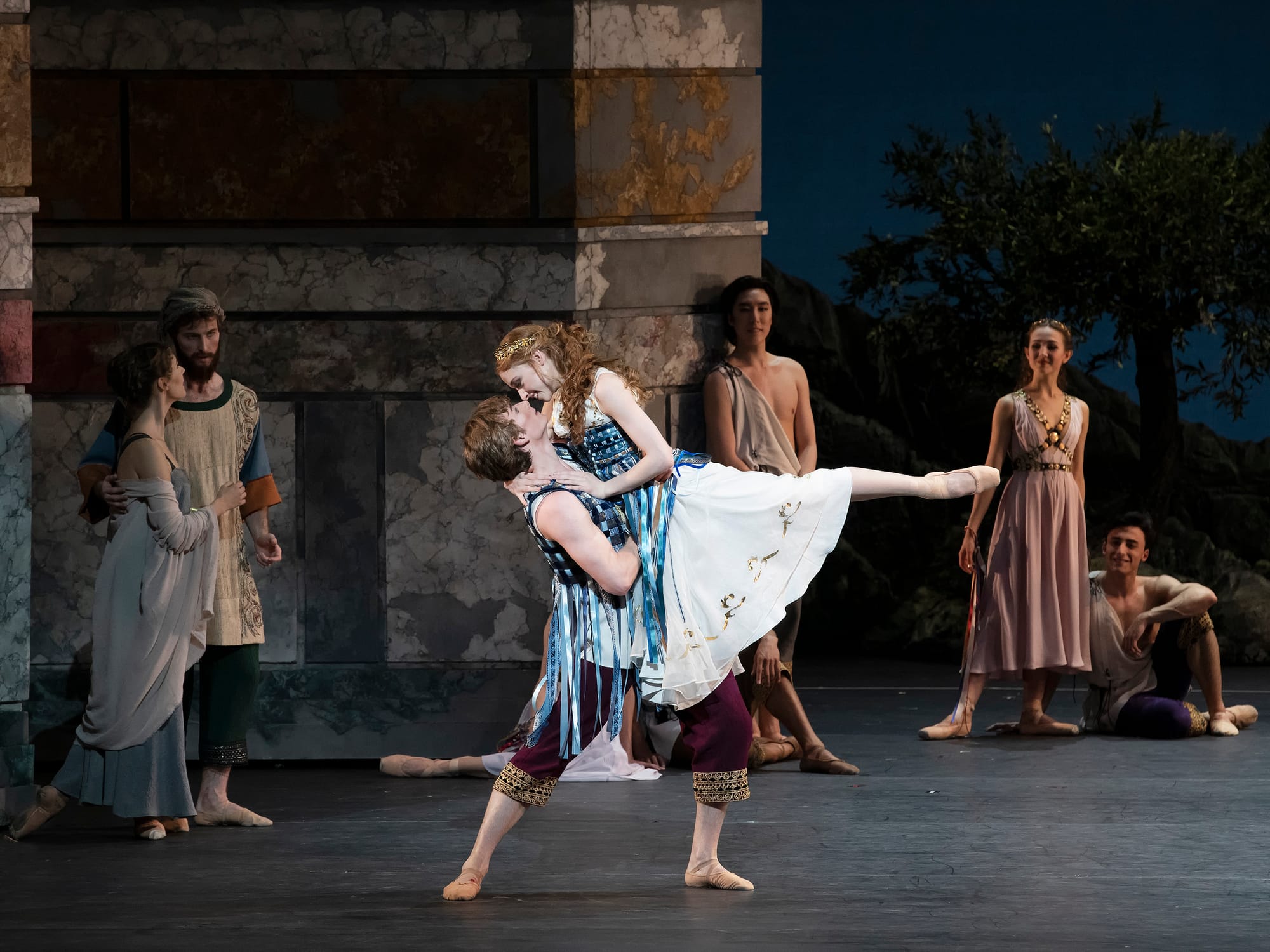
Though the details were not always clear, the dancing was glorious. Hurlin's Callirhoe had a vibrant lyricism--even her hair seemed alive. The choreography, with its tendril-like arms and rapturous backbends showed off her elegant, flowing line. Ratmansky gives Callirhoe a range of emotions, expressed clearly through her dancing. She is all innocent rapture when she first meets Chaereas, despairing then resigned when sold to Dionysius, warm, sedate, and content in her married life with him, and finally, generous and forgiving when she reunites with Chaereas. Hurlin's radiant luminosity made it seem inevitable that every man she met would fall for her.
Aran Bell's Chaereas was less rounded, and since the pivotal moment, when he thinks she betrayed him and he confronts her so harshly, takes place off stage, his guilt and sorrow didn't have all the impact it should have. His dancing, though, full of barrel turns and bravura jumps, had a thrilling, exuberant joy and his partnering was flawless. The two torch lifts (one for each act) were seamless, and an emotional rather than an applause-generating highlight.
As in so many of Ratmansky's ballets, there were many supporting roles and to a man (and woman) they were danced with understanding and commitment. Daniel Camargo, guesting this season from the Dutch National Ballet, gave his solo mourning for his wife, full of beautifully stretched arabesques, a mournful dignity. (He did perk up, though, once Callirhoe appeared.). Katherine Williams as the Queen of Babylon danced with an icy power, and Gabe Stone Shayer, as both the lead pirate and the Egyptian general danced with a fierce determination. As the 1935 scholar wrote, the work is a melodrama, but Ratmansky and the dancers played it straight and honored its conventions, and this glimpse of the ancient world has many moments of incredible beauty.
Copyright © 2022 by Mary Cargill



