The Body Speaks
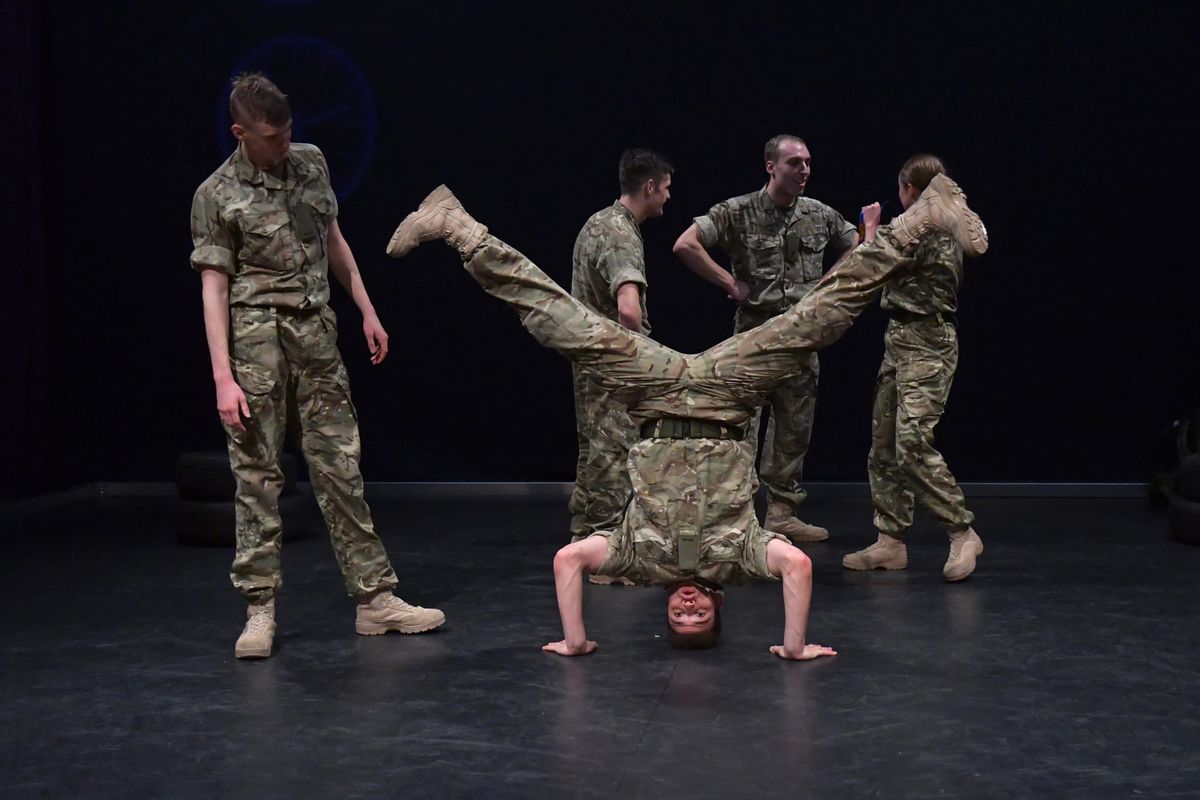
“5 Soldiers: The Body is the Frontline”
Rosie Kay Dance Company
San Francisco Performances
Taube Atrium Theater
San Francisco, CA
April 11, 2019
A West Coast American premiere of a work created in Britain is not an everyday event. One produced “In Association with the British Army” definitely would have to be considered esoteric. Kudos for San Francisco Performances for having taking the risk to program something as unusual. The Rosie Kay Dance Company’s “5 Soldiers: The Body is the Frontline”, a tribute to the men (and women) who go to war for those of us who either don’t want or are lucky enough not to have do it was striking for its no holds barred perspective on what is such a painful reality.
“5 Soldiers” received a superb realization from the lone woman Harriet Ellis and the four men – Luke Bradshaw, Alan Hunte, Josh Hutchby and Alexander Smith (still a Trooper in the Welsh Cavalry). The Taube Atrium Theater, the new 300-seat modular space carved out of the fourth floor of the Veterans building, offered a cool, neutral environment with superb acoustics and good raked sightlines.
Kay divided the piece into three main sections: creation of an efficient fighting force; stress reduction behavior during R&R; and living through action. In something like an overture, you get a glimpse of these soldiers hanging out while waiting to be called. Two of them squabbled; Ellis did push ups; one fiddled with a radio, another packed and repacked his gear. It looked so innocent.
The choreography, we were told, is based on the actual training practices of the British army, and the act has a little of the feeling of Reality Television: you know it’s not real but it surely feels like it. Impressive with power, precision and sheer stamina, these dancer/soldiers are unstoppable. They march, doubling the speed in perfect unisons, fists to the sides, arms shot out like weapons. Their faces are masks, their eyes fixed, as they become less of who they are but become part of something bigger than themselves. While you understand the necessity — and effectiveness of this training -- it becomes almost unbearable to watch as you see signs of distress and desperation. Each one collapses but inevitably steps back into the call of those robotic stepping patterns.
The second part opened with playful horsing around and teasing that almost goes out of bound. A set of tires -- toys that almost become weapons. We also pick up on certain propensities of drill sergeant Hutch, held in check by Bradshaw’s sense of discipline. Ellis engages in a moment of relishing her own sensuality while her partners throw themselves into raucous, desperate club dancing. While “5” has many emotionally affective moments, here fear arose for the lone woman who is stalked by raging testosterone.
Kay doesn’t go that way. Instead of attacking, the male quartet begins to imitate Ellis’ dancing; they “share” the woman by lifting and carrying her to gently explore her skin. It’s the touch of human skin, the softness of flesh, and perhaps her smell that reminds them of their own humanity. In a lovely finale they hoist the dreaming Ellis like an honorable prize. Hutchby’s clumsy attempt to draw Ellis into a very earthly encounter is really quite funny, leaving Ellis more bored than insulted. But she gleefully follows Bradshaw’s invitation. This poetic Pas de Deux starts playfully with one of those ubiquitous tires and becomes increasingly passionate and private. The baroque music for that duet, however, felt oddly out of place until the last section in which these soldiers “see action” in a dead desert (video, set and costumes by Louis Price), and all the music dates from the baroque era. I am not sure what those scores were supposed to suggest, maybe laments for the dead?
Crouching around a square of a helicopter pad, the dancers become whirling propellers, dropping from the plane and scurrying in the semi darkness. It is dark, and the fear from these exploding formations, desperate crawls, and curling into balls, becomes palpable. The choreography is fractured and looks, but is not, chaotic. Somehow the dancers find each other, stick together in serpentines, circles and hang on to each other. But finally Hutchby and Bradshaw walk downstage and hold up Hunte, the one who had had the most difficult time to join. Earlier on he had lost a fierce man-to-man encounter with Hutchby. Now he has lost more. The last image of him soldiering on into the darkness with his two stumps would have shattered anyone’s equilibrium. It almost felt over the top.
We had been told that Kay had choreographed the unforgiving drill patterns from actual military training. So we watched what was supposedly the most realistic scenario, but we primarily admired the skill and discipline that these dancers brought to those difficult tasks. These dehumanizing patterns also became the evening’s most abstract and stylized dancing. As “5” progressed, and the choreography gave us glimpses of the humanity and differences between those five individuals, the work became “real”. We could identify. The evening’s most theatrical final image also spoke most telling about our common humanity.
copyright © Rita Felciano 2019



