"The Body Is the Brain" -- Hope Mohr
"Signals from the West: Bay Area Artists in Conversation with Merce Cunningham at 100"
Hope Mohr Dancer: The Bridge Project with SFMOMA's Open Space
ODC Theater
San Francisco, CA
November 8, 2019
The most recent Hope Mohr Dance Bridge Project, the ambitious, challenging and often mesmerizing “Signals from the West: Bay Area Artists in Conversation with Merce Cunningham at 100” is Mohr’s contribution to the many celebrations of the choreographer’s birthday. Almost three-months long, it brought together writers, activists, institutions and scholars in conversations, lecture demos and collaborations with each other. Rashaun Mitchell and Silas Riener opened the project in August by teaching an open audition of excerpts from “Scramble,” “Roaratorio,” “BIPED,” ”Change of Address” and “Fluid Canvas.”
The project closed with ten local performers — not all dancers – presenting world premieres based on their encounter with the Cunningham legacy. Those were interspersed by a quartet of dancers in the Cunningham excerpts. Sarah Bukowski, Traci Finch, Emily Hansel and Stacey Yuen, dressed in leotards vaguely reminiscent of “Summertime,” beautifully worked through the timing and expansive precision of Cunningham’s choreography.
Legacy is at the core of Mohr’s thinking for the Bridge Projects. What do we do. she asks, with dances after their creators are gone? Followers try to “preserve” them by re-thinking, re-constructing or re-creating them “in the spirit of…” Not good enough, says Mohr. That leaves out too many would-be beneficiaries such as people of different cultural traditions; those discriminated against because of economics, identity, social status or background. For Mohr curating is as much a socio-political as an artistic practice that she hopes can build inclusive communities. Previous legacy-based initiatives have included "Paramodernities" (Vaslav Nijinksy, Alvin Ailey, Merce Cunningham); “Radical Movements: Gender and Politics in Performance” (thirteen participants); “Have We Come a Long Way Baby?“(post-modernist women Anna Halprin, Lucinda Childs and Simone Forti), and “Ten Artists in Response to 'Locus'” (Trisha Brown).
Maybe most striking in this evening of Cunningham-inspired work was the broad spectrum of evoked responses. What artists had in common was that none of them had ever been part of the Cunningham school or company. The kinds of imaginations and skills they brought to these experimental endeavors earned them the well-deserved applause. I suspect the collaborative efforts were among the most useful for them.
For “Stop Play:: Quincunx”Julie Moon and Maxe Crandall had additional performers, among them a singer and leather culture habitué with bullwhips. They took on Soap Opera’s unlikely suite of incidents that became thoroughly muddled up, whether by the luck of the dice or accident I couldn’t tell. Fun to see was the performers’ zest at the mayhem and how, whoever they were, they stayed themselves. Danny Thanh Nguyen excelled on the whips. “for_rest” Nicole Peisl, a lithe tall dancer with an extraordinarily flexible body and a fine sense of timing, had invited audience members to form a semi-circle around for her improvisation. They would and did call for rest periods. My sense, however, was that her dancing became so involved and so intricate that she performed much longer than she might originally planned because watchers were loath to interrupt her. It became a bravura effort even though, perhaps, not planned as such.
In the whimsical “Work in Place,” choreographers Sophia Wang Brontez Purnell teamed up for a filmed performance in a huge warehouse filled with obstacles. The dancers had to deal with supposedly inanimate objects, each other and the invisible camera that could wreck havoc with a chosen trajectory. No wonder they ended up giggling on top of each other.
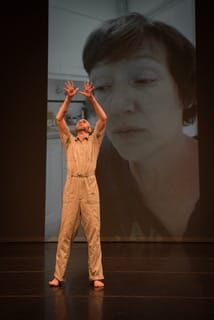
Program notes by Dazaun Soleyn explained that he had chosen random numbers and rules for “(Study)one”. Frankie Lee knotted and stretched himself on a diagonal towards a shadowy figure or figures (Claire Fisher) behind a screen. Eventually the two performers exchanged places. The concept was simple but the realization became gently evocative. “Moves Cords Names” showed Christy Funsch on a diagonal looking out of a window, pensively reciting what turned out to be one hundred artists who had influenced her. In front, long-term partner Nol Simonse improvised sections of the pieces on which they had worked together. Her quietness and his volatility fused perfectly.
For “Tejidos/Weavings, or No puedo hablar con mi voz sino con mis voces,” Danishta Rivero invited four fellow musicians for an improvisation that included live electronics. The performers moved around each other but proximity did not determine what we heard. The music gradually seemed to coalesce into a wildly dissonant unity. I couldn’t help thinking of John Cage. gabby fluke-mogul was an Orisha on the violin. Dancer/Writer Alex Escalante regaled us with a narrated solo performance, “Paris”, which pitted a distraught assistant in a mad dash to get Cunningham to the theater on time.
Sofía Cordová’s “Underwater Moonlight (days of blood & milk)” was a large film installation with sharp geometric forms that mutated in changing light. While visually attractive, it did not communicate beyond the particular moment. I regret not having seen Jenny Odell's “Merce-bau”. It was projected as a pre-theater performance in the Lobby before I got there. I also missed Julie Moon’s installation in one corner of the Lobby.
copyright © Rita Felciano



