That Old White Magic
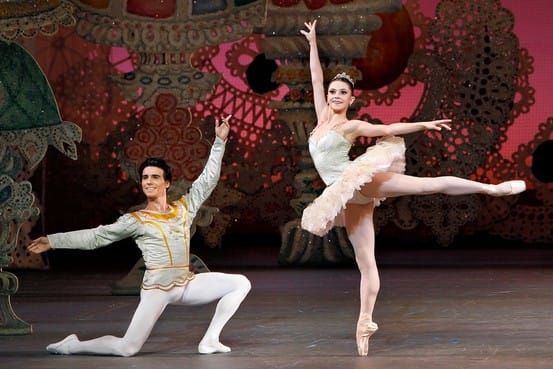
"The Nutcracker"
New York City Ballet
David H. Koch Theater
New York, NY
November 27, 2009
For many New Yorkers, black Friday is also white Friday, when the wonderful Balanchine version of "The Nutcracker" makes its first appearance. This perennial is a cash cow, yes, but it is also a heartwarming salute to innocence and childhood and to the Maryinsky Ballet of Balanchine's youth. The first act brims with good cheer, as the wealthy Staulbaums meet and entertain their equally wealthy and well-behaved friends. The simplicity of the action is oddly moving--children dancing around a Christmas tree, a mother tucking her little girl in bed, a child cradling a broken doll, all perfectly matched to the rich Tchaikovsky score. In the middle of the warm hub-bub, Robert La Fosse's Herr Drosselmeier stood out for his imaginative and detailed characterization. He was a holdover from the more courtly 18th century, flourishing an imaginary handkerchief and in his old-fashioned knee breeches, he seemed to be slightly out of place in the more robust and forthright 19th century, and danced as if he were remembering minuets of long ago. It was a delicate and gentle performance.
This time traveling is part of the enduring charm of Balanchine's "Nutcracker". He had danced in it as a child in Russia, and elements of that production remain in this one. The little prince's mime, meticulously performed by Lance Chantiles-Wertz, is from Balanchine's memory of the Russian production. The energetic hoop dance, led by candy cane-in-chief Sean Suozzi, is, as we now know from the fascinating video on the life and films of Alexander Shiriaev (who danced the original hoop dance and whose early interest in the possibilities of film gave us a meticulous recreation of it), a recreation of the original. The magical moment when Sugar Plum seems to float across the stage, too, is an homage to Balanchine's memories of the Maryinsky.
Of course, Balanchine provided much original choreography, including the soaring solos for Dewdrop, danced by the luscious Sara Mearns. Unfortunately, the music soared a bit too quickly for her long legs and she badly lost her balance a couple of times trying to keep up. No one wants to imitate the Russian habit of forcing the conductor to follow the ballerinas' sometimes wayward tempos, but surely the dancers, the audience, and the music itself would benefit from a bit of common sense.
Megan Fairchild's Sugarplum had no problems keeping up--she is a much smaller dancer, though the crisp tempos didn't always allow the choreography to breathe. Her solo was beautifully phrased, and her upper body had a welcome softness. Joaquin De Luz was her cavalier. His solo, too, was elegantly phrased, without any flashiness, but he is an example of life's unfairness; for all his many gifts and generous stage presence, he is just too small to be an effective partner. Daniel Ulbricht, another small powerhouse, was explosive as Tea, with amazingly powerful jumps and an air of having a ball. The other dancers weren't alwaysup to his standard; Rebecca Krohn as Coffee missed the gentle and timeless melancholy of the lovely melody (based on an Armenian lullaby), and was efficiently hoochy-cooch. Erica Pereira as the lead shepherdess danced meticulously and precisely, but, as yet, still has the air of the best dancer in school performing a graduation exercise. The children, including Callie Reiff as Marie and Colby Clark as Fritz, were well-rehearsed and as charming as always; there is nothing like white magic for the holidays.
copyright © 2009 by Mary Cargill



