Tennis, Anyone?

Tennis, Anyone?
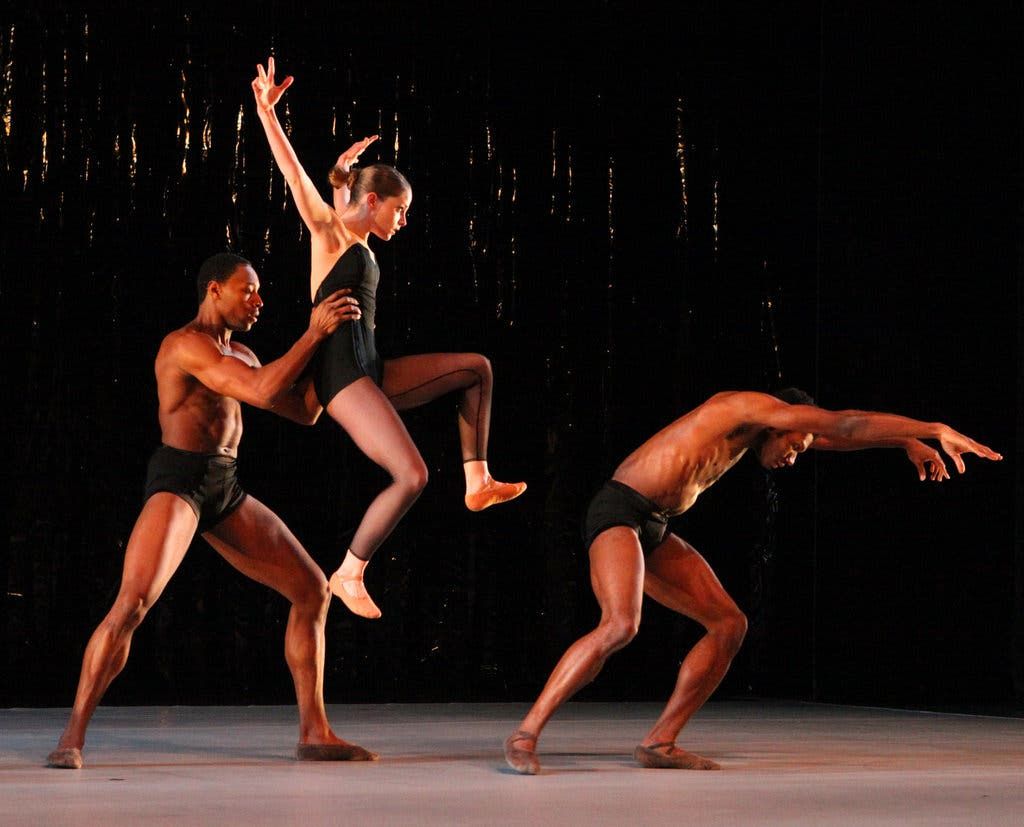
 Joseph Watson, Emily Proctor and William Cannon in "Stamping Ground" photo © Ruby Washington

"Uneven", "Stamping Ground", "Red Sweet"
Aspen Santa Fe Ballet
Joyce Theater
New York, NY
February 24, 2011


The Aspen Santa Fe Ballet is celebrating its 15th season, quite an achievement in this era of budget cutting.  The 10-member company danced three pieces at their recent Joyce appearance--at least there were three different titles, but the works (by Cayetano Soto, Jiri Kylian, and Jorma Elo) were so similar that it seemed like one long dance punctuated with some changes in sound.  The choreography was as mannered and predictable as any drawing-room comedy, with the staccato, sway-backed, butt-sprung jerky movements danced in harsh lighting so familiar to audiences nowadays.  Instead of a gilded youth bouncing on stage with "Anyone for tennis?", all of the ballets had black leotard clad automotons emerging from the back of the stage apparently saying "Twitching, anyone?" since all three works involved a whole lot of shaking.  The pieces all involved a great deal of anonymous ferocity, and were without structure, form or craft, and the dancing was impressive without being interesting.

"Uneven" is by the Spanish-born, German-based Cayetano Soto, to music by David Lang, played live by the cellist Kimberly Patterson.  The women, dressed in flattering black and white leotards, had occasional insect-like movements; indeed it seemed as if Soto's view of women began and ended with "The Cage".  Kylian's "Stamping Ground", too, featured dehumanized dancers, this time moving in silence punctuated by vigorous slaps, which was eventually replaced by percussive music.   "Red Sweet" by the ubiquitous Jorma Elo, was set to music of Vivaldi and Biber (roughly a contemporary of Vivaldi), so the musical accompaniment didn't have the abrupt switches in mood that many the works using multiple composers do.  But there was no apparent attempt to get inside the music, it was just used as wall paper behind the same jerky movements that the earlier works featured.  The very appealing dancers worked up a sweat, and certainly deserved their applause; they also deserved better choreography.

copyright © 2010 by Mary Cargill

Read more

Words and Music

Words and Music


Program B: American Heartbeat - County and Western
"Home (Excerpt 1)", "Deck of Cards", "Home" (Excerpt 2"), "Songs that Tell a Story", "Home" (Excerpt 3)", "Going Away Party"
Program C: American Mavericks - West Coast Composers
"Prelude and Prelude", "Jenn and Spencer", "Pacific", "Grand Duo"
Mark Morris Dance Group
The Joyce Theater
New York, NY 
July 21, 2026 (Program C), July 23, 2026 (Program B)


Programs B and C of Mark Morris’s all-American music season had distinctly different approaches.

By Mary Cargill
Not Your Average Bird

Not Your Average Bird


“Swan Lake”
American Ballet Theatre
The Metropolitan Opera House
New York, NY
June 19 and July 18 (matinee), 2026


Much has been written about the splendor of Chloe Misseldine's dancing in American Ballet Theatre's "Swan Lake" over the past couple of years, including the debut that led to her onstage promotion, but little of it prepares one for the nuance of the live experience. In her third season dancing the dual roles of Odette/Odile, Misseldine has refined

By Marianne Adams
Soul Man

Soul Man


Program A: Soul of America--Jazz and Pop
"Pizzica", "Three Preludes", "Dancing Honeymoon", 'You've Got To Be Modernistc"
Mark Morris Dance Group
The Joyce Theater
New York, NY 
July 14, 2026


Mark Morris is honoring the American semisesquicentennial—a long word meaning 250th anniversary—with a long look at his works choreographed to American music.  The first of the three programs saluted earlier popular composers, primarily Louis Moreau Gottschalk (“Pizzica”), George Gershwin “Three Preludes”, and the early

By Mary Cargill
A Backward Glance

A Backward Glance


"Sylvia"
American Ballet Theatre
Metropolitan Opera House
New York, NY
July 10, 2026 matinee and evening and July 11, 2026 matinee and evening


The high-class circus of “Don Quixote” week was followed by the stylish exaltation of Ashton’s “Sylvia”; both ballets are joyful explosions of dancing with large casts which allow ABT to show off its many dancers, but “Sylvia”, with its cohesive and coherent style is first-class art as well as first-class entertainment.  The

By Mary Cargill


