Tell Me A Story
"Itchy Bot Bot (A Family Portrait) "Kimono Wednesday" "Giggling Flame and Roaring Waves" "La Lorona" "The Sound of Snow" "Heartbreak Hotel"
Oakland Ballet Company
Laney College Theater
Oakland, CA
June 2, 2018
Oakland Ballet has a noble past, a rocky interim and a promising future. Artistic Director Graham Lustig, the company’s experienced choreographer and administrator since 2010, offered his possibly most encouraging spring season yet. He also has audiences in mind who never tire of the classics, think “Nutcracker”, and “Swan Lake”. These are story ballets, and everyone loves a story. Lustig’s commissions for this program were based on stories. A smart and timely idea.
He did so by giving local choreographers an opportunity, part of his effort to ground the company in the East Bay. While laudable, one also has to accept the possibility, actually the fact, that not all of the work will be of equal quality. Despite programmatic weaknesses, “Scene & Heard” proved to be a pleasing, forward looking afternoon of dance: honest choreography, well performed by a company on the move. And how gratifying that for once, one did not have to be satisfied to have at least one dancer of color in the ensemble.
On the Internet “bots”, apparently, endlessly repeat simple messages. Whether Danielle Rowe’s hilarious “Itchy Bot Bot” (A Family Portrait)” has any relation to that function, I don’t know. It did shine with marvelously stiff-legged, funny ticktock movement in which its characters look like mechanical toys. Father (Richard Link) and mother (Emile Kerr) could have stepped out of “American Gothic,” graduating son (Landes Dixon) like an advertisement for a college education. But it’s the downtrodden, knock-kneed Cinderella daughter (Ramona Kelley) -- her jumps on point sound like sobs -- who grabs the chance to be carried off by the stranger. The finely delineated characters, tell their resonant story economically, with a splendid sense of humor and Rowe’s fine sense of mixing vocabularies. She is somebody to be watched.
A story ballet should not need program notes. Michael Lowe's “Kimono Wednesdays” tells us about a controversial happening that surrounded the return to Boston of Monet’s “La Japonaise” when the public was invited to don a kimono as a welcoming gesture. Well danced, the ballet's sequences, however, looked fractured; the work probably needs something like a through line.
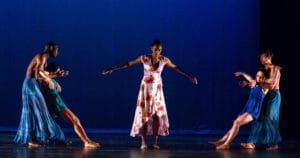
As choreography Antoine Hunter’s ensemble piece “Giggling Flame and Roaring Waves” employed both music and silence. He set individuals against each other through gestural and sign language. But several times he pulled the agitated performers into something like a living, breathing mound from which an individual arises triumphantly. Since Hunter is deaf, “Giggling” put a spotlight on that condition, but the work could also be seen from a wider perspective.
Two other premieres approached dance theater. Cooperation between Vincent Chavez and Kelley resulted in “La Llorona”, based on a Mexican folktale, vaguely reminiscent of Medea. The piece was choreographically thin but showcased Coral Martin, a beautiful dancer, both lyrical and dramatic.
Bat Abbit’s “The Sound of Snow”, also based on “Ethan Frome," lately seen in another version at San Francisco Ballet, is a trio with a collage of music, most prominently Scott Joplin. That choice only made sense if one considers that Joplin and Edith Wharton were contemporaries. Here in a snowy setting it seemed a malapropism. Still, Christopher Dunn’s desperate Ethan effectively veered between the two women who, however, deserved more delineation. The work ended with a powerful image: Zeena (Samantha Bell) planting her hands on her now two life-companions.
Lustig’s frothy “Heartbreak Hotel” used Elvis Presley’s music interpreted by other singers. I often wished for the King’s take on them; his voice needed to be there. “Heartbreak” starts with an old-fashioned evening of social dancing during whichpartners have to find each other. The orderly line of chairs on which men and women face each other, of course, breaks into chaos. Watching the sidelines became a special pleasure. A lovely romantic duet between Link and Sharon Kung leaves the latter deserted; at least one of the women decides to sit the whole thing out. The struggle between Bell's aggressive courting of a very reluctant Darwin Black qualifies for “Heartbreak’s” highlight — a pas de deux.
copyright © Rita Felciano 2018



