Teatro alla Scala's "Don Quixote"
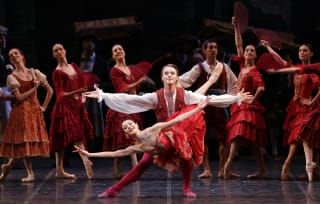
"Don Quixote"
La Scala Theatre Ballet
Teatro alla Scala
Milan, Italy
July 10, 2018
At a time when the need to stage story ballets is sometimes discussed in the U.S. as a necessary evil the La Scala Theatre Ballet shows in its latest production of Nureyev's 1970 adaptation of Marius Petipa's, "Don Quixote", with its July 10th opening in Milan, that traditional ballets, when well staged, can be as gorgeous and thought-provoking as Ratmansky’s "Concerto DSCH" or Peck’s "Murder Ballades". After all what could present more paradoxes than a libretto that forefronts an appeal for transcendent over carnal love argued by a protagonist (Don Quixote) who himself can’t distinguish dream from reality?
From the start of the ballet’s overture it was clear that the Orchestra della Scala, under the direction of David Coleman, guaranteed a successful evening of music. In particular the solo violinist was consistently spectacular, especially in Act II accompanying Virna Toppi during her solo as Queen of the Dryads. Another strong feature of the evening was the lighting, engineered by Marco Fillibeck. In Act II Fillibeck contrived a natural light whose warmth acted as a theatrical reminder that the scene itself walked the line between the natural and the unreal, since, after all, it takes place in the mind of an unconscious Don Quixote. Also notable was the start of Act III that began with the men and women of the corps squaring off, bathed in gorgeous ruby accents.
The corps dancers, directed by Frédéric Olivieri, showed spectacular timing but most noticeably so in Act III where the group sense for the posture and syncopation of Spanish dances like flamenco distinguished these sequences from similar American productions where at times dancers seem to guess at this.
With Act I the dancing begins. Timofej Andrijashenko, debuting in the role of Basilio, was challenged by timing in the first act in passages performed with Kitri, danced by Nicoletta Manni. On his own, Andrijashenko was strong in a sequence of tour des reins and his press lifts of Manni generated snap shot moments, but his sequences became muddied when the two presented fast footwork, side by side. In contrast, Manni’s timing was superb. She noticeably gelled with the orchestra’s phrasing during her piqué turns and brought theatricality to her lovely and touching minuet with Don Quixote, mimed throughout the evening by Giuseppe Conti who convincingly captured the dreamer’s role by alternating between spent, older man and fired up, compulsive dreamer.
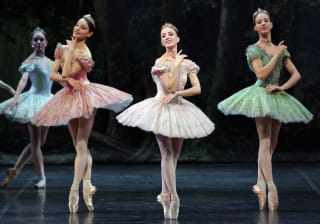
The finest dancing of the night happened in Act II where, clad in moss green, Virna Toppi as Queen of the Dryads was astonishing. Her épaulement alone was breath-taking, shoulders, arms, wrists moving liquidly, emphasizing her role's organic connection to nature. She retained this quality in her upper body whether striking arabesques or swinging her leg from overhead though fifth position during the extended sequence of Italian fouettés. Also impressive in Act II was Manni who, in pale rose, not only changed costumes but demonstrated a complete shift of style as well in the part of Dulcinea. The softness of her pointe work and the gentle entrance and release from attitudes during Dulcinea’s variation contrasted sharply with the imperiousness Kitri projected when, in Act I, Manni used a sequence of rigid attitudes, bringing down the leg like an axe to intimidate a line of potential suitors in the town square. In the role of Amore, Antonella Albano was stunning with Manni, the two ballerinas mirroring one another’s pointe work. However, Albano also showed nice comic timing slipping repeatedly between Manni and a hot in pursuit Conte with a series of gently but firmly mimed, Nos.
Nicoletta Manni, Virna Toppi and Antonella Albano, photo © Teatro alla Scala
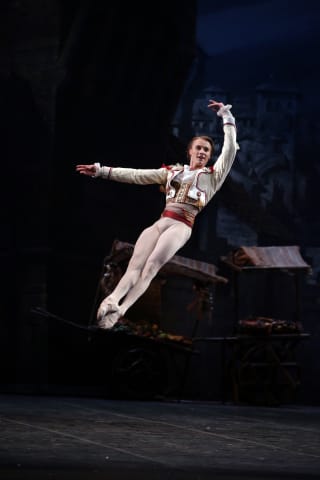
By Act III, the dynamic between the principals had metamorphosed with Andrijashenko a changed dancer, his timing dead on with that of Manni’s. Andrijashenko joined Manni and Kitri’s two friends, performed by Alessandra Vassallo and Caterina Bianchi, and Espada, danced by Marco Agostino, in a series of gorgeous pirouettes, the ensemble moving on the diagonals with precision and energy. In the Grand Pas de Deux, Manni and Andrijashenko, all in white, were again arresting. During the adagio, the couple captured the pulse of the orchestra in the set up and release from Manni’s sequence of arabesques. During the variations, the dancers also blended the gymnastic requirements of the movements with the music. For instance, during Kitri’s sequence of fouettés the extension of Manni’s leg in the preparation for the rond de jambe snapped each time just as the cymbals crashed without rushing the phrase. Similarly impressive was Andrijashenko, whose long, lean frame, made his vertical jump seem to float in space as his legs snapped together during his double cabrioles.
From their response – over ten curtain calls – the audience in that storied hall, draped in crushed velvet, had also appreciated the opening night of Teatro alla Scala's, "Don Quixote".
copyright © 2018 by Sean Erwin



