Taylored Style
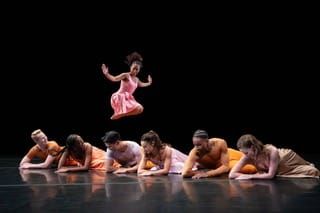
Program A: "Polaris", "Tablet", "Cloven Kingdom"
Program B: "Tablet", "Churchyard", "Esplanade"
Paul Taylor Dance Company
Joyce Theater
New York, New York
June 19, 2025 (Program A) and June 21, 2025, evening (Program B)
The Paul Taylor Dance Company faces the same problem that all companies built around a founding choreographer face when that choreographer is no longer around—how to keep the company fresh without ignoring the past. Michael Novak, the current director, has been looking both backwards and forwards without seeming to loose his focus; he has featured new works, especially those of Lauren Lovette, the former NYCB principal who is now the Taylor Company’s resident choreographer, and also reviving older Taylor works which have dropped out of the current repertoire. And of course, he has worked to keep the well-known works in dancing shape. The Joyce seasons have featured lesser-known Taylor works and the smaller theater suits the more experimental Taylor. (I can’t forget Jada Pearman in the 2022 revival of Taylor’s 1957 haunting “Events II”, where she and Eran Bugge quietly shifted positions while listening to the sound of rain falling.) This year there were two revivals, the 1960 “Tablet” and the 1969 “Churchyard”, both of which have not been performed for some fifty years, as well as three major works from the 1970’s, “Polaris” (1976), “Cloven Kingdom” (1976), and the evergreen “Esplanade” (1975).
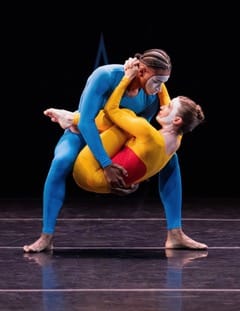
“Tablet” is a quirky pas de deux choreographed for Pina Bausch (yes, that one) and Dan Wagoner with decor and costumes by the minimalist artist Ellsworth Kelly. (The Observer has a detailed article on the issues involved in reviving “Tablet” (https://observer.com/2025/06/paul-taylor-dance-company-tablet-churchyard-joyce-theater/.) The two dancers, Kristin Draucker and Devon Louis, appear to share a mask, as Louis’s white face looked like it was cut out from Draucker’s ownn mask. This might indicate two halves of the same whole or pieces of some surrealistic puzzle, but the work does not need deep thoughts to be appreciated; it seemed like a quirky experiment in movement, breaking phrases into separate shards. It was set to a spiky commissioned score by David Hollister and was structured rather like a traditional pas de deux, starting with a slow duet, followed by two solos, and ending with a technical display showing off some very unusual lifts.
It began with controlled, deliberate moves, as if the two dancers were impassive puppets forming a fascinating series of mechanical shapes. Louis’s solo was more fluid, as he scooted across the stage in a series of squatting jumps. Louis, a phenomenally strong dancer, used his reticent, unflashy demeanor to make these look effortless and natural. Draucker’s solo may have had a theme, as she blocked her ears and rubbed her hands together like some gigantic insect, but what I remember was her subtle femininity, as she made every move look graceful.
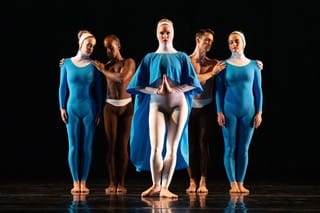
There is little grace in “Churchyard”, one of Taylor’s light vs. dark works, seem through the prism of a controlling figure. It is set to medieval tunes, and the costumes by Alec Sutherland, with the hints of a wimple in the women’s head coverings, suggest a historical setting, though the turquoise leotards of the opening half imply a timeless quality. (An early review described the costumes as being red and white, so perhaps the turquoise was a later addition.) The piece opened with Elizabeth Chapa holding her arms in prayer as four couples walked on. They danced a stately measure, courteous and distant. Jessica Ferretti and Shawn Lesniak lived things up with a light and airy dance, full of flying jumps. At times, the choreography seemed to ignore the music, and couples held balances with slow-moving arms as the music bounced along; there was something oddly unsettling about their stillness.
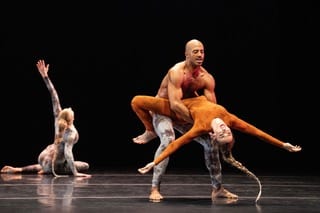
The second half was even more unsettling, as the turquoise disappeared, replaced by earth colored leotards with odd bulges, suggesting plague pustules. The dancing became wilder and more animalistic, with frantic, floppy, ungainly, staggering moves, the men, at times, holding the women like carcasses of meat. Chapa returned without her religious headdress, and danced a fierce solo, as if she were casting a spell, forcing the cast to follow her off stage and her voracious, open-armed leaps seemed to prefigure those of the mysterious goddess in Taylor's 1998 “The Word”.
The cast was magnetic, and Lisa Borres Casey was especially vivid, tossing her long braid as if it were a weapon; a useless weapon, perhaps, as Taylor seemed to be saying that the love and gentleness and the consolations of religion of the first half will inevitably fade in the face of danger and death. Churchyards, after all, are often next to graveyards.
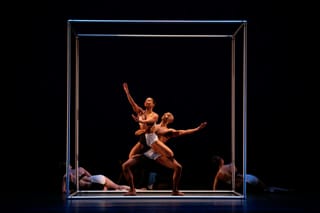
There are no lessons in “Polaris”, except, perhaps, that it is fun to experiment. “Polaris” has two parts, the first flowing and lyrical and the second sharp and uneasy; both have the same choreography, the same costumes, and the same set (an open golden cube designed by Alex Katz), but different dancers, different music (both parts were commissioned from Donald York), and different lighting. This was not a secret, it was described in the program, so the audience got to play along, watching the moves in the first half and wondering how they could look different.
The detailed casting lists gave us a clue—the tall, stately, and lush Emmy Wildermuth opened the work with slow, deliberate solo in the first half and was replaced in the second by the small, intense Jada Pearman whose snappy, tense arms slashed the air. It really did look like completely new choreography. It is one of Taylor’s most inventive works, a witty puzzle as opened ended as the cube the in which the dancers moved.
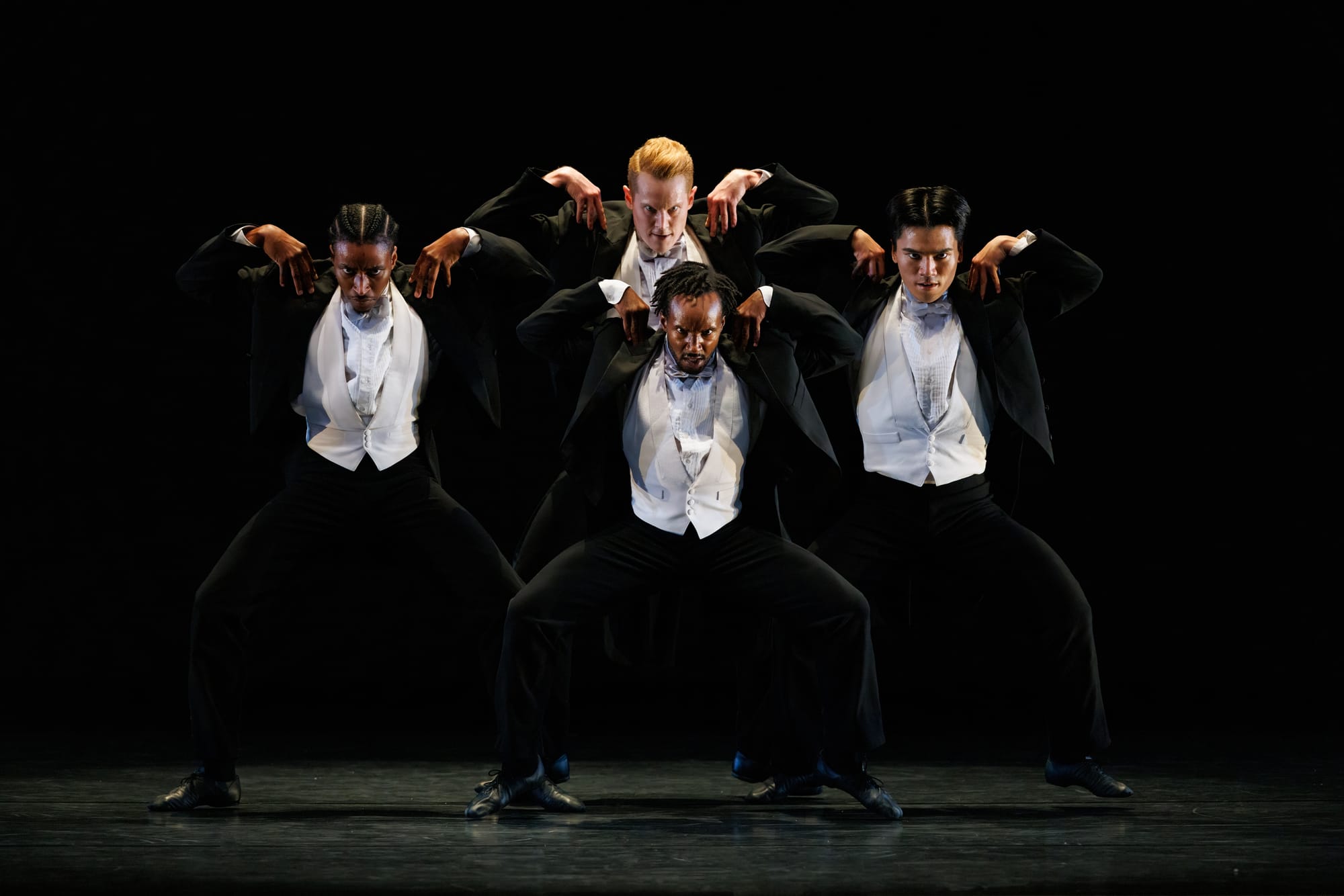
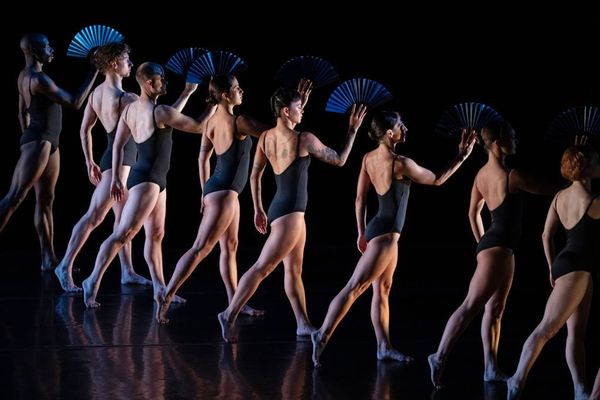
“Cloven Kingdom” is another witty romp, as the music ricochets from the stately baroque atmosphere of Arcangelo Corelli to the wilder percussion of Henry Cowell and Malloy Miller. The eight women opened the work, wearing long silk dresses by the fashion designer Scott Barrie and preening like 1950’s fashion models to the dignified Corelli. They were interrupted by four men (Devon Louis, John Harnage, Shawn Lesniak, and Austin Kelly) dressed in white tie and tails and dancing to the drum music like demented head waiters. They crouched, they played leap-frog, they pounded their fists, they did impossibly difficult jumps, holding their hands like claws as if it were the most natural thing in the world; Kelly was particularly dead-pan, as if daring anyone to find their movements strange.
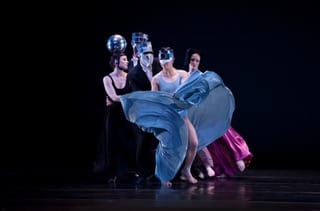
The women’s animal nature couldn’t resist, and they joined in the mayhem, several wearing mirrored hats which reflected the lights onto the audience—“you too”, the beams seemed to say, “belong up here with the other animals”.
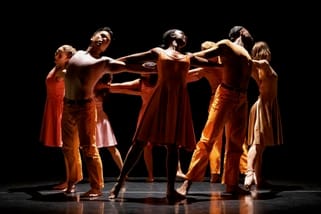
Taylor also reaches out to the audience in “Esplanade” with a warmer message, when, after the explosion of energetic jumps, a lone woman (Jada Pearman) stands on the stage with her arms open, seeming to invite the audience to share the joy. There was certainly enough joy to go around, as the dancers seemed to relish every second of the dance; they looked genuinely, warmly, and glowingly happy, with no fixed or artificial grins. Its brilliant simplicity never gets old, and the sight of those dancers, gleaming in their orange outfits set off by the black background, walking, skipping, and jumping through Bach as if the stage were a trampoline seems as daring and inventive now as it must have done fifty years ago.
© 2025 Mary Cargill