Tango Depths
"m¡longa"
Sidi Larbi Cherkaoui and dancers
New York City Center
New York, NY
February 26, 2015
Tango is said to be a dance of seduction and despair, but Sidi Larbi Cherkaoui’s tango-inspired “m¡longa” delves deeper. Focusing on the myriad of underpinning tensions and connections formed between two (or more, as the case may be) people in the dance, Cherkaoui explores the emotions that are shared, and the function of the intertwining attraction embedded in the dance’s fabric. Named after the ubiquitous in Buenos Aires “milongas” – gatherings where tango is danced – a typical milonga it is not, nor is it a typical tango show. Instead, the U.S. premiere of Cherkaoui’s work showed it as a take on the dance, an experiment in examining it, and an attempt to unlock the doors of this dance’s secrets through dancing.
Though he was not raised with tango or its traditions, Belgian-born Cherkaoui’s style of weaving patterns and collection of spinal and earthy movements nonetheless works particularly well in the tango landscape, and his “m¡longa” dances as a result had a very natural feel to them. The choreography stays true to tango’s basic precepts in its framework, but within it Cherkaoui allowed for a number of modernizing liberties, extending the curves in certain of the motions, making the lines in the lifts longer, the accents harder and less controlled, and leaving ample room for tacit expression of the emotions underlying the moves.
Cherkaoui’s work is surely an outsider’s attempt to understand the dance and peel away its layers, but nearly all of its components possess a mix of the foreign and modern and the authentic. For the choreography Cherkaoui worked with tango specialist Nelida Rodriguez de Aure who consulted on and rehearsed the work. The music similarly had an insider/outsider blend. Most of the score consisted of original compositions by the famous Argentine tango musician and composer Fernando Marzan and Polish composer who has worked with Cherkaoui on many prior projects, Szymon Brzóska, with a few famous tango pieces by Astor Piazzolla and Gerardo Matos Rodriguez mixed in.
A similar blend existed in the dancing cast, with ten of the twelve dancers being independent tango couples with extensive dancing experience in Buenos Aires. Together with a modern dance couple, they and their performances revealed both the different nature of their dancing and the different goals Cherkaoui appeared to have set in having them dance. The slowed down or dramatized choreography seemed determined to draw out the essence of the Argentines’ senses of their dance to the surface in their sections, while the contemporary couple seemed tasked with expressing what they felt in tango through more modern movements, particularly in their very acrobatic duet toward the end of the night, when after a series of lifts Jennifer White watched Jason Kittelberger transition to the floor and back through many rippling spinal bends.
With tango born in Buenos Aires and occupying its own sphere in Argentine culture, “m¡longa” began with a glimpse of that world through a projected onto the curtain documentary-style video recording of a typical milonga at a café. After a brief peek at the dance’s place in the real world, the curtain rose to reveal five musicians on the side of the stage who seamlessly picked up where the video’s music left off. Their appearance, along with two dancers standing with their backs against each other in the middle of the darkened stage, made the transition seem like an invitation to go deeper into this dance’s world.
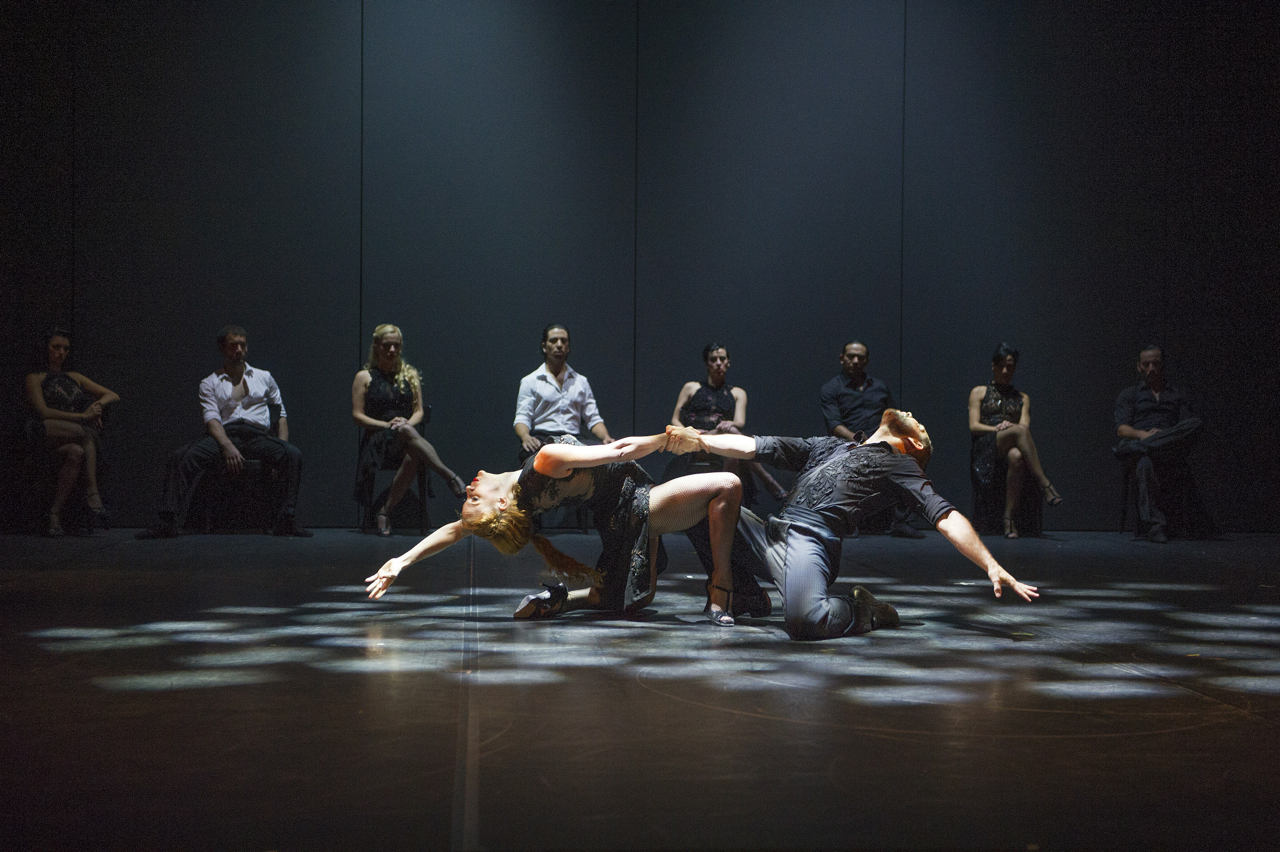
The first couple presented Cherkaoui’s theme of zooming in on different aspects and emotions within tango. Dancing almost the entirety of their duet back to back, the dancers explored the connection they felt between each other. The couple wandered through the stage as though looking for something, or some way to realize the attraction they felt, and when their eyes finally locked their movements slowed and they explored the dance’s connecting powers with curiosity, taking their time reducing the physical distance between them. The couple was then joined by others, and the dancing progressed as though at a real milonga, with each couple existing in their own, distinct private world even if the movements they performed were largely identical. First exhibited in this dance, the display of individualities and differing stories were a constant in the show, and when the different couples ended up alone on stage at different points in the evening each of their tangos was different: some were stories of attraction, some of jealousy and possibly betrayal, such as a tango for three with two women seamlessly alternating places with one clearly an interloper, some were stories of passionate fights and reconciliations.
Providing some added cultural grounding and innovation to the show, and helping further its revealing mission, the performance was embellished with several innovative video and graphic elements from set designer Eugenio Szwarcer. For one of the first duets, which had two dancers stand alone on opposite sides of the stage as the woman adjusted her hair and make-up, replicated video versions of the couple were projected onto the stage back and repeated the dancers’ movements. Once the real couple started dancing their projected selves danced as well, but then the dancers stood still, looking at each other, as their digital doppelgangers went on, which bifurcated into distinct layers the emotions they felt and showed on the stage from the dancing that appeared on the screen.
A separate section had a lone male dancer appear at the front of the stage as projections of photographs and scenes from Buenos Aires appeared on the curtain in front of him. With captivated and determined movements he manipulated the images of different parts of his city as though on a tablet device, enlarging and swiping away collaged depictions of the famous Caminito street, Casa Rosada, Obelisco de Buenos Aires, Teatro Colón, and other landmarks. The last image, a blown up photograph of the Ricoleta Cemetery, fed into the next scene as the curtain rose and projected video footage of the famous cemetery onto the stage back was greeted by the group of dancers in mourning. As they found their partners and began to dance to Piazzolla’s “Libertango,” the funeral was also experienced through tango, but with the dance now displaying passions of resilience and grief.
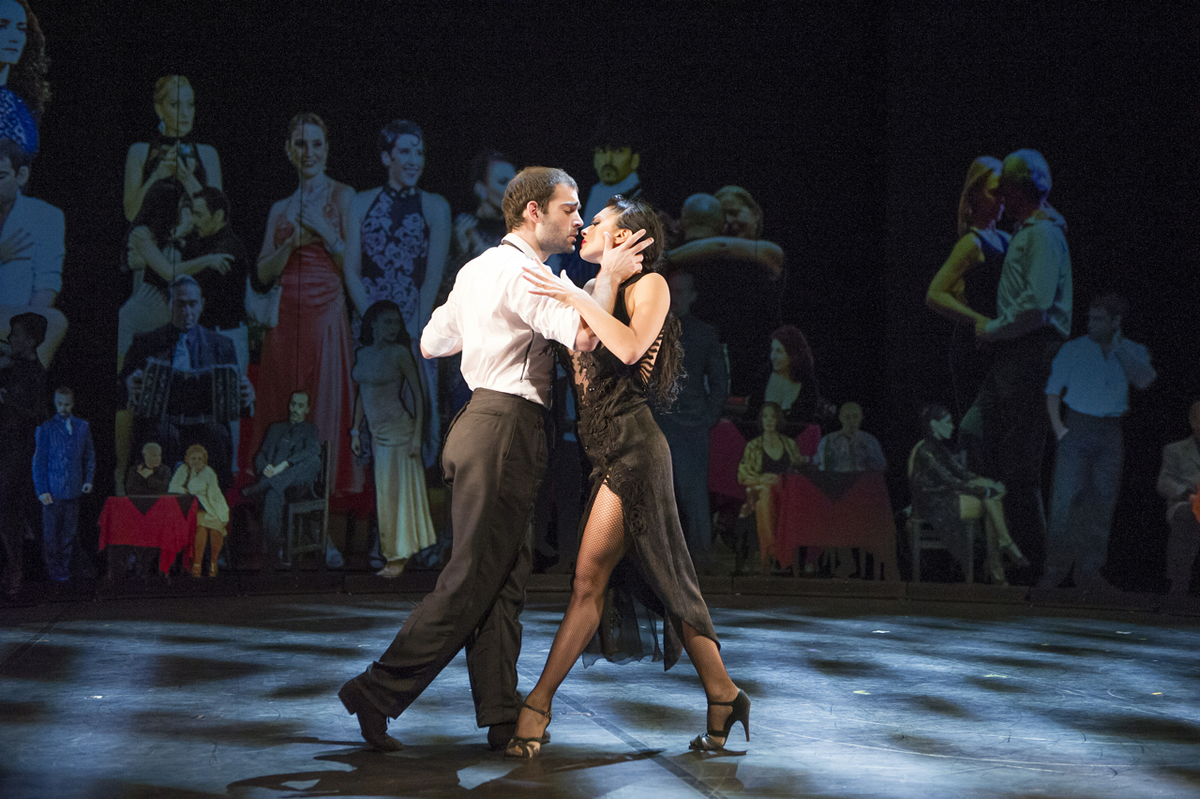
But most creative was perhaps the use of white cutouts in the form of people, which, when blank, looked decorative and modern, but when filled in with projected photograph images created a very realistic sense of real patrons at a milonga. These cutouts watched the dancers and blended seamlessly with them, and in one scene when the group of real performers left the stage and most of the forms were removed, a male and female cutout remained on opposite sides and mirrored a real couple who proceeded to fight onstage and then dance a physical, aggressive tango. Their dance was the projection then, making real the feeling existing between their calmly seated graphic selves.
At the end of the 90-minute performance of licking leg flips and passionate grasps laced with endless stories and emotions, the six couples returned to melancholy pensive moves that started the night, ultimately ending the evening as its first couple began, with their backs against each. Though they were not touching, the connection they’ve fostered throughout the evening with each other and the audience was undeniable.
copyright © 2015 by Marianne Adams



