Taiten: Noh & Kyogen
“Taiten: Noh & Kyogen”
Japan Society
New York
November 14-16, 2019
Japanese Noh is said to be the oldest living theatrical form, its roots going back to the fourteenth century. It is bound by the minutest of rules, every gesture and step refined to abstraction. Its subject matter, too, was developed centuries ago and deals with an unreal world of warriors, ghosts, madwomen, angels, gods, and priests. Although Noh may be deeply conservative, the performance of “Taiten” last week at the Japan Center shows that it can be more than an archive of the past. The work was originally created to celebrate the 1912 enthronement of the 123rd emperor of Japan. It has now been recreated and brought up to date to celebrate the ascendance of Hirohito, the 126th emperor, whose enthronement is taking place this year with numerous rituals and celebrations.
Since “Taiten” was created to celebrate the ascension to the Chrysanthemum throne, it has rarely been performed. But to mark the occasion of a new emperor, the Yokohama Noh Theater decided to commission Katayama Kuroemon X to restage the piece. Kuroemon X was a logical choice to head the project since he is the leader of the prestigious Kanze School in Kyoto, where “Taiten” had been premiered in 1915. The Japan Society gave the restaged work its international premiere.
Noh plays combine music, drama, and dance, with dance being a major element. “Taiten” concerns a god who praises peace and prosperity in the country and performs a celebratory dance. This narrative places the piece among the first of five types of Noh plays. In restaging the drama, which Kuroemon X had never seen, he consulted with Noh scholar Dr. Haruo Nishino, and revised the script for modern audiences. In addition, he discovered documents from his father and grandfather, which helped him, and he created new choreography.
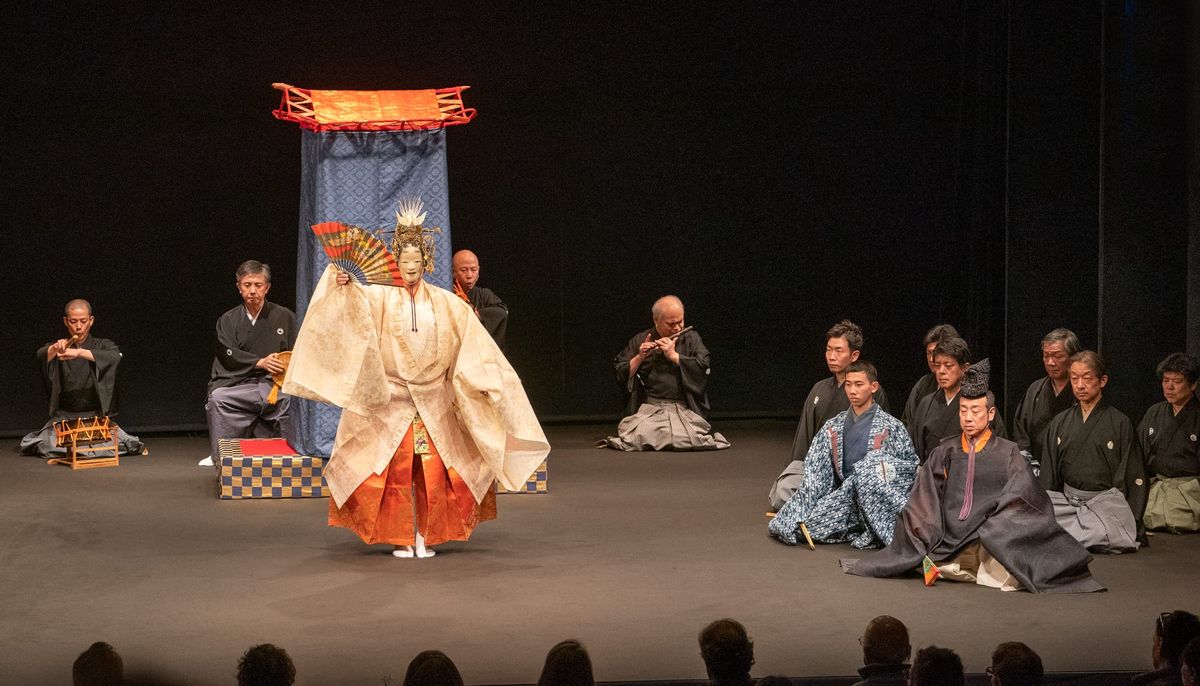
The narrative is simple: An imperial envoy and his servant deliver a proclamation announcing the new emperor’s enthronement. The two then witness dances by a Heavenly Maiden and the god Amatsu-kami, congratulating the emperor and blessing the prosperity of the land.
Since Noh is a ritualized form, it has none of the swashbuckling action of Kabuki. Violent action and high emotion are delivered with extreme restraint. In traditional fashion, the set consists of simple wooden fencing. The four musicians sit at the back of the performance space, the chorus to one side. All are dressed in shades of black, grey and beige, and like the dancer/actors, all are men.
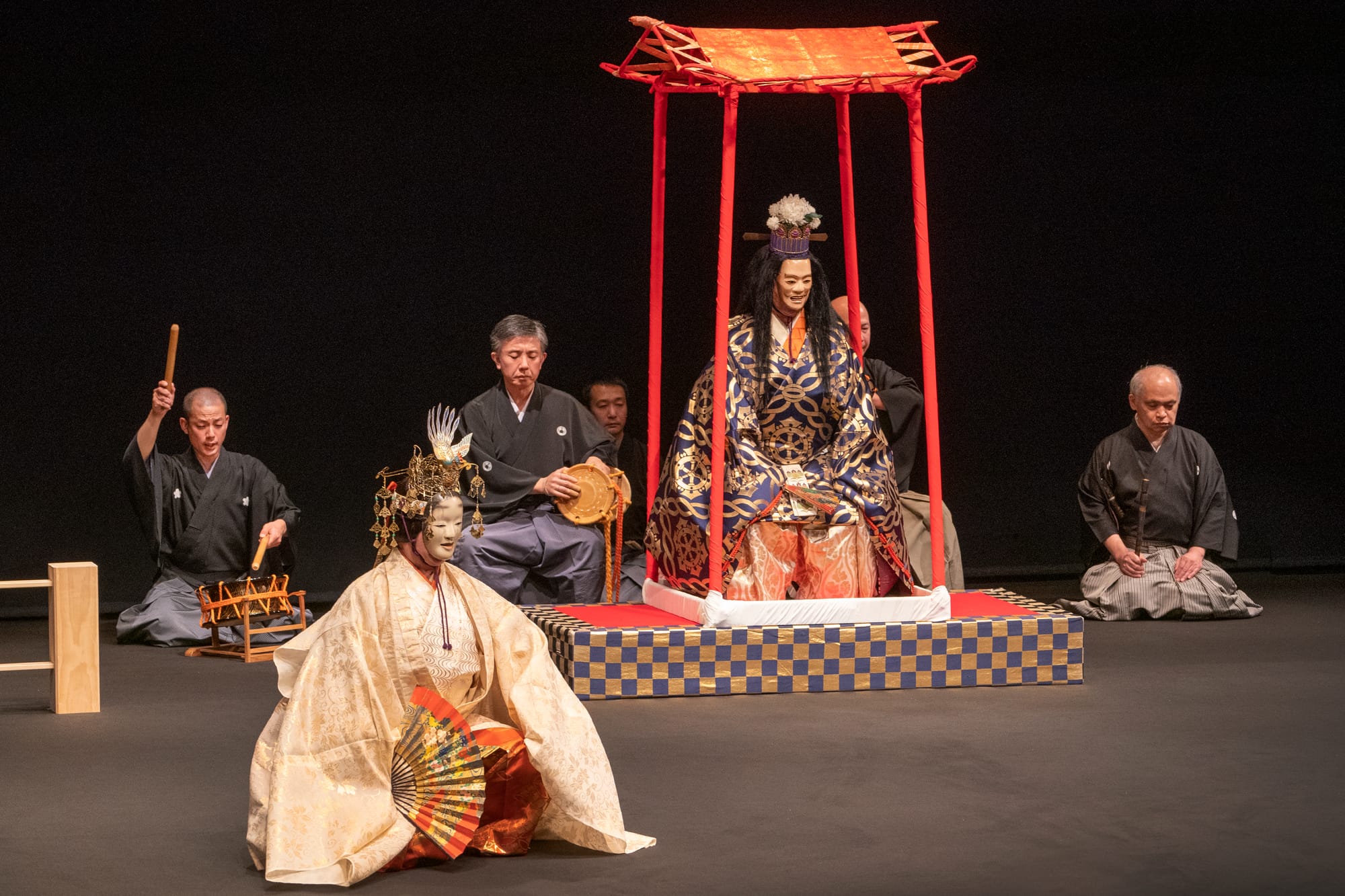
Contrasting with the muted colors of the musician and chorus costumes, are those of the actors, which are more elaborate and in the case of the heavenly characters, extraordinarily rich. The Heavenly Maiden and the god Amatsu-kami also wear masks, as do all celestial characters in Noh drama. The role of the central god is always taken by the leader of the particular Noh school which is performing the work.
After making the announcement of the emperor’s ascension to the throne, the envoy (Hosho Kinya) and his servant (Hosho Naoya) sit before the chorus to witness the dances, first of the Heavenly Maiden (Mikata Shizuka), and then the god (Kuroemon X). The costumes of these characters are voluminous and stiff, constricting the kinds of movements that can be done in them and helping to form the total dance image.
The maiden’s solo is at first done in place and then gradually moves out to take up more of the performance space. Her pace is slow and formal, consisting of small steps in one direction then another, punctuated by flourishes of her long sleeves and manipulations of her fan, as well as occasional stamps of her foot. The god’s dance is more emphatic, gradually increasing in speed. Each step is precisely taken, with tiny variations, such as the toes curling up in some instances and not in others. The dances are accompanied by the musicians and the chorus singing words that celebrate the new emperor and praise the richness of the land into eternity.
Although ”Taiten” is by no means the most complex or affecting of Noh dramas, it gives an idea of the feeling of a Noh performance and of character types. More typical was the Kyogen offering on the program. Kyogen, a comic theatrical form, is given in between Noh plays or acts of plays at traditional Noh performances. We would probably call Kyogen pieces skits, since they are short, lasting fifteen or twenty minutes. However, Kyogen, too, has a history going back to the fourteenth century when it was developed with Noh, and it also has its own age-old repertory. Kyogen represents earthly life and everyday people as opposed to the lofty, aristocratic Noh dramas.
Here we saw “The Snail,” in which a master instructs his servant to find a snail that the master wishes to give his grandfather as a sign of longevity. The problem is that the servant has no idea what a snail is, and the master’s description leads him to believe that the monk he discovers sleeping under a bush, is the desired snail. The monk encourages the deception for his own amusement. He proclaims he is a snail and insists that the servant dance with him to a silly song about snails and bugs. The two dance together until the master appears looking for his servant. He ends up joining the dance as the monk leads them all away. The humor is closer to Chaplinesque understatement than to slapstick, and it seemed to transfer effortlessly to the western audience, who could be heard chuckling throughout.
The performance opened with a musical offering by the four musicians entitled “Gaku,” that, according to the program note, is the name of a dance scene from a Noh play, which expresses the joy of an eternal life.
There is no question that Noh is, for western audiences (and many Japanese) an exotic form whose tempo and subject matter are far removed from modern life. Nevertheless, Noh has influenced a number of western artists, including Robert Wilson and Jerome Robbins. And once you settle into it, shut off the cell phones and all the attendant noise and hectic activity that continually engulfs us, its rewards are many.
copyright © 2019 by Gay Morris



