Symphonic Variations
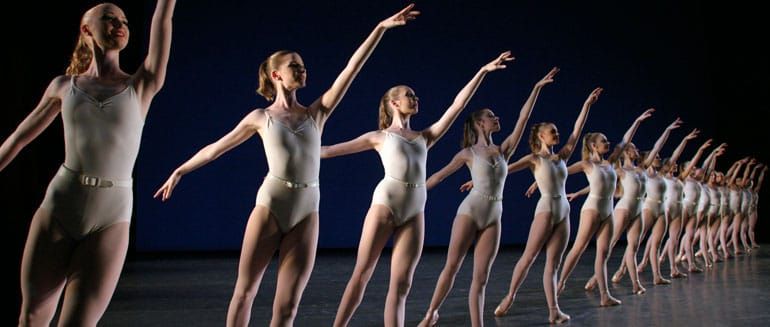
"Symphony in C", "Symphony in Three Movements", and "Western Symphony"
New York City Ballet
New York State Theater
New York, NY
May 3, 2008, matinee
One of the few-all Balanchine programs in this Robbins-fest season was also an all symphonic program, an immersion into Balanchine's astounding variety; three completely different responses to three different symphonies, all developed from the majestic geometry of the Russian classical ballet in which he grew up. "Symphony in C" and "Western Symphony" both, in their different ways, acknowledge "Swan Lake", and "Symphony in C" had an eloquent evocation of the tragic atmosphere in the second movement's dancers, Sara Mearns and Charles Askegard. They avoided the trick of over-dramatizing the steps (the final pose in the pas de deux was a simple, musical, pause in the movement, not the final flutterings of "The Dying, Gasping, Eventually Expiring Swan". Mearns is a lush dancer, with a subtle sense of phrasing, and there were many simply glorious moments; one of my favorites was the series of grand battements, where she paused slightly with her leg up and leaned back onto the waiting Askegard, a sublime moment of perfect trust.
The other movements were all danced well, though without the extra poetry that Mearns brought. Abi Stafford, with her brother Jonathan, in the first movement was precise, careful, and accurate; it was like watching the world's best ballet class. Megan Fairchild, with Gonzalo Garcia, did the bouncy third movement. Garcia has a beautiful, floating jump and an elegant style, and he and Fairchild looked very good together. He is taller than some of her regular partners, and showed her off well. The role suits her sparking footwork, but it would be nice to see her in more emotionally rich roles. As yet, Tiler Peck doesn't seem ready for emotion, but boy, she has the technical side covered. Her fourth movement is one of the sharpest, cleanest, and snappiest versions I have seen. That turning sideways kick was tossed off as if it were the easiest, and most fun, thing in the world.
"Symphony in Three Movements", with its flouncing pony tales and prancing steps, has become somewhat of a "fun" ballet over the years, but Daniel Ulbricht, with Sterling Hyltin, brought an unusual power and strangeness to his role. He has an incredible jump, which can come across as flash, but in this performance, he added weight and power and an intensity that made him concentrate on the flashing Hytlin. Their performance echoed and amplified the odd astringency of the music.
So did Wendy Whelan and Albert Evans in the snaky, Orientals pas de deux. Though the leotard costume did Whelan no favors, she danced with an almost lyrical clarity, avoiding the harsher, angular, Agonistic approach, and Albert Evans was equally lyrical and equally interesting.
"Western Symphony" can be found on the same map as Petipa's Spain describing an imaginary place filled with with classical vistas. For all its cowboys and dance hall girls and loose limbed vigor, the basic choreographic shapes and steps would feel at home in the Maryinsky. Indeed, the four little dance hall girls of the second movement need to metaphorically wave to their earlier little swan cousins for the joke to work. Adam Hendrickson was an ardent and very funny cowboy Siegfried, and this is the only version of "Swan Lake" where the male solo seems justified. The lovely Kathryn Morgan underplayed the Odette echoes, possibly a bit too much, but that is preferable to telegraphing "This is FUNNY" to the audience.
Unless the dancer is Damian Woetzel, that is, and he can telegraph anything he wants. His Rondo, with Teresa Reichlen, was obviously part of his farewell tour, and his pure joy and extravagant wit, not to mention the technical verve of his dancing, gave the audience something to cheer about. Reichlin was his leggy, but still classical, companion in this most classical of westerns.
copyright © 2008 by Mary Cargill



