Sylphs and Others
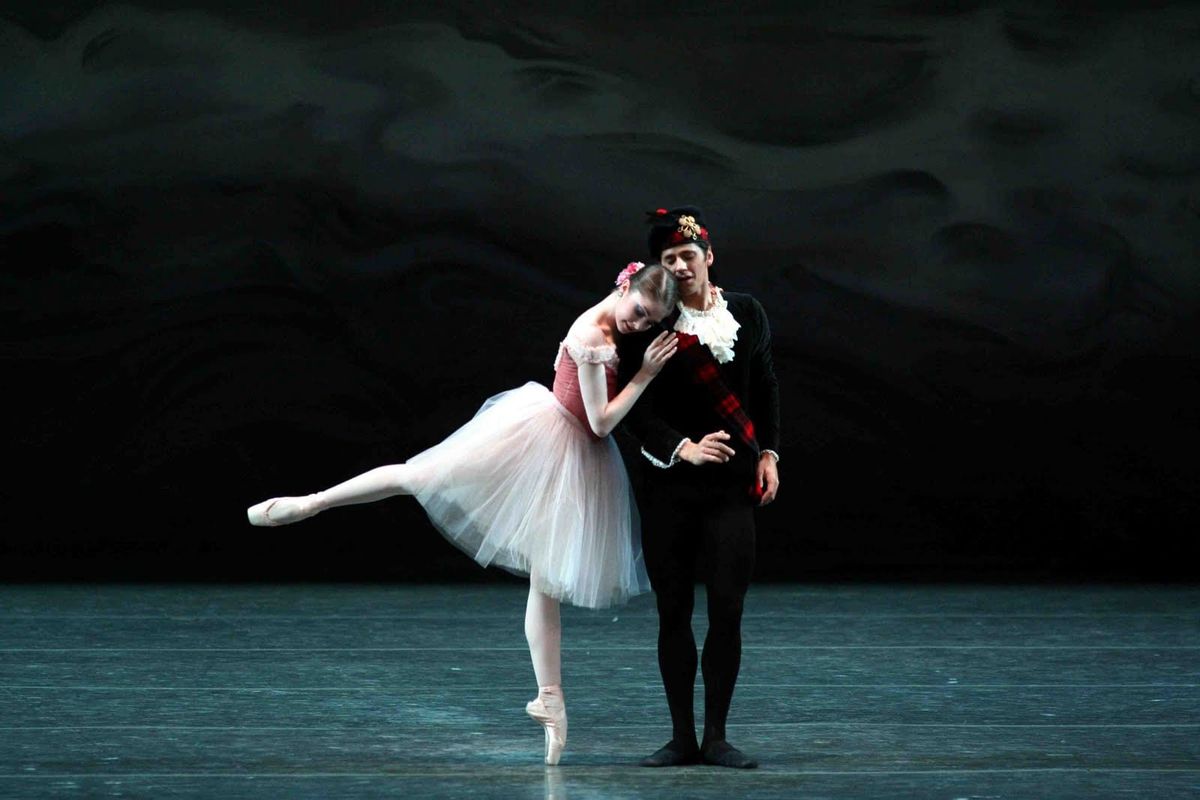
"Scotch Symphony", "Quasi Una Fantasia", "Concerto DSCH"
New York City Ballet
David H. Koch Theater
New York, NY
May 22, 2009
Balanchine's "Scotch Symphony" is a somewhat haphazard take on "La Sylphide", and despite some true romantic choreography, it lacks emotional logic. Why does the sylph, who has spent most of her time gesturing up to the sky, where she belongs, suddenly become earthbound and perfectly happy as a bravura classical dancer? Why do the village boys, after dancing so willingly with the local sylphs, suddenly turn into heavies, separating our hero from his own sylph. And why, after their ominous appearance separating the couple, do they literally throw the sylph at the person not called James? There is no real exploration of the two different worlds which so intrigued the romantic period, just some wonderful, but unconnected choreography, which can be enjoyed on its own terms, but which leads me, at least, to wish I was watching the real thing. This season saw a new set, designed by Karin von Aroldingen, which replaced the leafy glen with what looks like a particularly arid part of the Sahara, but, while it adds nothing to the atmosphere, doesn't get in the way of the dancing.
Kathryn Morgan and Robert Fairchild both made their debuts, and while neither could really connect the almost unconnectable dots, their vignettes were lovely. Morgan was a combination of marzipan and mist, an absolute charmer combining a creamy upper body with an echo of the true romantic style in her floating, curved arms. The wonderful bit where she leans down to whisper to her partner, which echoes both "La" and "Les Sylphides" was so much more than just a pretty pose, it had a radiant imagination. Her dancing had a gentle confidence without any hard edges and it was an extraordinary performance, debut or not. Fairchild's part is less faceted, he is just a nice guy in a kilt and a feathered hat who only has to do a few complicated turns to get his sylph, but he danced cleanly and partnered well. Brittany Pollack was the little Scotch girl who appears in the first section, never to be seen again. She had more enthusiasm than style, and seemed to be looking in a mirror, rather than gazing at the Scottish hills; she appeared to be less the village belle than the village pill.
There were lots of pills in Benjamin Millepied's new "Quasi Una Fantasia", a dark and dreary exercise in making the lead ballerinas, Rebecca Krohn and Janie Taylor, look like rag dolls or corpses to be dragged anonymously around. The choreography was the squat, arabesque, and lift style, slow during the first two movements, and then switching into a "Glass Pieces" style of pulsating minimalism in the last movement. There were some intriguing group poses, but they didn't seem to lead to anything, and the constant hints of violence were quite offputting.
Millepied as a dancer is a perfect gentleman and generous partner, as he showed in Alexi Ratmansky's colorful and cheerful "Concerto DSCH". The large corps are dressed in simple but flattering leotards which resemble old-fashioned bathing suits, and the piece has a playful air of friends romping on the beach. The head rompers, Juoquin de Luz, Gonzalo Garcia, and Ana Sophia Scheller, pull out all the stops, and Scheller, always a pristine classical dancer, seemed to relax and have fun. The center movement focuses on the lead couple, Millepied and Wendy Whelan, in a pas de deux that uses her majestic serenity. The couple seem to be saying a sad and rueful farewell, while their friends dance in the background. This dual focus isn't distracting (the background dances are not raucously virtuosic), it just seems to be a slightly ironic observation that while friends can be sympathetic to our sorrows, their lives do go on. Finally Millepied and Whelan exit at opposite ends, pausing for one last look. It was an understated, grown-up, bittersweet, and truly moving moment.
This was undercut a bit, for me, by the finale, where they reappeared, apparently perfectly happy. There was also some more unbelievable technique from De Luz, slashing and turning like he had just been set free. But astounding though his dancing is, he is a much richer performer than this bouncing ball of a role lets him be--he, and the other dancers, deserve a chance to try for poetry as well as bravura.
copyright © 2009 by Mary Cargill



