Swans Away
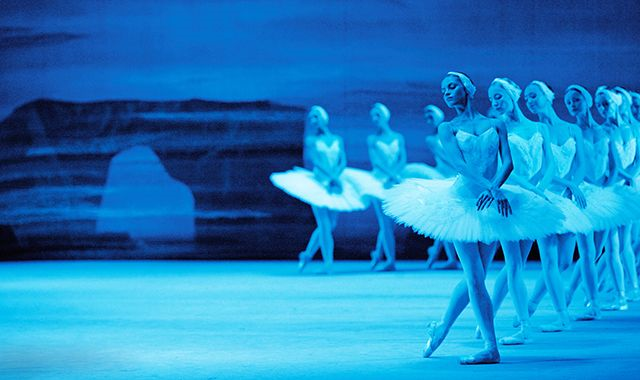
"Swan Lake"
Bolshoi Ballet
David H. Koch Theater
New York, NY
July 15, 2014
Ballet companies, it seems, might as well program "$wan Lake" and be honest about it, since there are no productions around resembling the original Petipa/Ivanov story. The Bolshoi's Grigorovich reworking is no worse, but certainly no better, than others seen in New York. It is, at least, set in the Middle Ages, though the designs (by Simon Virsaladze) seem to be influenced by an unique style called Gothic Expressionism. The court scenes are dominated by a big gold blob that rises up and down, and the lake scenes are a turquoise haze devoid of mystery, poetry, or beauty. The costumes are comparatively restrained for Virsaladze (only the jester wore two-toned tights), though Prince Siegfried seemed to be quite fond of sequins. The black swan tutu was especially attractive, with a black velvet bodice and a hint of wings on the skirt.
Grigorovich has basically abandoned the story, so Siegfried doesn't get a party or a present, the Queen Mother doesn't tell him he needs to marry, and Odette doesn't let him know about her day job as a swan or warn him about swearing allegiance to someone else. This vagueness makes the final act basically an emotional blank (except of course for the Tchaikovsky music, which has hidden any number of choreographic and dramatic blunders over the years). Odette seems to die of some unexplained illness behind a screen, leaving Siegfried to channel Albrecht kneel briefly on an empty stage--there is no apotheosis, so the music seems to end abruptly, and no emotional release.
There are some smaller dramatic miscues, as well. Odette is robbed of her extraordinary entrance, where Siegfried mimes "I see a beautiful and mysterious woman", preparing the audience to applaud her entrance. Grigorovich lets the audience see her hidden in a group of swans--only a glittering crown indicates that the ballerina is on stage, and before this really registers, she hops into her opening dance. The staging generally has the queen and her retinue seated at the back of the stage, rather than on the side, so the dancers turn their back to them and perform straight to the audience, which is good for applause but not for dramatic effect. Siegfried doesn't even turn up to watch his prospective brides from the back of the stage, only showing up in time to reject them. Grigorovich has transferred some of Tchaikovsky's plangent, mournful Act IV music to Act III for a pas d'action for Siegfried, Odile, and a group of black swans, where she captivates him on a darkened stage, after which they charge into the traditional Black Swan pas de deux, where she, with dramatic redundancy, has to seduce him all over again.
The most significant digression from the original is the Rothbart figure, who is now an extremely active Evil Genius, shadowing and mirroring many of Siegfried's movements; indeed, he seems more interested in the prince than in the swans, and how and why he controls them is left unexplained.
Much of the ballet has been re-choreographed; even the beautiful Act 1 pas de trois (now danced by Siegfried and a couple of girls) retains only an outline of the traditional steps, with many of the frilly, delicate, musical combinations replaced by athletic jumps and turns. The Bolshoi, for some reason, abandoned the full-blooded character dances years ago, substituting fairly generic classical variations with vague character accents; even the Neapolitan tambourines made no noise.
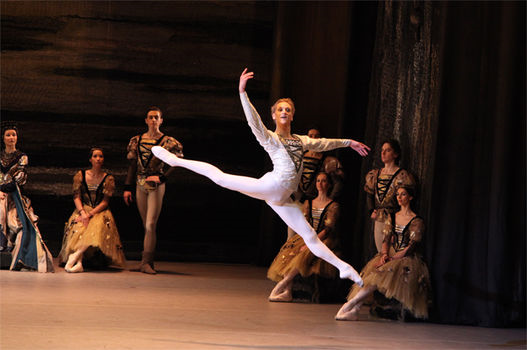
Siegfried (David Hallberg) seems to have been given only one stage direction: "enter jumping and continue". But Hallberg made extraordinarily beautiful shapes with his jumps and arabesques, no matter how unmusical and undramatic they were. His cool approach suited the abstract nature of Grigorovich's version, and he was a tender and gentle partner in the white swan pas de deux, which fortunately, retained the traditional Ivanov choreography.
Svetlana Zakharova, too, is a somewhat cool dancer, who demonstrates rather then lives the choreography. The shapes she made in the white act flowed from one iconic pose to another in beautiful, if uneventful, harmony. There was no feeling of growing trust, of a brief hope, or of impending tragedy, though any feelings would be hard to develop in this impassive production. Her black swan, once she got her feet into some real choreography, was icy and thrilling. Her solo has been re-choreographed to the slinky oboe music and was the most effective of the non Petita/Ivanov efforts. Her fouettés were well-whipped, as she threw her leg out as if she were shooting bullets; her singles (ending with a double flourish) were much more effective than many of the more recent embellishments. Unfortunately, she has retained the old Soviet habit of stopping the music to soak up (and milk) applause when she finished, forcing the poor Prince to hang around until the music starts up again in mid-phrase.
The irritating jester (renamed the Fool) pranced energetically, inserting himself in many of the set dances, including the Act 1 pas de trois. Igor Tsvirko made some spectacularly gymnastic leaps, almost tying his legs into knots as he flew around, much to the audience's delight. The Evil Genius, Vladislav Lantratov, made the most of his campy choreography, with lots of goochy-goochy-goo hand movements, and danced cleanly and clearly. The corps, despite two unfortunate spills (perhaps the unraked Koch stage took some getting used to) looked very good, and the slightly stiff-legged swan steps had a unique charm. The dancers in the pas de trois (Kristina Kretova and Maria Vinogradova) looked fine in what little Petipa was left, dancing with a juicy bounce. I was especially struck by Anna Rebetskaya's Russian princess. Her luxurious upper body made the little hand flicks sing, (a Russian folk style Petipa used so memorably in Aurora's Act III solo). The Bolshoi orchestra, conduced by Pavel Sorokin, tore into the magical score, making it all the more disappointing that there was so little of "Swan Lake" on the stage.
copyright © 2014 by Mary Cargill



