Surreal Wonderland
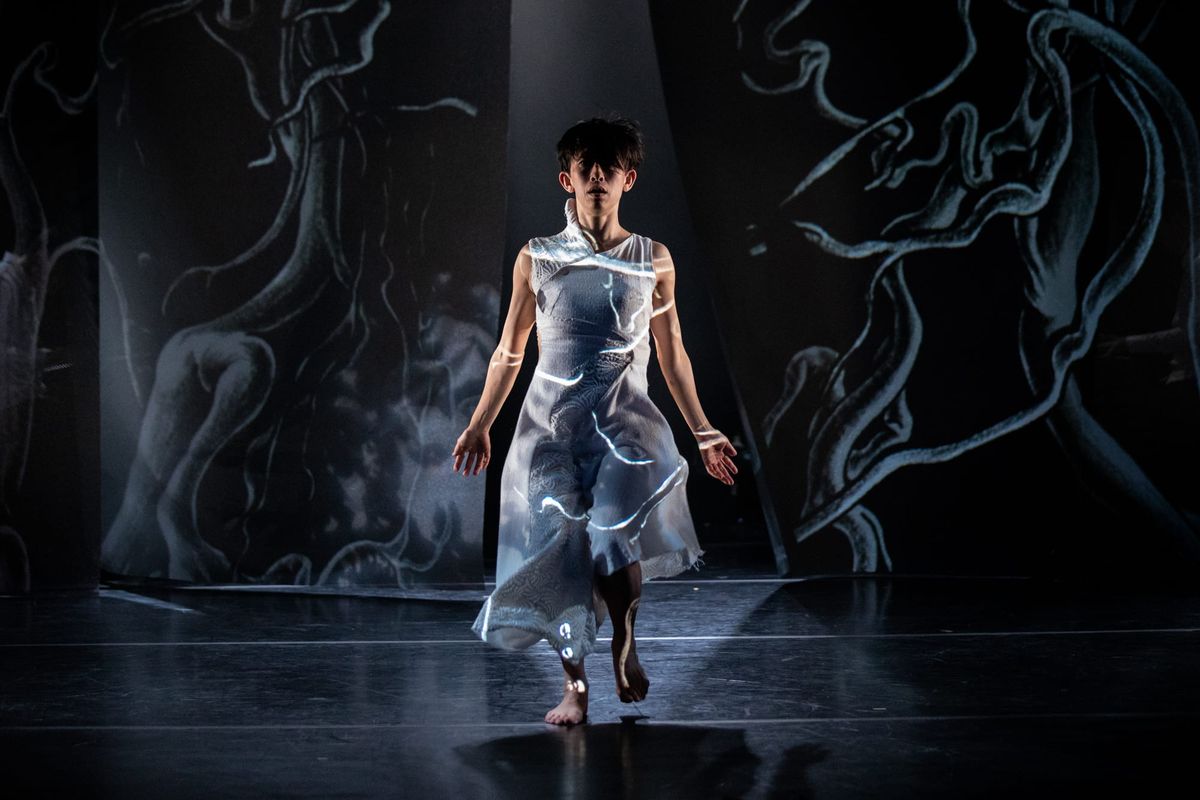
“Fruits borne out of rust”
Tabaimo and Maki Morishita
Japan Society
New York, NY
March 7, 2020
Japanese visual artist Tabaimo is a woman on the verge of mid-life, determined to make that transition productively. “Fruits borne out of rust” is a multi-dimensional collaborative performance piece, weaving imagery, sound, and movement to tell mesmerizing stories through scenes that also provoke laughter and discomfort. Co-created with choreographer Maki Morishita and dancer Chiharu Mamiya, the “fruits” partnered Tabaimo’s visual art with a striking solo dance performance to explore this new phase in each of their lives as artists.
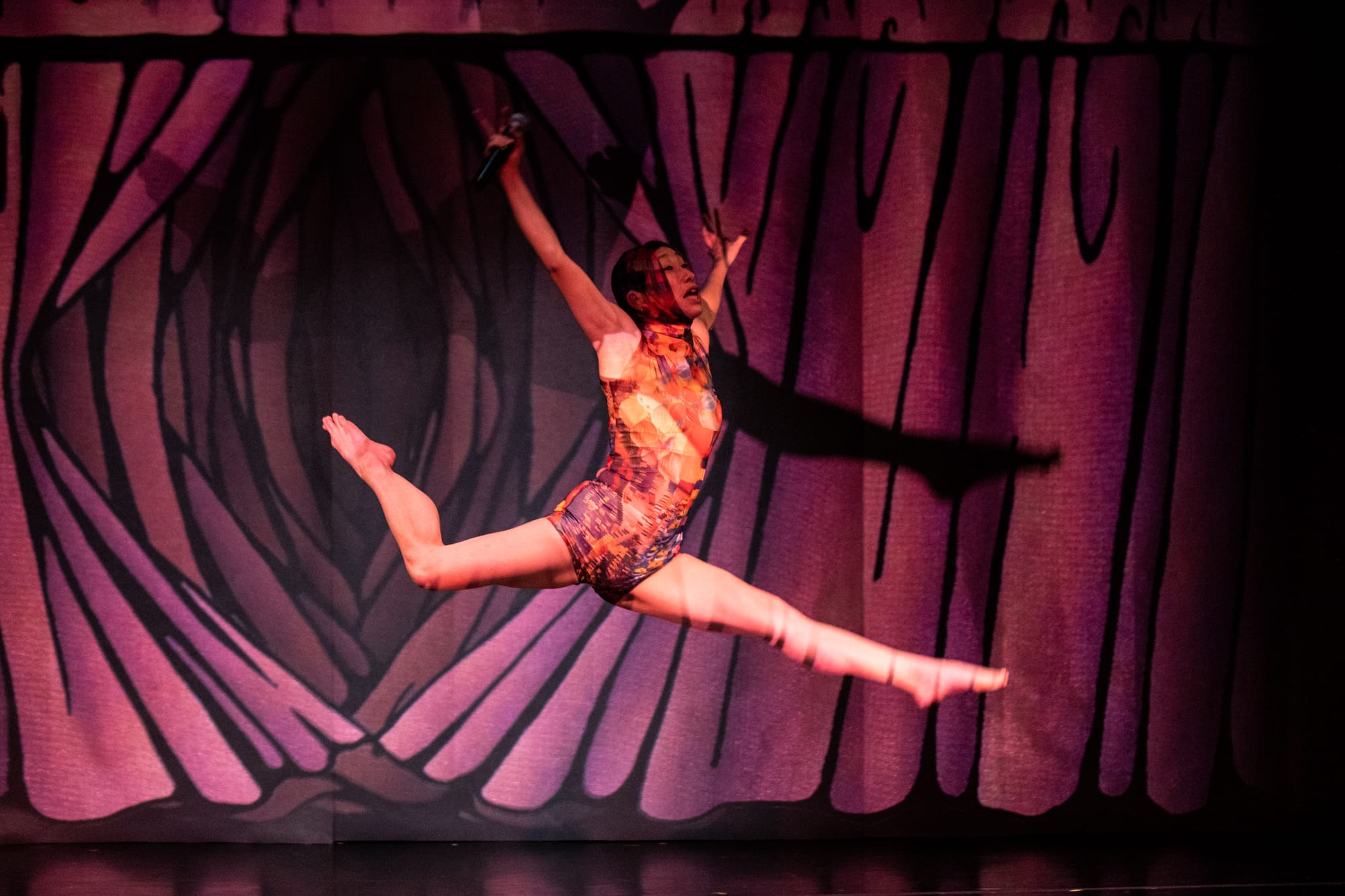
Though the images dwarfed Mamiya, she nevertheless drew the eye as the dynamic center of each scene, slipping in and out of a scrim screen that stretched across the stage, opening or using her torso and looming shadow to add humanity to the cage or the furnished room or the waves of seaweed that framed the scenes. The work’s most impressive achievement was integrating the video art with the dancer’s movement, along with the live music that swirled around both.
As the audience entered the lit auditorium, Tabaimo silently drew on a large whiteboard, creating a dense visual overture to the performance to come. With markers, she sketched and filled in a boxy world, a flying dove, and a winged strawberry, and added the title in Japanese and English. Her art, which mixes black lined images and shadings with bright color, looks like overgrown Japanese wood block prints. After she titled the work (and the performance,) the lights went down, and a man came and unceremoniously erased her drawing, the artwork gone in Buddhist impermanence, leaving the images stamped only in memory. Tabaimo exited to the floor, where she took her place to play the xylophone synthesizer, sitting adjacent to three projectors that filled the stage with huge versions of the erased images.
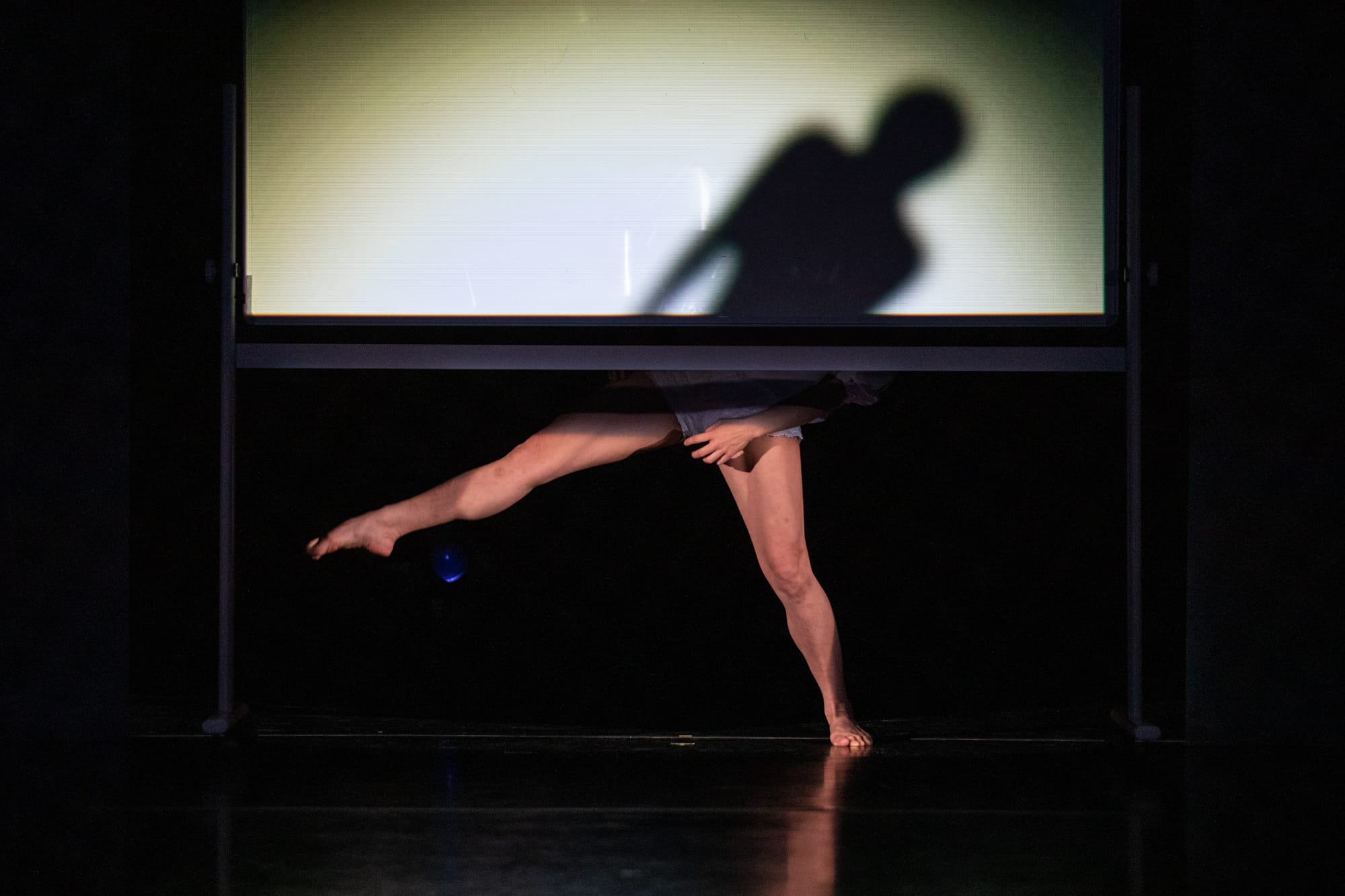
The whiteboard and, later, a wide scrim that covered the stage, became the screens for all the transient and morphing images to come, and through video, Tabaimo’s stylized block prints came to life. The opening two scenes partnered Mamiya with the now illuminated whiteboard. Only the dancer's legs were visible in the large framed space under the whiteboard; her torso was hidden, though the shadow on the screen of the top half of a body at first seemed to be hers-- until it started to move independently, a disorienting and giggle-inducing image. The shadow doppelgänger was a character throughout; her real shadow also loomed through work, crisp and dark in a harsh spotlight.
The precision of Mamiya’s movement was continually tested, needing to perfectly align with the video images. Her legs and arms angled just so; she added delicacy with twirling fingers and swirling movement to etch her own lines in the frame of Tabaimo’s art. She inhabited the art, making her body a part of each environment. In a soft white dress, she also became a small screen, where targeted images showed on the carefully placed canvas of her torso, her feet and arms dark in shadow.
In the fully furnished room of one scene, large drips fell from the roof and windows, and a single huge drop slid down the back of Mamiya’s body. Disembodied hands pulled her through an invisible break in the scrim, as if she’d been sucked out of the space by an energy force. When she reappeared, also invisibly, the image had turned into to an enormous cage, with a dove trapped and enormous, fluttering to be free. The dancer and the dove danced their struggling duet.
Music threaded through each scene, played live in a triangle surrounding the dancer and images. On the two sides of the stage, usually hidden by the scrim screen, were composers Keisuke Tanaka and Yusuke Awazu, playing drums, electric pianos, a cello, bass and French Horn. Tabaimo was the point of the triangle of sound, at the xylophone synthesizer. The shifting rhythms often guided Mamiya’s movement – arms shifting up and down to the drum beat, legs or torso gliding with the score. Tabaimo embraced the contrasts of silence and sound, darkness and light, giving her idiosyncratic texture to each scene.
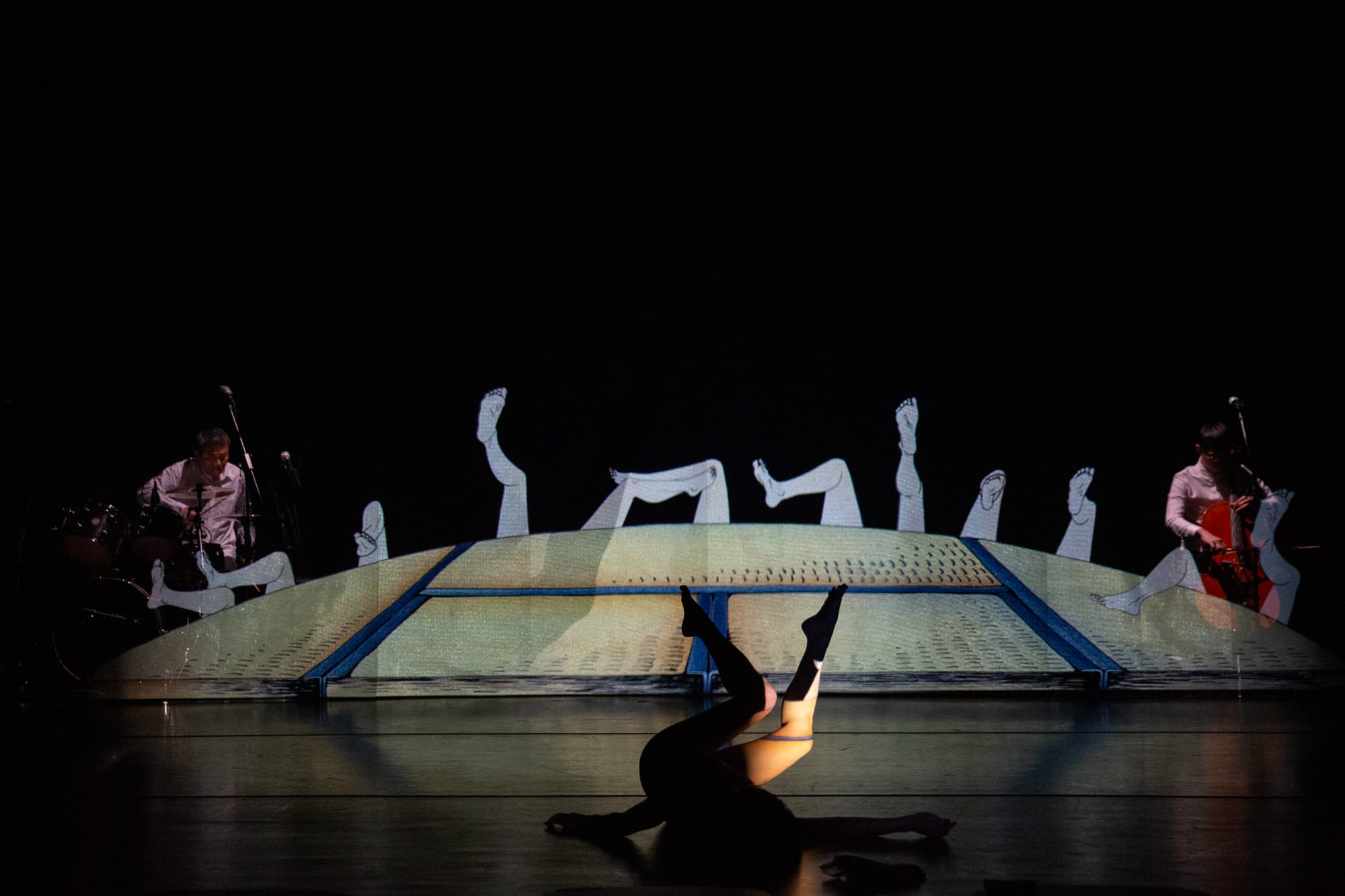
There was so much input, it was hard for the viewer to take it all in, and Tabaimo offered some humor to lighten the load. In a late scene, we were treated to a video kick-line -- Mamiya’s precise live kicks matched with a line of video kicks that were worthy of Esther Williams.
An apt celebration of International Women’s Day, the three female collaborators who drove this work connected personally to its central metaphor. Tabaimo described “Fruit borne out of rust” as a work about their transition, as women, into their lives after age 40. Like the chemical reaction of iron being oxidized, as Tabaimo described, she finds stability from instability, and then progresses to the next phase of instability. For her and her collaborators, the transition is leading to their artistry’s next iteration.
Her images offered conflict and contrast more often than comfort. The dove of peace was trapped in a cage, and Mamiya was framed by windows and dogged by her shadow, as she melted among often jarring possibilities. Tabaimo’s flying strawberry cake, though, was both grand and ridiculous; it was huge sweet fruit, borne out of rust.
copyright © 2020 by Martha Sherman



