Surfeits
Dance Day at The Reach Festival
Kennedy Center for the Performing Arts
Washington, DC
September 21, 2019
An incredible amount of dance was performed in Kennedy Center’s formal and improvised spaces on Dance Day, September 21. From morning into the night it drew a huge audience. I was part of the crowd in the main building’s corridors and theaters, on the terrace overlooking the Potomac River and on the campus’ extension south with its three blunt, new masonry blocks – buildings by the architectural firm of Steven Holl. I saw snatches of diverse dance on video screens placed theroughout the area, but attended only two entire performances, each about an hour long.
At 3 PM, I walked into the Opera House and found one of the few empty seats. I didn’t have a printed program until afterwards, so was looking blind at what seemed an opera ballet, most likely modern but not radically so. Elaborate it was, and the stage was crowded with grotesque figures. Were they fauns these creatures? Many had long tails and some sported what could have been horns or pointed ears. Dancing and singing don’t readily combine, but this production tried relentlessly to make the two activities fuse. The result was curiously static – for all of 60 uninterrupted minutes. Afterwards, I found a discarded program. What I’d been looking at was the operatic musical “Cats”, by Andrew Lloyd Webber, based on a book of poems by T.S. Eliot. The choreography for this touring production (currently at Kennedy Center through October 6) is by Andy Blankenbuhler after Gillian Lynne’s 1981 British original. The audience this afternoon roared its approval, more for the singing than for the acrobatic balletic dancing.
At 6 PM, I went to see what had originally been announced as a revival of “Fives” by the late choreographer Choo San Goh. It had been one of Goh’s most potent works, his melding of neoclassical ballet, Dutch design and and his own questing. It turned out that only a female-male-female trio from the complete piece was shown by dancers (Andrea Allmon, Nicholas Cowdan, Peyton Anderson) of The Washington Ballet. I look forward to seeing all of “Fives” again after many years during The Washington Ballet’s upcoming season.
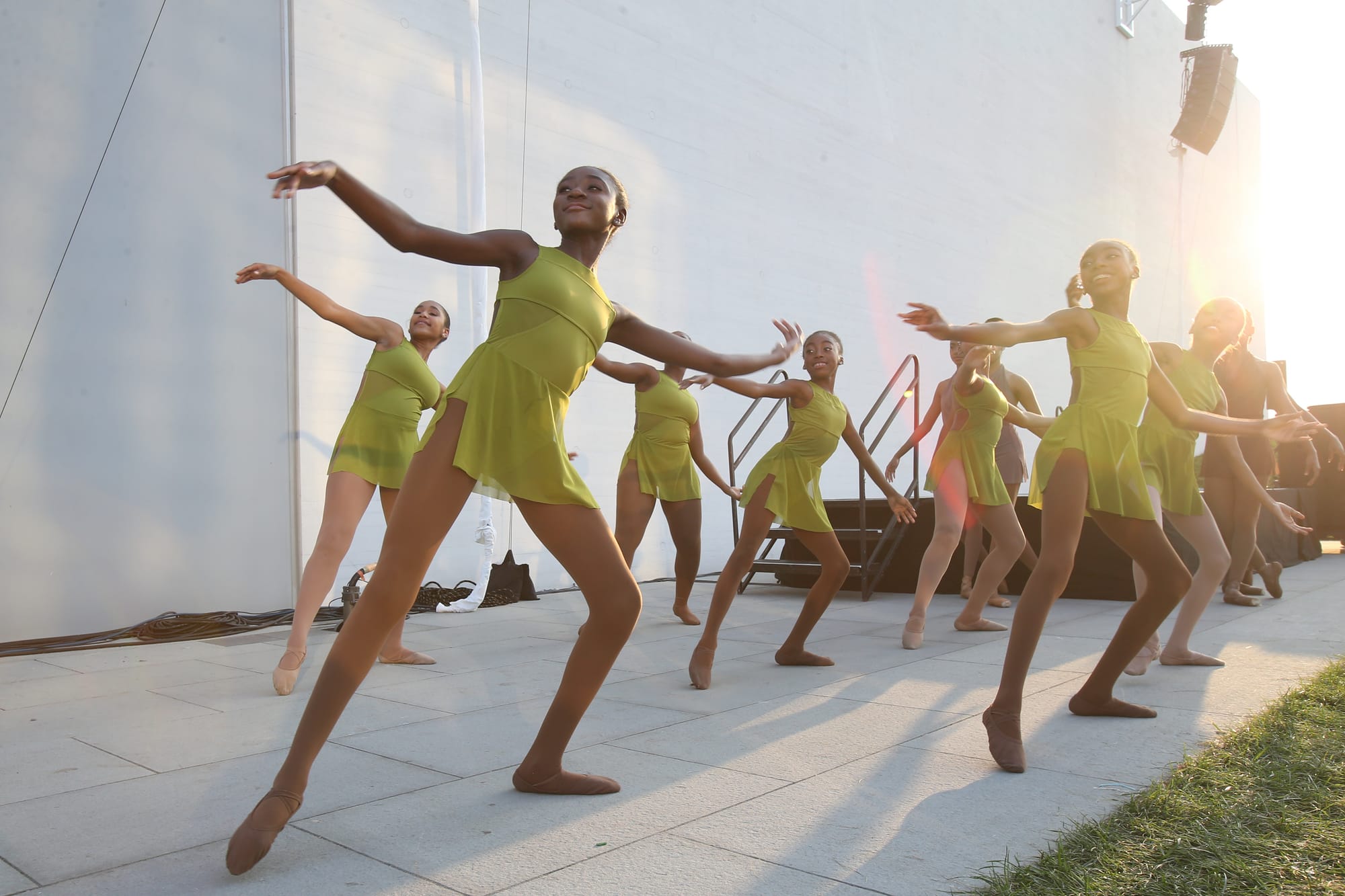
The Goh trio was part of an overview of DC dance, moderated with panache by critic Lisa Traiger. A succession of old and/or current choreographic excerpts was shown on an outdoor stage amidst the new architecture. First, Ms. Traiger mentioned Therrell Smith, who is about to celebrate her 102nd birthday. That lady founded and led a ballet studio for African Americans in 1948 and she still moves astonishingly. Then a group of young African American students demonstrated ballet discipline.The pupils were from the Jones Haywood School of Dance under the direction of Sandra Fortune Green and showed smart choreography by Brandye Lee. Next, Rima Faber displayed the late Pola Nirenska’s approach to weight, continuity and modern-dance tension. Faber had been in Nirenska’s company and had worked as her rehearsal assistant. Nirenska had settled in DC after studying with Mary Wigman in Germany, Rosalia Chladek in Austria and Rudolf von Laban and Sigurd Leeder in World War 2 Britain plus with Ted Shawn after World War 2 in the USA. Faber’s demonstration was luscious, and her explanations were cogent.
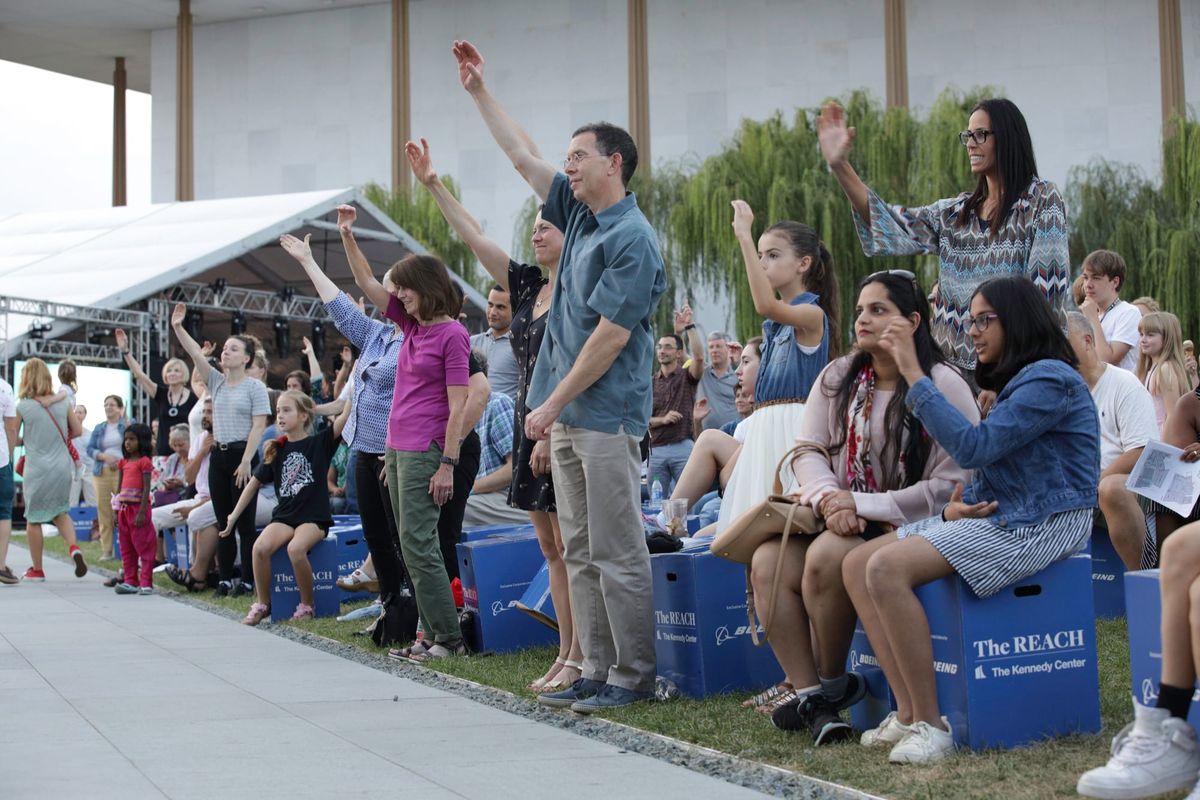
Excerpts of Liz Lerman and Elizabeth Johnson Levine dances led to a sampling of long-time dancer, choreographer and teacher Maida Withers’ modernist, informal group style. Christopher Morgan did a taxing, free-form solo by Carla Perlo who had founded Dance Place. African Heritage Dancers and Drummers dancers swayed and snapped to drumming (by Melvin Deal, from a wheel chair) and to clapping. Many from Capitol Tap, nine on stage and more in the main aisle, signaled rhythmically with shoe work on wooden tap boards. Finally there was audience participation led by Sarah Beth Oppenheim’s Heartstueck Bernie group, concluding the program with snatches of square dancing being done by many.
Kennedy Center wasn’t the only place in DC that featured dance that day. Regular classes were being given all over the area. Rob Bettmann’s Day Eight organization held an arts journalism conclave that included dance writing. And, undoubtedly, some people danced just for themselves!
copyright 2019 by George Jackson