Sunshine and Shadow
"Donizetti Variations", "La Valse", "Chaconne"
New York City Ballet
David H. Koch Theater
New York, NY
January 28, 2015
by Mary Cargill
copyright © 2015 by Mary Cargill
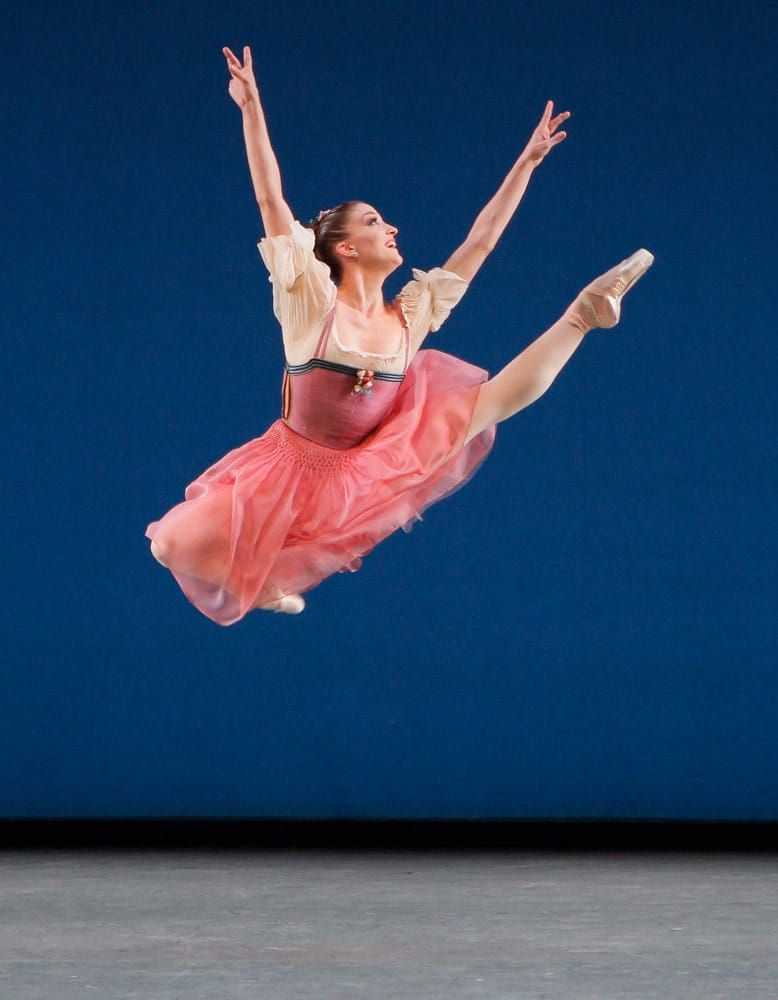
The New York City Ballet's intriguing program showcased three takes on Balanchine's views of romance, each featuring a central couple surrounded by formal corps patterns. The Bournonville-influenced "Donizetti Variations" will probably never appear on anyone's list of Balanchine's greatest hits, but it is a supremely crafted distillation of Bournonville's sunny finales and looks like an excerpt from a lost 19th century work set in an idealized Spain, reworked for modern technique.
Ashley Bouder and Andrew Veyette, who certainly have technique to burn, danced the main couple. Balanchine's bounding musicality suits Bouder's magnetic energy, which she tempers so beautifully with a fluid and creamy upper body. Her pas de chat volés were sky-scraping but she showed a calm and serene center which make it all look so easy, as if she were sitting on air.
However, she wasn't quite able to convey the feeling of triumphant young love that the choreography hints at, and she seemed more of a pal than a bride. Veyette, too, seemed to be concentrating more on his steps than on telling the implied story. His beats, so essential to the choreography, were brilliant, but his heart was still. The corps, especially the three men in their Spanish-inflected trio (Devin Alberta, Daniel Applebaum and Troy Schumacher) were fleet and sunny.
There is no sun in the hot-house, doomed atmosphere of "La Valse", where Sara Means and Tyler Angle made their debuts, with Justin Peck as the Man in Black. Despite some fine dancing this was not yet a cohesive performance. Angle and Mearns seemed at times to be dancing in their own ballets; Angle flung himself into the choreography as if he were eager to join the decadent swirl, rather than being a helpless and heartbroken observer. Mearns made some of her dramatic moments a bit too strong, reacting to the necklace as if she were in an old-fashioned melodrama pushing away liquor offered by the mustachioed villain. At the same time she seemed neither vulnerable nor trapped and her death looked almost accidental. Peck, too, seemed less ominous that the usual dark figure, offering Mearns the gloves and jewels as if he had no idea of their effect and rushing off the stage in a paroxysm of despair when she died. The side couples, though (Lauren King and Antonio Carmena, Georgina Pazcoguin and Sean Suozzi, and Ashley Laracey and Zachary Catanzaro) danced with a heedless, distinctive and desperate abandon and the three fates (Markia Anderson, Gretchen Smith and Lydia Wellington) danced with synchronized and haunting menace.
The stately and majestic "Chaconne" is in some ways the mirror image of "La Valse"; both are atmospheric and illusive, but "Chaconne's" main couple lives in Paradise rather than on the edge of doom. Teresa Reichlin and Adrian Dancing-Waring made their debuts and Reichlin moved through the serenely mysterious opening like a luminous mist, floating effortlessly in her partner's arms. She was less successful in the brighter second half, where the pair share what can appear to be a private and exalted conversation that the audience is privileged to overhear. Reichlin danced cleanly but evenly, giving each phrase the same calm accent and the dances had a rather clipped, dry feel. Danchig-Waring responded in kind, dancing smoothly but rather uneventfully and directing his attention to the audience.
Their companions on Elysium, however, seemed quite at home on that rarefied plain. Aaron Sanz, a dancer new to me, used his tall elegance to great effect in the imaginary lute pas de trios and looked like he was born to dance "Emeralds". Lauren King and Antonio Carmena danced the odd, off-balance pas de deux with a sprightly flair which avoided any hint of cuteness. Even without a completely transcendent lead couple, this ballet is radiantly pure.
copyright © 2015 by Mary Cargill



