Sunny Side Up
"Don Quixote"
American Ballet Theatre
Metropolitan Opera House
New York, NY
July 1, 2026, matinee
Cy Doherty first performed the Don in 2022 as an apprentice, creating a remarkably vivid picture, both comic and tragic, of a befuddled but sincere visionary searching for an ideal. He was equally vivid in this performance, though the new production has turned the iconic dreamer into a silly old man who just wants a young wife. The traditional ballet is about the real (in balletic terms) world of the village; it is not “Sylvia” where mythology and humanity mingle, and having Amour as Cupid appear in the definitely Spanish opening and closing scenes is somewhat distorting. The Prologue now has Amour, the little Cupid who normally flits around in the dream scene, appear and mime shooting the Don with an arrow to the luminous Dulcinea music. Cupid’s arrows, of course, symbolize uncontrollable romantic love, and the current Don does seem to have marriage on his mind, proposing to Kitri, and various other village women. This does confuse the plot (such as it is), since he also helps Kitri’s romance with Basilio by trying to help her escape her pursuers and urging Kitri’s father to finally let them be married. But the Don does play a comparatively small role in the ballet, and even if hormones have replaced ideals, the ballet was a glorious feast of dancing.
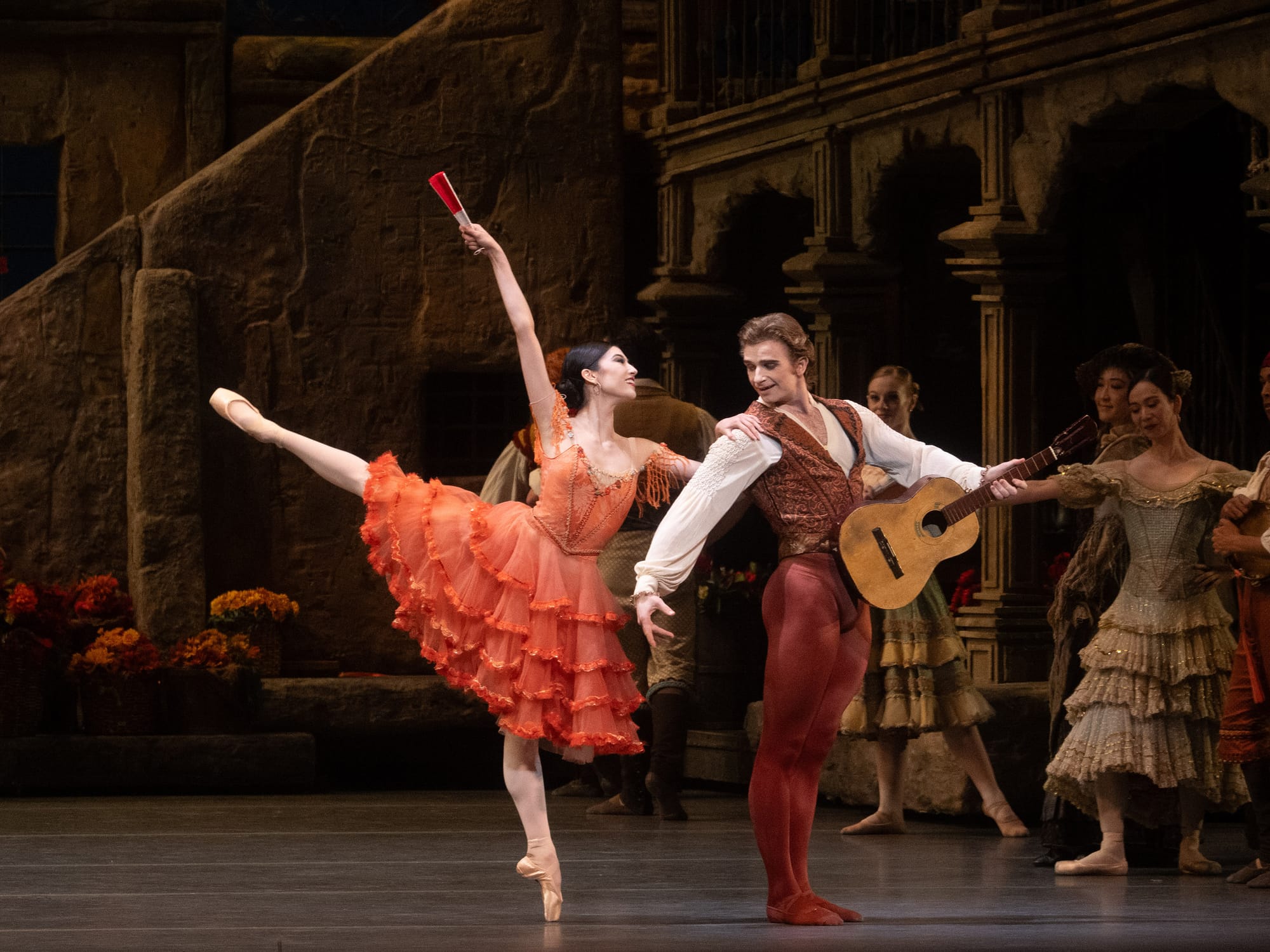
The tall, elegant Chloe Misseldine made her debut; she seemed an unusual choice for the feisty Kitri, but she flew on with a warm and engaging charm, her long legs flicking up effortlessly in some high Plisetskaya leaps. She and her Basilio (Aran Bell) had a fine rapport, and their mime scenes had a witty and natural timing; she used her eyes to great effect, giving him little skeptical side glances to keep him in line. Technically she hit all the high spots, with solid balances, fast turns, and strong footwork, and she seemed to luxuriate in the movements. I especially loved her delicate little pawing feet in her Act III solo. Her fouettés, done without a fan, were solid, with singles and doubles, though she did travel a bit.
Most impressively, her character traveled a bit as well; she gave the ballet a distinctive arc. She was charmingly soubrettish in Act I, a lyrical dream (with very strong hops on point) in Act II, and a radiant classical ballerina in Act III.
Bell was equally fine as Basilio; he was a delightful scamp in the first act, and a very strong partner. His “no hands” fish dive finale was almost nonchalant, and his one-handed lifts secure—he even paraded Kitri across the stage on the final one. The newly added goblet solo was powerful, with every position clearly etched. He had great fun with the fake suicide, looking around to make sure he wasn’t being observed, and carefully arranging his cloak, almost winking at the audience. The final pas de deux was not as flashy as some, but beautifully controlled, with fast, secure turns, elegant tours into arabesques, and strong jumps. But what lingers is the feeling that this was a truly happy couple, that they were dancing for each other. The fireworks were fine, but the warmth and joy was even stronger.
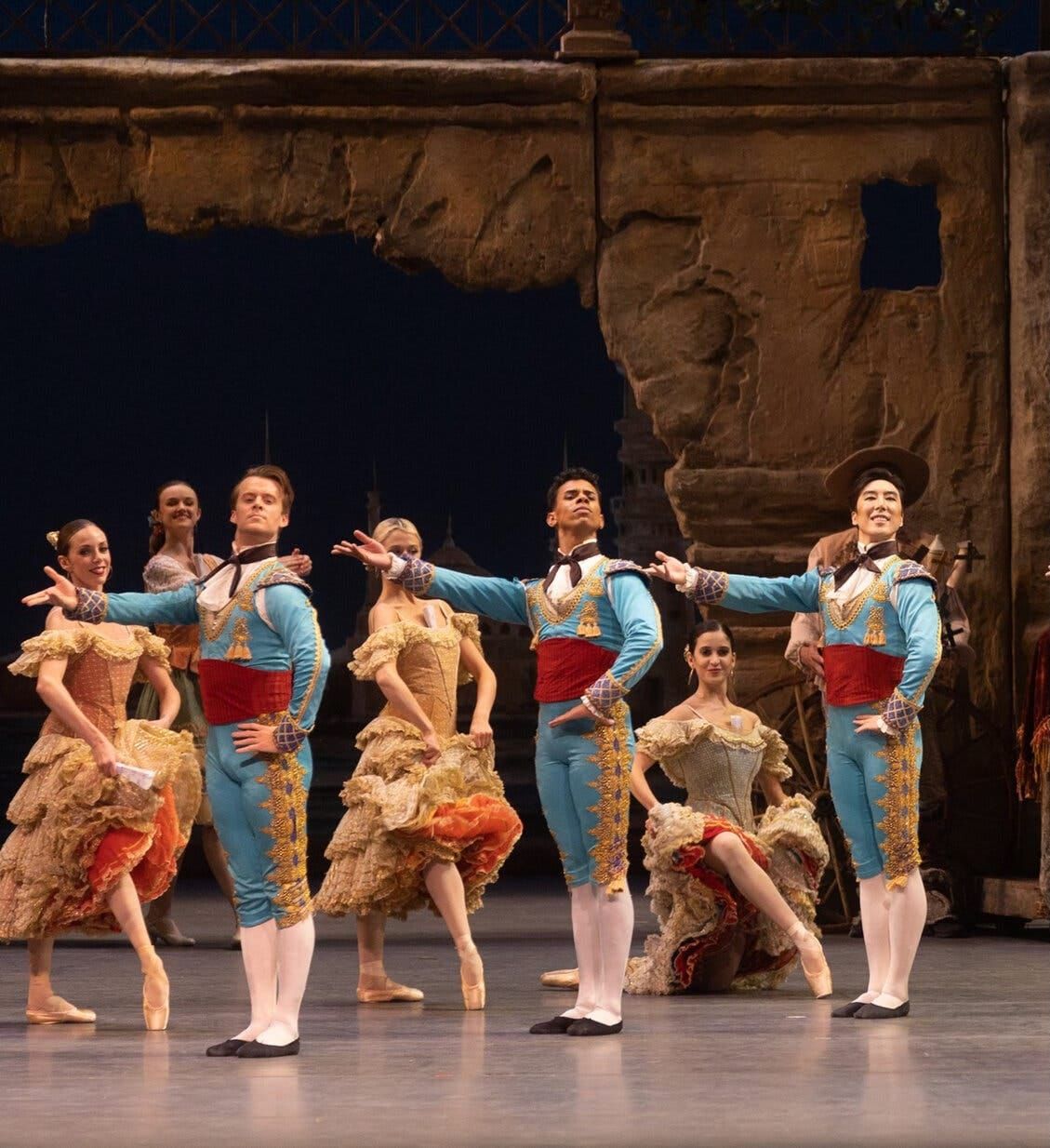
There were plenty of fireworks elsewhere. Joseph Markey, still in the corps, made his debut as Espada. He danced with a flourish, just this side of camping it up (how he loved his cape) and was thrilling. His proud upper body and distinctive, stylized arms would have intimidated the bravest bull. So too would his six fellow toreadors, whose powerful jumps were impressively and stylishly synchronized. Daniel Guzmán, an apprentice, was a flamboyantly confident Roma boy, pounding his tambourine while showing off multiple pirouettes and double tours, and looking very happy doing so.
Ingrid Thoms was a bit muted as the Queen of the Dryads, though her Italian fouettés were solid and her diagonal jumps floated effortlessly. Breanne Granlund as her cohort Amour gave her elegant little solo a soft and flowing quality. Elisabeth Beyer and Madison Brown danced the bouncy little flower girls; their styles didn’t really mesh so the synchronized work was a bit ragged, but their wedding party solos were joyous. Beyer had especially secure turns; her grand pirouettes seemed to revolve on ball bearings. Brown, though she tended to exaggerate her extensions (soft knee-length tutus don’t look great flopping upside down) had a beautiful jump with extraordinarily soft landings.
The corps too, were in on the fun, dancing with a wonderful Spanish-inflected vigor. The classical dream sequence, with its distinctive geometry was, once the Don left them alone, luminous. Petipa, it seems, was playing with numbers, having groups of three and four emerge from the off-center diagonal lines, forming a variety of shapes. These three and four groups appeared again in the wedding scene, with three girls in pink and four girls in orange practically skipping through some delightful emboîtés. For all its technical bravado “Don Quixote” includes, like all of Petipa’s work, a celebration of beauty, and the dancers, from Misseldine and Bell on down, delivered.
© 2026 Mary Cargill