Stylish Moves
“The Sixth Beauty,” “Presto,” “Games,” “The Lottery”
Ballet West
The Joyce Theater
New York, NY
March 26, 2015
With the amount of style, elegance and stature it brought to its first opening night in New York City in over 30 years, Ballet West fit right in. The three New York premieres and the world premiere of Helen Pickett’s “Games” may have been imperfect, but the presentation of each conveyed the unique identity of the Utah company, and did so far more eloquently than their 2012-2013 CW reality TV show “Breaking Pointe” ever could.
Before moving toward the dramatic, the program started with the elegant and mostly classical-looking “The Sixth Beauty,” a work created by Matthew Neenan in 2014 to “Solo Piano Works” by Alberto Ginastera. In “Beauty” the company, dancing in lyrical costumes reminiscent of those for Jerome Robbins’s “Dances at a Gathering,” undertook a presentation of reflections and intimacy inspired by a loss of a child (a sixth child). The first section featured five dancers in various expressions of angst and grief, with a sixth one, Christiana Bennett, standing to the side at the back of the stage and slowly moving along it, as though she were a ghost. The ballet then progressed to a solo-turned-duet from Bennett who was joined by Rex Tilton, and a series of sections with multiple couples and dancers, each showing somewhat different moods, all without losing their elegance.
The work was a great choice for a first introduction to the company, as its emphasis on the body and lines and the push-pull contrapositions of the elongated shapes in the choreography emphasized this company’s almost uniformly remarkable tall, slender and pliant physiques. Although the work was about emotions, the dancers expressed that strictly with the body, with fluid and reaching leg extensions in some places and uncomfortably raised shoulders in others. And they excelled at it, even if at times the ballet did get repetitive and too body-focused, particularly in Bennett’s solo, which seemed to consist almost entirely of admittedly beautiful leans back with a leg extended into a forward tendu, and then leans forward with a leg in a coupé to the back with her facing one of the wings. For all the flux of the group dances, this solo just had too little choreographic meat and felt mostly like a collection of empty lines.
The night’s second New York premiere, the company's resident choreographer Nicolo Forne’s “Presto” set to Ezio Bosso’s Quartet No. 5, was more modern and featured choreography that reflected the music almost to a fault. With most steps falling on notes with little syncopation, this ballet too capitalized on the beauty of the four dancers it employed, and one of the two females, Jacqueline Straughan, with her incredibly arched feet and delicate leg presentation, was particularly mesmerizing. The dance seemed loosely a look at two relationships with glimmers of narcissistic streaks, as the dancers would periodically steal looks at the others on stage, as though to check if the others were watching them. But for the quizzical costume choices – the four dancers were dressed in odd futuristic silver jackets – these preoccupations with attention were almost understandable given the dancers' appeal.
And then came “Games.” Not board games or sports games, but relationship games, played out on city streets, an office room, apartment spaces and cell phones, all in an admitted ode to New York City and the loves it sustains. Utilizing only three dancers, the new Pickett ballet presented a modern love triangle, starting with two women, Allison DeBona and Arolyn Williams, on a date, with one of them, Williams, seduced by a man, Christopher Ruud. His presence created a cycle of the three of them trying to fit in to Claude Debussy’s “Jeux” accompaniment as Michael Andrew Currey’s efficient and innovative set design of two easily rotatable blocks made for easy transitions among the different city settings. Inspired by Nijinsky’s ballet by the same title, the relationships here lacked complexity but were full of complication, as DeBona tried to win her girlfriend back by first attempting to seduce Ruud away from her, then playing on jealousy and at times, though not at all at first, got lost in the attraction that rather shallowly, but somewhat predictably, ended these games with a ménage à trois.
The dancing, again greatly enhanced by the cast’s physicality, exhibited elements of theater as the dancers walked along the stage, showed lightly veiled frustration and deviousness, and plotted or impulsively jumped into their next moves. There was something very natural about their behavior, which made sense as Pickett’s creative process is interactive, and in working on the ballet she urged the dancers to ask themselves what they felt in a particular moment and how a particular move felt.
Unfortunately, despite its naturalism the ballet as a whole still failed to go further than skin deep. The girls' dances may have been full of dialogue, oddly merging love and friendship, but there was no real connection between them, or with the intruding man, and little of the attraction made sense. Their constant use of mobile phones, presumably exchanging text messages, might have looked like an accurate snapshot of the young generation today, but similarly evaded meaning as it was unclear to whom these messages were being sent (it did not seem like they were being exchanged among the trio). Still the ballet was interesting in its portrayal, and it may even be fair to say, a worthwhile critique of contemporary big city dating, and what was lacking in substance was made up for by the dancers’ aesthetics.
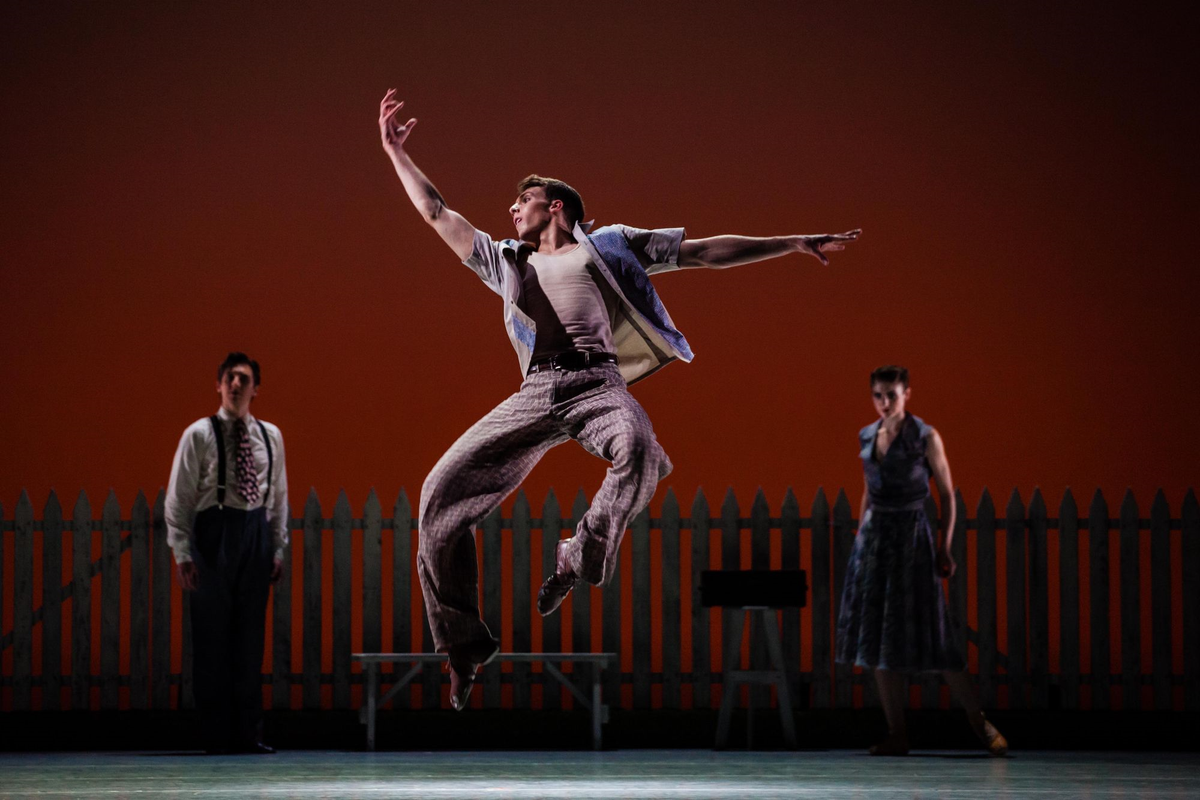
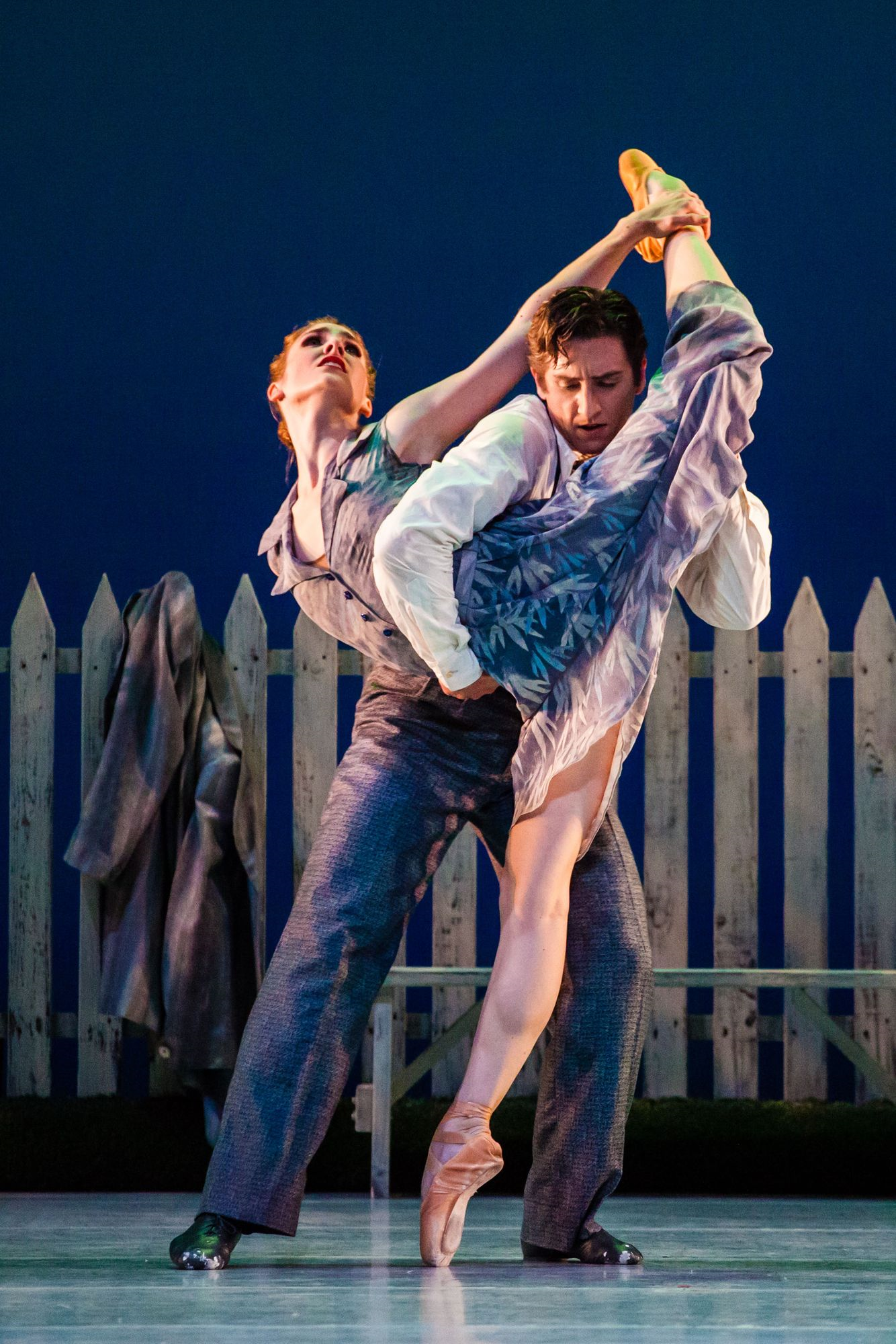
If these dancers had one real shortcoming it was the skill of dramatic expression, as most of their dancing was performed with a cold demeanor of high fashion runway models, and that was most apparent and most hamstringing in the night’s last work, Val Caniparoli’s “The Lottery.” Based on Shirley Jackson’s short story of the same name, Caniparoli’s ballet converted a story about an archaic rite in a small village, where the unlucky chosen one gets stoned to death for no good reason, into ballet form. The work started off with the dancers nervously and quickly picking up stones that lay in the middle of the stage surrounded by a picket fence. As they cleared the space, a postman arrived with a box, and the 14 dancers proceeded to dance duets and solos, expressing their own stories with many stunning arabesques, jumps and aerial lifts.
When each couple had their say, it was time to pick their “tickets,” and the couples approached the box one by one, each taking a folded piece of paper from the box. The “winner” would differ performance to performance, according to the program, and be determined at random by the dancers’ selection of the tickets. On this night the ritualistic opening of the papers as the dancers stood in a circle revealed it to be Sayaka Ohtaki. A very statuesque dancer with eloquent footwork, Ohtaki nonetheless underwhelmed in her expression of desperation as she was ostracized by the rest of the dancers, such that even her scream “It’s not fair!” failed to create adequate drama. Though the ballet’s ending was designed to be thrilling, with a pile of stones (fake) falling from the ceiling, crushing this chosen one and ending the ballet, it instead fell somewhat flat.
Still, if the works Ballet West presented weren’t particularly memorable, the dancers made them so.
copyright ©2015 by Marianne Adams