Stravinsky Times Four
"Dances Concertantes", "The Cage", "Concertino", "Stravinsky Violin Concerto"
New York City Ballet
David H. Koch Theater
Lincoln Center
New York, New York
January 24, 2025
The evening featured four ballets set to Stravinsky, two by Balanchine (“Dances Concertantes” and “Stravinsky Violin Concerto”) and two by Robbins (“The Cage” and “Concertino”). Though they shared the same composer, the ballets were all different, and it made for a varied evening.
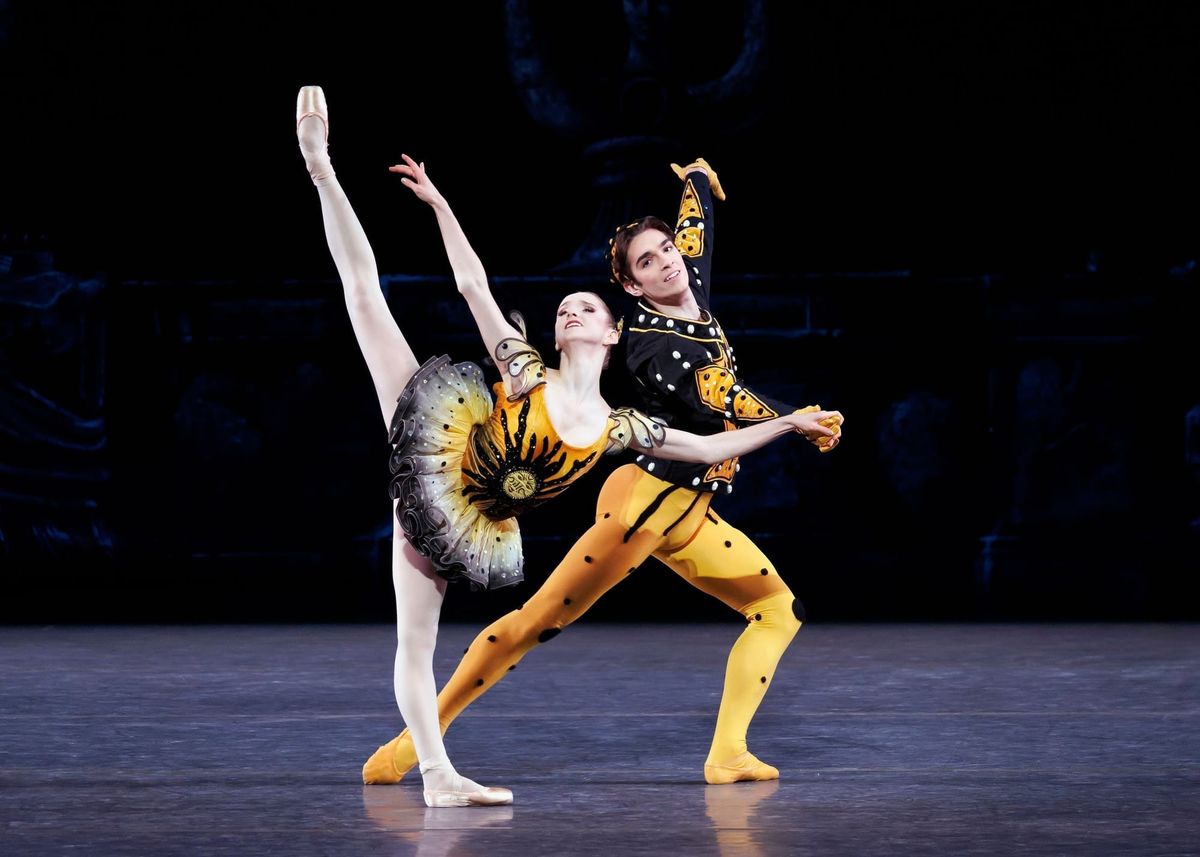
“Dances Concertantes” started life in 1944 for the Ballet Russe de Monte Carlo with sets and costumes in high-40’s chic by Eugene Berman. Balanchine rechoreographed it in 1972 for NYCB’s Stravinsky Festival, but kept the original designs, which evoke a stylized commedia dell’arte, with the tongue in cheek drop curtain acknowledging Berman and a theater within a theater set. The clear, bright costumes look like the traditional colors of Harlequin’s diamond costume grew legs and flouncy, bouncy skirts and jumped on stage, and the four trios and one main couple (Emma von Enck and David Gabriel) made the stage gleam like Christmas lights.
The dance is self-consciously theatrical, as each trio and the duo introduce themselves before the drop curtain with a “come watch us entertain you” flourish before they reconvene in the stage on a stage setting. Gabriel as the master of ceremonies was especially welcoming, inviting the audience into this world; it is rare for Balanchine toso obiously break the fourth wall, and “Dances Concertantes” has none of the serene exaltation of many of his works, but it is a sweet-natured nod to an older theatrical tradition. The choreography is lighthearted, though technically challenging, with some throwaway jokes; the men go into deep plié and seem to forget to move, the women get stuck in positions as the men run back and forth between partners. Each trio gets chance to show off, and all looked sharp and engaged. The red group (Dominika Afanasenkov, Nieve Corrigan, and Victor Abreu) got the most dynamic music, and their swinging shoulders and chugging hustle were wildly applauded.
The heart of the ballet is the long pas de deux for the central yellow couple. It is youthful and charming without being coy and von Enck and Gabriel sparkled. The choreography is unusual for a Balanchine pas de deux as there is little actual partnering and they often dance the same steps side by side. They do hold hands, almost skipping now and then, and the final moment has von Enck posing with her leg behind her as Gabriel turns her several times as he lowers himself down; a quirky and witty finale.
There is nothing quirky or witty about Robbins’ 1951 ballet “The Cage”, a rather fraught updating of “Giselle”, turning her into a 1950’s Freudian nightmare, complete with the wilis in bride of Frankenstein fright wigs. (It is odd that NYCB has no problem with the idea that women are insects who relish killing every man they meet but believes the audience is too fragile to see the word “Tzigane”.) But despite its overwrought elements, it can still pack a punch with a committed cast and this was an especially fine one. Alexa Maxwell, a vividly convincing dancer, was the novice, Emily Kikta was magnificently fierce as the insect who might as well be called Myrtha, Chun Wai Chan had a lyrical vulnerability in the Albrecht role, and Victor Abreu, in his brief appearance as Hilarion, died a convincing death.
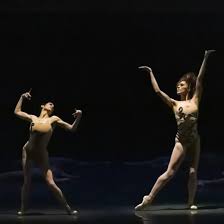
Maxwell gave the role a boneless strength, bending and stretching, rippling her spine and sharpening her hands with an awkward and concentrated power. She was torn in the pas de deux with Chan, fighting to repress her brief spasm of tenderness, and her final burst of fury was almost a surprise—this was such a immediate, gripping performance, it seemed as if perhaps this once, the Novice might relent. But this updated Giselle finally obeyed her Myrtha.
Robbins’ “Concertino”, a surviving section of a longer Robbins work for the 1982 Stravinsky Festival, also refers, perhaps almost unconsciously, to an earlier work, in this case to Balanchine’s “Agon”. It is as if the dancers of the second pas de trois continued their conversation; for me, unfortunately, they did run out of things to say and began repeating themselves.
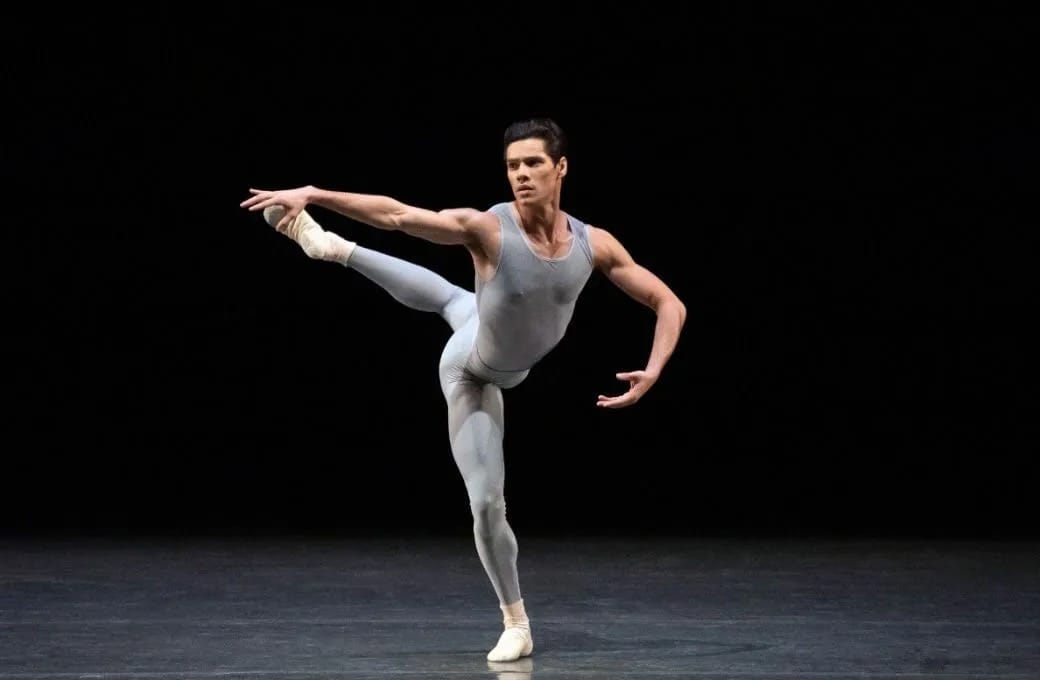
Emilie Gerrity, Jovani Furlan, and Jules Mabie were the trio, the men in grey leotards and Gerrity in a pale blue one. It opened with the three dancing together impassively, showing off various quirky moves and hip thrusts, and ended with Gerrity being carried off stretched out like a horizontal parcel. The final movement was more varied, as each dancer got a solo, beginning with Furlan, who seemed to be exploring his balances and pliés; his arabesques were rock solid. Mabie’s solo was looser and floppier and he danced with a fine quirky timing. Gerrity got the final solo, with sharper moves and triumphant little prances before the two men joined her for the final sudden blackout. It is interesting to watch, if only to compare it with Robbins’ stronger works, and certainly the dancers gave it their all, but it feels like Robbins was being dutiful—a flexed foot here, an off-center balance there and the work seemed to float pleasantly above the music.
Balanchine’s “Stravinsky Violin Concerto” was also choreographed for a Stravinsky Festival, the first one in 1972. Like “Dances Concertantes” he returned to an older work; he used it in 1941 for “Balustrade”, made for the Original Ballet Russe with sets and costumes by the surrealist Pavel Tchelitchev (it was not a success and disappeared after three performances). Unlike “Dances Concertantes”, Balanchine dropped the original designs and used simple black and white practice costumes for his new work. It is an endlessly fascinating exploration of Stravinsky’s music, with two lead couples ( Sara Mearns with Aarón Sanz and Ashley Larceny with Joseph Gordon) with a corps of 18. It opens with introductions, though not, as in “Dances Concertantes”, by acknowledging the audience. Each principal parades in with a group of four corps members, luxuriating in the complex and astringent rhythms. There is no emotional logic to the work as a whole, nor any narrative reason for the frolicking, folk-tinged finale, but it has an astounding musical logic and its complex beauty has moved far beyond the need for linear explanations.
The heart of the ballet is the two central contrasting pas de deux, the first athletic and enigmatic and the second elegiac and just as enigmatic. Mearns was more elastic and pliable than the usual sharp-elbowed gymnastic approach as she wrapped herself around those convoluted shapes, loyally supported by Sanz. As in so many roles, she found her own convincing and dynamic way through the steps. Ashley Laracey danced the haunting second solo with an incandescent vulnerability, with Gordon as her enigmatic protector; they captured undefined yearning of the dance with an understated fervor and gave a magnificent performance.
© 2025 Mary Cargill



