Statements
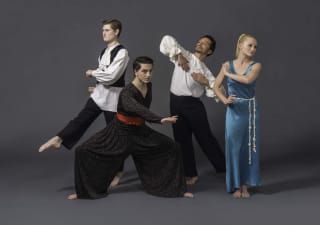
Choreography by Michio Ito and Dana Burgess
Dana Tai Soon Burgess Dance Company
National Portrait Gallery
Washington, DC
March 17, 2018
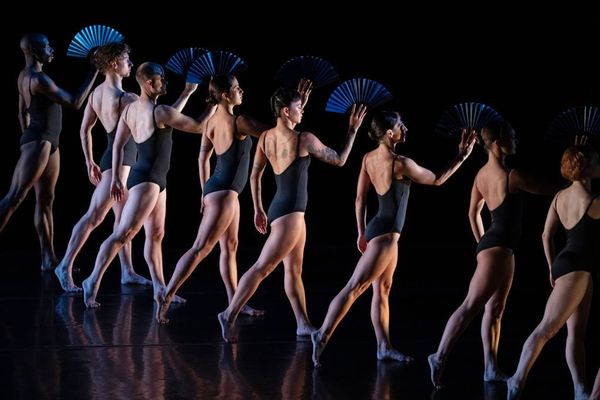
The site of the performance was an oblong salon on the Portrait Gallery's second floor. Prominently on display in addition to the dancing was a large portrait of a female dancer by Ferdinand Hodler (1853 -1918), the Swiss German painter. Hodler shows both motion and pause in his subject's pose, and areas of geometric flattening and of volumetric rounding in her body's contours. The painting's palette is modern, with a purposely limited selection of coloring book, semi-pastel shades. The first three dances on the program, Ito's, were simpler than Burgess's explorations of shifting or conflicting moods in the four other pieces. Most of the dances by both choreographers were solos or duos. Only one work by Burgess required a larger cast - six performers. It seemed, however, not a single entity but a confluence of sequential statements.
Ito's "Pizzicatti" solo (1916) takes some umpapa music by Leo Delibes and milks it for its mechanical possibilities. The soloist’s arms are held stiffly and move like levers that are parts of an automated assembly line or of an airplane's propeller blades. There is a little relief from the persistent staccato rhythm – a passage of flowing arms. The dancer’s lower half stands mostly in sturdy plié. The piece comes off as a Chaplinesque comment on industrialization and modern times. No reason why it couldn’t be performed by either a man or a woman, but I’ve never seen it with a woman. This time, Ian Ceccarelli processed it with vigor and a hint of humor.
In “Ave Maria” (1914), to Franz Schubert music, Ito has a woman’s arms and body sway as if ascending to heaven on the gentlest of winds. The looks she casts back to earth are like blessings. On previous occasions, Sarah Halzak has danced this solo with a Leonardo DaVinci smile that illuminated her features from within. This time, though, Halzak’s smile seemed frozen. “Tone Poems 1 & 2” is later Ito (1928) and to music by Japanese composer Kosaku Yamada. Two figures (Ryan Carlough and Felipe Oyarzun Moltedo) appear to be opposed while remaining persistently themselves. Their standoff seemed a prelude to Burgess’s new “For Giulia”, danced by Ayap and Christine Doyle to Ernest Bloch music. The two women seem to challenge each other relentlessly.
Is Burgess's “Confluence” (2015), also to a Bloch composition, about passing on patterns of behavior, from one couple to the next generations, even though the particular feelings change? “Khaybet” (1999) shows the extent of emotional transformation within one individual – a veiled woman. Ayap revealed (to Philip Glass music) that the woman’s veiling is part of herself but is also imposed tradition, that it is a defense as well as a susceptibility. “Dariush” (1998, to music by Sheila Chandra) is definitely male bravado as Oyarzun Moltedo projected it.
The nine dancers on view were all members of the Dana Tai Soon Burgess Dance Company: Ceccarelli, Halzak, Carlough, Oyarzun Moltedo, Ayap, Doyle, Cristin Arthur, Sidney Hampton and Kelly Moss Southall.
copyright © 2018 by George Jackson