Stand and Dance
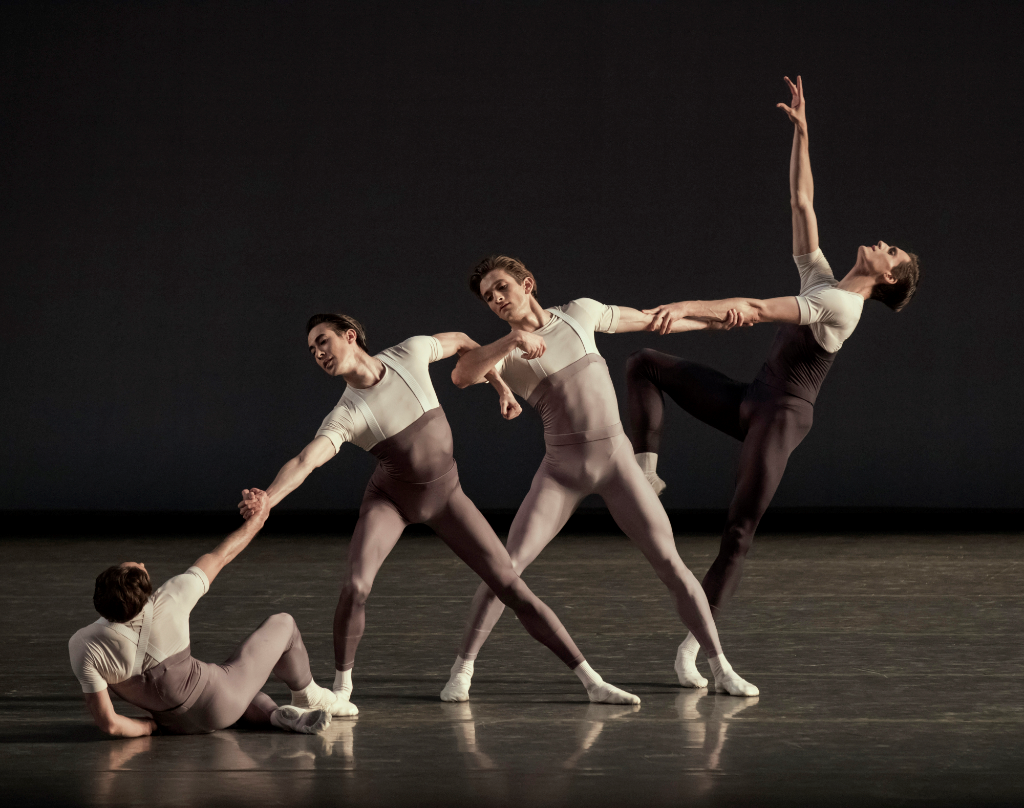
“Chiaroscuro,” “Slice to Sharp,” “Stabat Mater,” “The Decalogue”
New York City Ballet
David H. Koch Theater
New York, NY
May 12, 2017
The main event of the evening was the world premiere of Justin Peck’s fourteenth ballet for NYCB called “The Decalogue,” but as the audience waited for the fresh and new, the company dusted off and presented three ballets of the somewhat old. All dating back to 2006 and into the 1990s, the works that led up to the big reveal of the night were Lynne Taylor-Corbett’s 1994 ballet “Chiaroscuro,” Jerma Elo’s 2006 “Slice to Sharp,” and Peter Martins’ 1998 “Stabat Mater.” All fared well at showing where the company’s recent choreography stood, even if they looked distinctly of a different era when compared to what Peck had in store for the audience to culminate the night.
The first thing one may have wanted to say about “The Decalogue” would be that the ballet is “stripped down” compared to Peck’s other works, but that is not the right word because of how much substance there was in the choreography. “Pristine” fits better. Peck’s new creation to an original piano score by Sufjan Stevens was clean but detailed, not overly busy, not bustling with ingenuity like the choreographer’s other works, but measuringly delivering it.
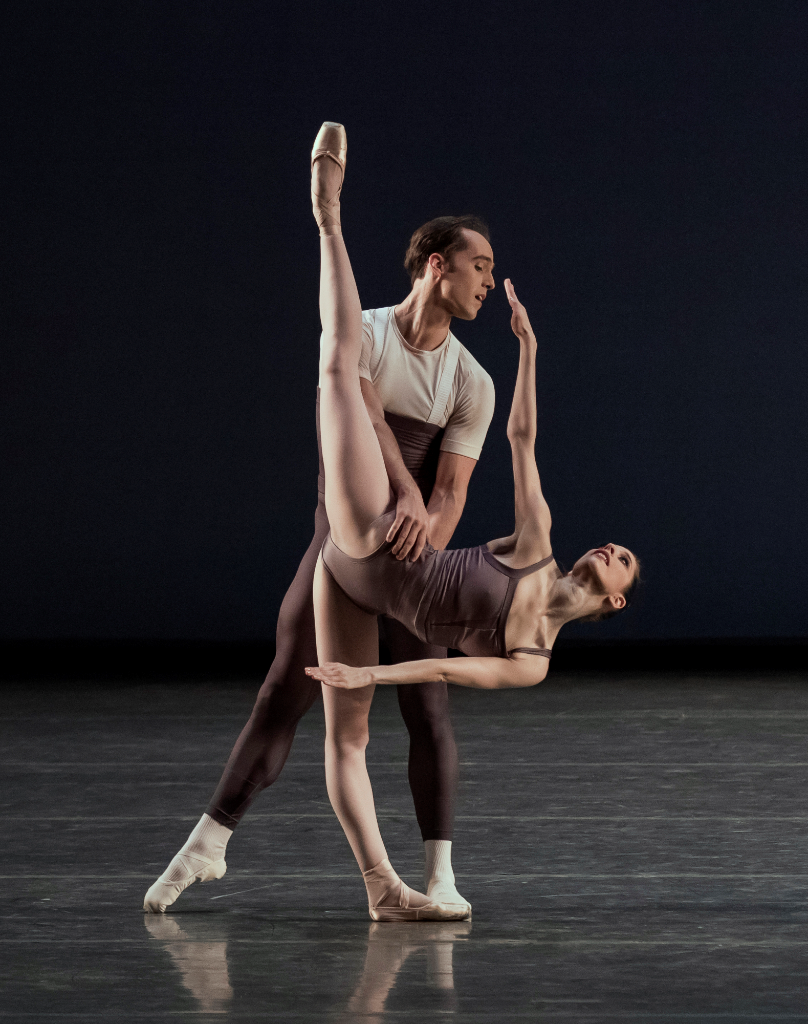
The word “Decalogue” is another word for the Ten Commandments, but the ballet didn’t have any overt religious meaning. It was, however, in ten section and for ten dancers, of whom Sara Mearns definitively looked like the lead, if not by design then through execution. Systematically, the cast, all in tights and leotards by Peck’s design, would dance, then stop, reshaping their movements, repeating a step in another way, and layering different intricacies in the delivery. There was the obvious and the subliminal, like in a lift where the men appeared to be lifting the women up, but were actually holding their arms around and away from the women’s bodies, leaving the real mechanism of the lift up to the women who executed it by pressing up off of the men’s shoulders.
Structurally, the first and last sections were for the full cast, with the rest giving the stage to more individuality and nuance. In the second section, for Harrison Coll and Gonzalo Garcia, we saw two men dancing steps in a mirror image of each other while facing the audience from start to finish, until their leg lifts, jumps and punctuality ended with them facing each other and disappearing into the opposite wings. Then came a section for Kristen Segin and Rachel Hutsell, the latter of whom was at a disadvantage in the form fitting costumers, and a duet between Mearns and Jared Angle, with many body twists.
Several differently assembled sections of duets and group dances later, in the ninth and final one for a smaller group of dancers, Peck signed his ballet with his trademark element. The move that has a dancer lying down and holding one leg up to the front appeared in a lift this time, with the men taking turns lifting a dancer up to execute it. It served as a reminder that while this eloquent dance with many formations and thought-out phrasings may have shown a departure from Peck’s usual jam-packed, energetic style, it was still Peck’s, just new and different, and still very much of this time.
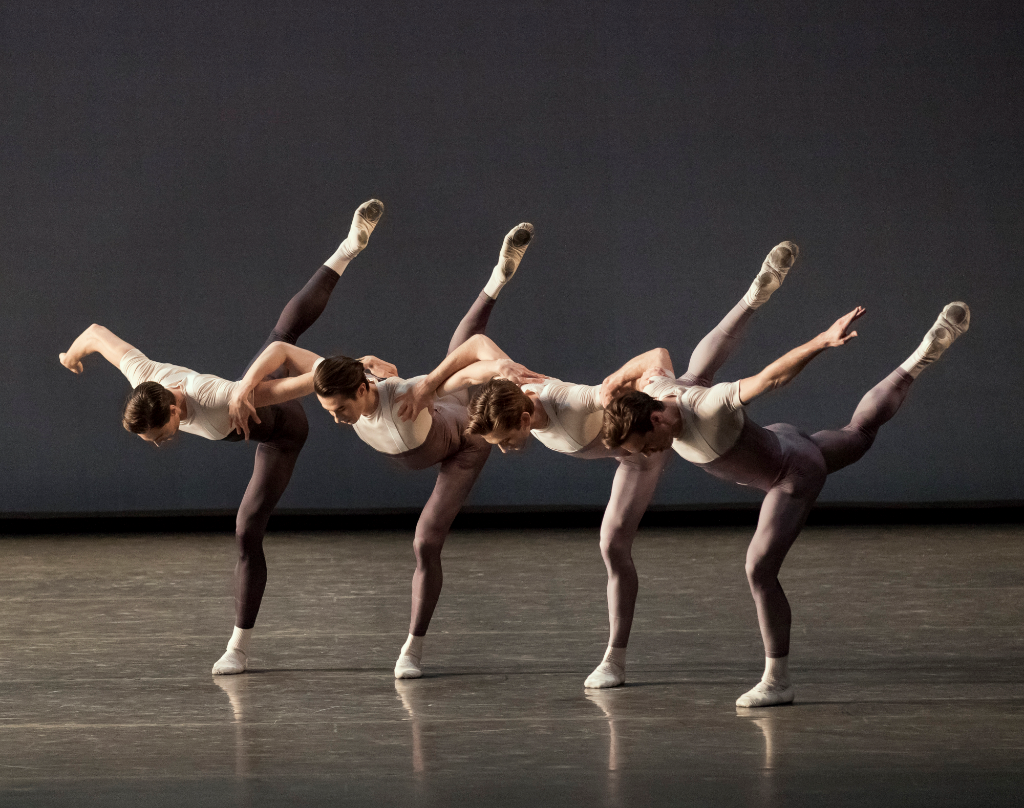
The elements of individuality and clarity of steps that were so central in Peck’s work were foreshadowed by the dances that preceded it. Taylor-Corbett’s “Chiaroscuro” to Francesco Geminiani’s music after Arcangelo Corelli’s “Concerto Grosso La Follia” was a delightful treat to lead off the night, with a cast almost all new to the work with the exception of Brittany Pollack. All the dancers focused on reflecting the shading of the ballet’s modern construction with their own individuality and gave the ballet an attractive presentation, but Lauren King’s almost surprising, inspired lyricism and Peck’s expanse of the steps through beautifully broad arm positioning, left the most compelling impression. The theme of individuality continued in the performance of “Slice to Sharp,” with several dancers seeking to find their own ways to highlight the many stops in the choreography that subtly subdivided the dance into many isolated sentences.
Of the most notable performances in Elo’s ballet, Ashley Bouder’s dancing suggested that the ballerina may have taken the title of the work too seriously by making her movements extra focused and sharp. But while at times this interpretation seemed to be unnecessary, it did add to the overall dynamic of the performance, and as always, Bouder’s precision, which she clearly took pride in, was impressive. Next to her, Maria Kowroski danced with similar accenting, but in a more fluid manner, and while it wasn’t as eloquent as Bouder’s, this approach still fared better than Teresa Reichlen’s attempt to give the steps elegance over any other quality. Of the men, Taylor Stanley almost matched Bouder in precision, coming out of jumps sharply and focusing each pause for an appreciable time.
By contrast with the first two works, Peter Martin’s “Stabat Mater,” the last bridge to the new Peck work, felt like a very long dance. Without debate, its lilting and elegant presentation of an older time to live singing was elegant, but after a few predictable duets, its allure wore thin. It paled more than other works next to the main event of the night.
copyright © 2017 by Marianne Adams



