Smelling the Roses
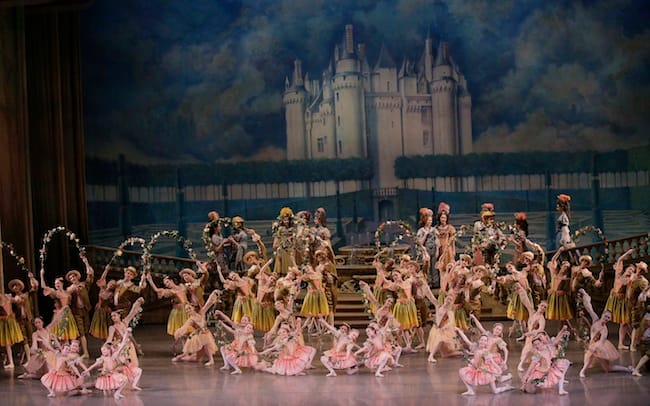
"The Sleeping Beauty"
New York City Ballet
David H. Koch Theater
New York, New York
February 12, 2017, evening
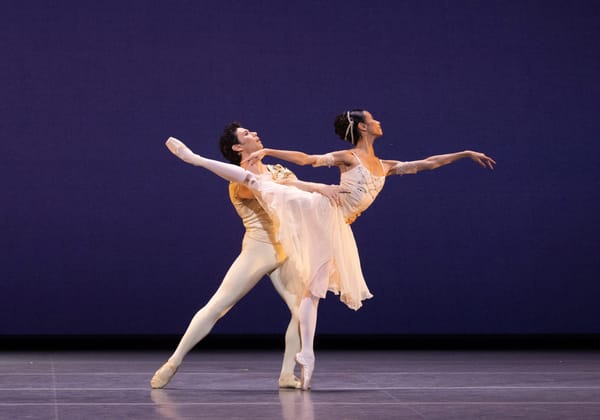
Peter Martins' version of "The Sleeping Beauty" is a bit like the girl with the curl in the middle of her forehead – when it is good, it is very, very good, and when it is bad it is, not horrid certainly, but certainly disappointing. Both aspects were on view Sunday night. Tiler Peck and Tyler Angle as the Prince and Princess were in the very good column, though Peck did take an unfortunate tumble during her entrance. She seemed to recover nicely, though this may have contributed to the sightly muted Rose Adagio. She was musical, exact, and beautiful but not especially spontaneous and seemed to be acting young rather than being young. There were certainly charming details, though, and I especially enjoyed her quick survey of the four suitors to choose which one got to lift her, and her pause to smell the roses before giving them to her mother.
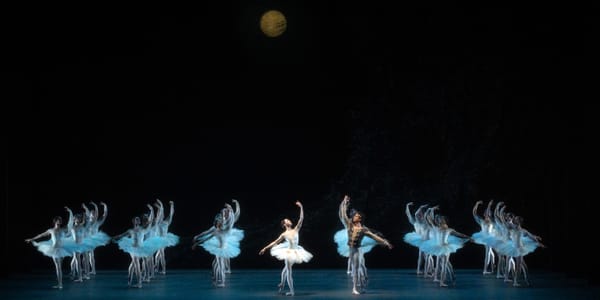
Her vision scene was a little more full-bodied than some, though her quick-silver solo with those lovely reverse développés had a pearly glow. Martins' vision scene is one of the most poetic versions around, with its Giselle-like entrance for Aurora and the silver-tutued nymphs flitting through the traditional choreography, only to vanish in a flash. Peck, with her authority and control, shone in the wedding pas de deux, though the fish dives seem to be the only step that needs speeding up, as the mechanics were clearly visible and the move didn't have its magical snap. Her deep, rich arabesque afterwards, though, was magnificently pure, and she gave it an unusual weight, as if it were a metaphor for the return of order to the kingdom.
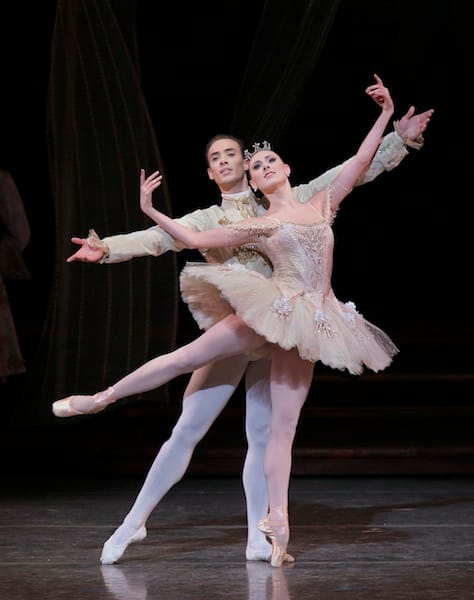
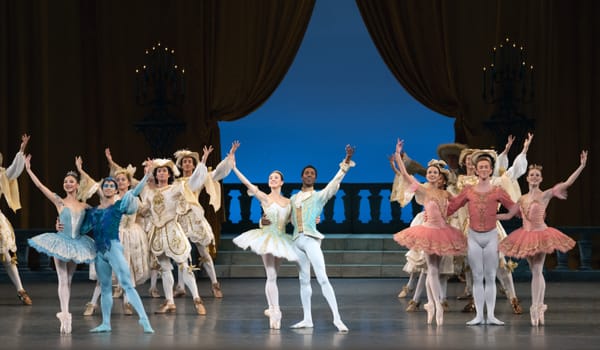
Peck's performance was enriched by her Prince; Angle danced Désiré at the 2002 SAB workshop, and even then he stood out for his gracious and noble demeanor. His dancing was smooth, unforced, and nuanced; he made the interpolated solo in the vision scene part of the story, as he exploded with joy at the thought of Aurora, growing more desperate as he realized he didn't know how to find her. One memorable moment was the pause after the dancing while Aurora nestled on Désiré shoulder before the couple's slow walk to the back of the stage to be crowned, as they stood a little taller to accept the responsibilities of ruling the kingdom with justice and mercy. I'm sure I wasn't the only one who wanted to run off and be governed by such a king.
The other roles, though, weren't always performed with such nuanced understanding. Martins' Carabosse, with her black glitter, is a one-note meanie, a far cry from the petty jealousy and blind vindictiveness, such human traits, of more detailed versions. Carabosse should be a bundle of human frailty, but Rebecca Krohn looked like she was auditioning for a road show version of Snow White's Stepmother.
Ashley Laracey, with her willowy arms and sweet presence danced the Lilac Fairy capably (fortunately Martins did away with the Italian fouettés) but her mime lacked emphasis and she looked like she was saving Aurora soto voce. She also responded to Carabosse's entrance before the music announced it, a bit like an actor answering the phone before it rang. This was only her second performance, so with experience (I do hope this beautiful version returns soon) she may relax.
The various Prologue fairies were not helped by the very fast tempi and were bare able to slam out the steps, much less create individual gifts. Ashly Isaacs and Brittany Pollack as Ruby and Emerald (the steps were recognizably Petipa) had some of the needed sparkle, especially Isaacs. Zachary Catanzaro danced Martins' fast, tricky, and rather unflattering choreography as Gold; this was set on a more compact dancer and Catazaro's legs had a hard time, though his turns were elegant. Savannah Lowery looked quite uncomfortable as Diamond.
Lauren King's sunny presence makes her look comfortable in anything, and she was a cheerful Florine; she deserves slower tempos to do justice to her juicy dancing. Troy Schumacher, as the Bluebird, was a bit small for her, so the lifts were somewhat strained. Though he didn't have all the elevation of some Birds, his beats were crisp and clear. In a small, often throwaway role, Antonio Carmena, accompanied by Harrison Coll and Ghaleb Kayali, danced the head Court Jester with a rakish charm, his hat set at an angle which gave him an irresistible Neapolitan air. And the versatile Aaron Sanz was a funny, fussy Catalabutte, eager, in typical bureaucratic fashion, to blame his lackey for the botched invitation, but dignified and serene at the final crowning.
Copyright © 2017 by Mary Cargill