Six Strings, One Soul
“Vuela”
Ballet Flamenco Sara Baras
Flamenco Festival
New York City Center
New York, NY
March 5, 2026
With truly great artists, it is often impossible to pinpoint the precise source of their magic. Is it the way Sara Baras's fingers slow as they curl into floreo – that signature hand flourish of flamenco – the way she fires off rhythms with machine-gun precision, or the way she suspends motion entirely, lifting her skirt in breathless anticipation before the movement arrives? Whatever it is, on opening night of her company's engagement at the Flamenco Festival, the magic began at curtain rise and did not relent until the audience, reluctantly, finally allowed the performers to leave the stage.
“Vuela” – created by Baras in 2024 as a tribute to the incomparable late flamenco guitarist Paco de Lucía – is a four-act journey organized around four elemental words: Wood, Sea, Death, Fly. On paper that sounds schematic. In practice, it felt like breathing.
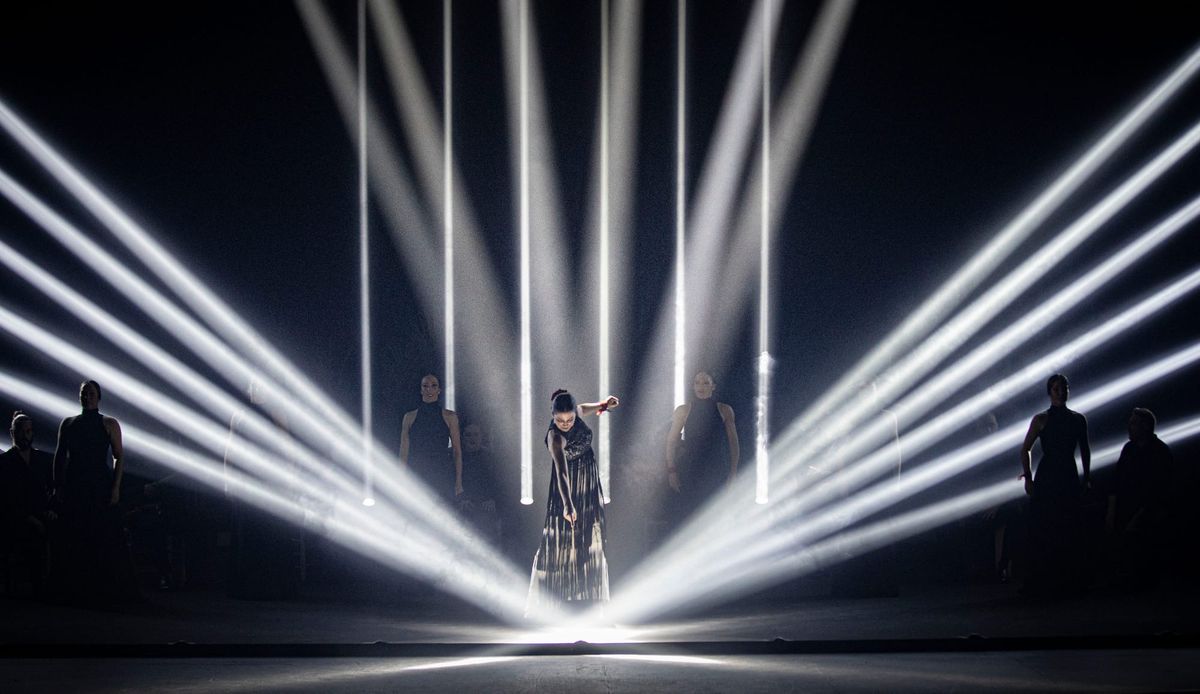
The first act, titled “Wood,” opened with a lone chair at center stage, a red jacket hanging off its back, and silence. As the music swelled, six lines of light were projected above the chair – like guitar strings, summoned slowly into form – an unmistakable invocation of the maestro whose spirit would inhabit so much of the show. Then Baras and guitarist Keko Baldomero walked on stage, moved two chairs to the center, and launched into "Inspiration" – a soulful overture to everything that followed. Baras moved slowly, first with just her hands, as though feeling through the music, soon letting its force spread to her legs and fly through seated footwork, then finally the energy overtook the dancer, and with a reach to the audience, the show began in earnest. Donning the red jacket, her staccato footwork fleshed out the sound, before she yielded the stage to her dancers, who used canes to add layers of rhythm and moved from composed demeanor to broad, radiant smiles.
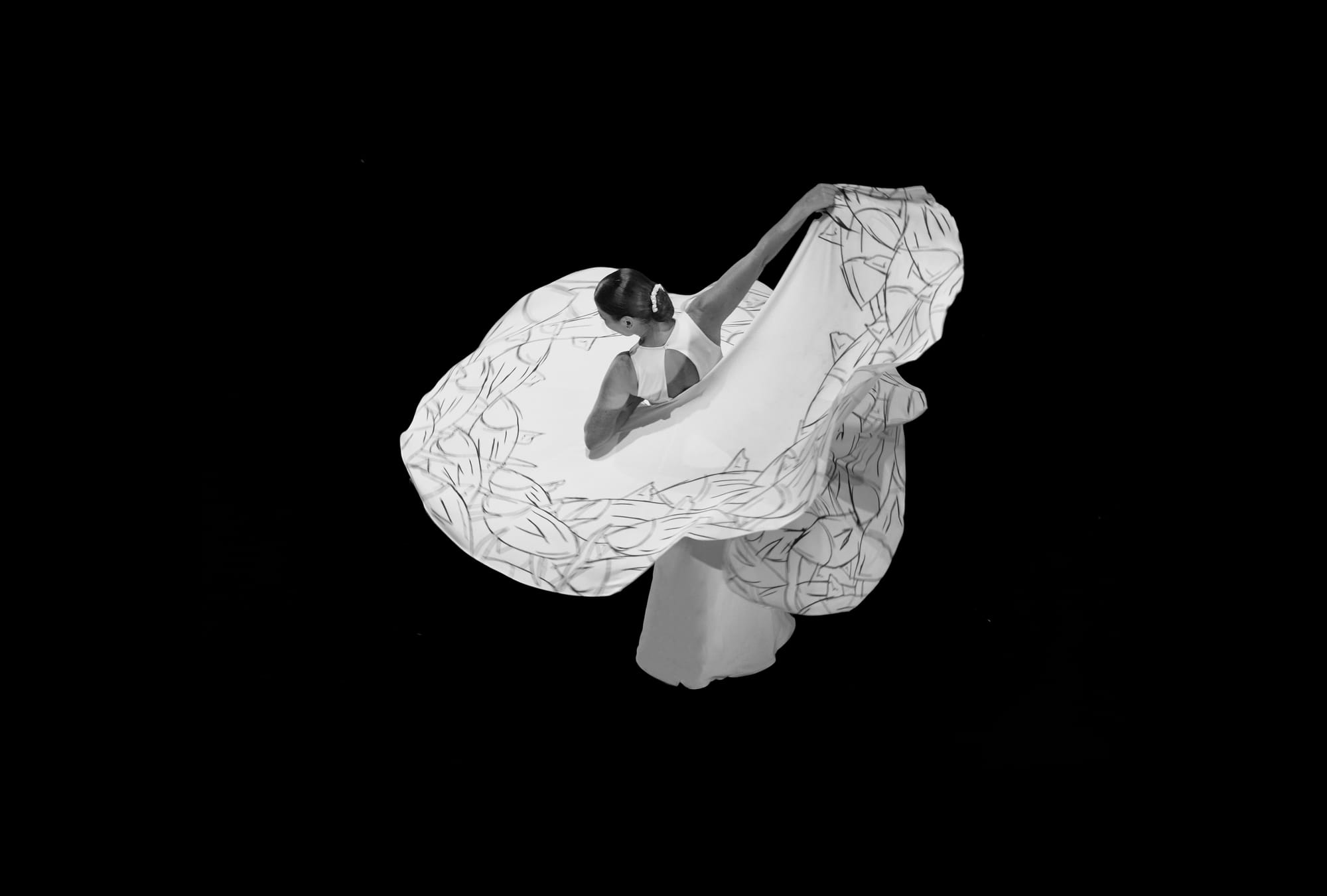
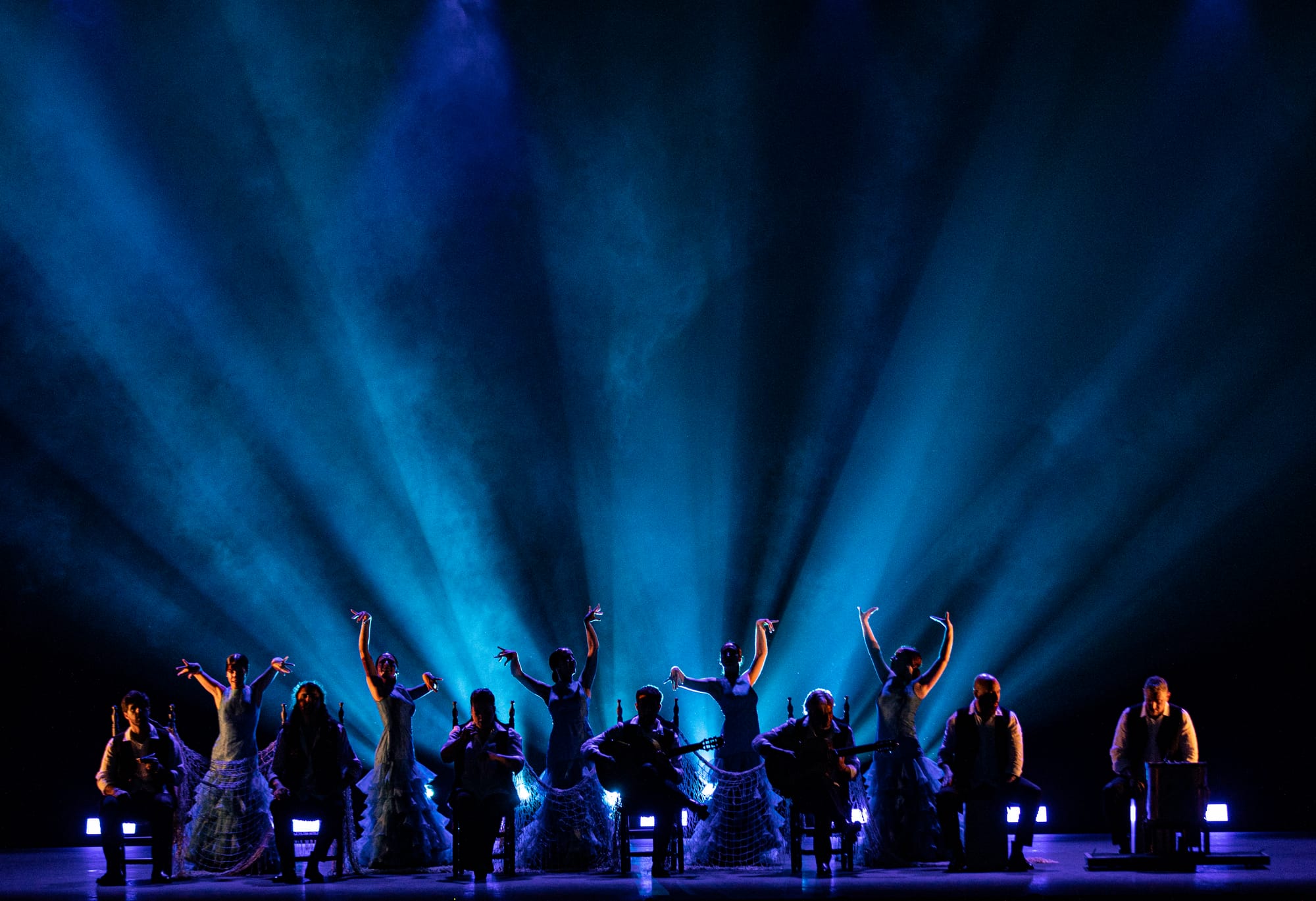
The second act, "Sea," was devoted to passion, though it might more aptly have been titled “Seascape” – so thoroughly did it traverse the textures and imagery of the natural world. Baras first appeared in silhouette against a design looking like abstract swallows in flight, moving through an assortment of classic flamenco poses that showcased the pure, austere beauty of the form. Then she began to spin, and her dress came alive. Forming shapes that evoked sea anemones and orchid petals, the dress was an accessory for sure, but in Baras’s handling it was also a collaborator – a respected partner in crafting the images she wanted to convey. Her footwork channeled energy not as a display of virtuosity but as something wholly organic, as though the music had no choice but to move through her. Soon she was joined by a second dancer whose movements echoed her own, like a mirror image, reflecting and passing on the movement as though carried forth by wind. Baras ceded the stage to five women in blue traditional dresses, but moving quietly like waves thanks to their barefoot dancing, with mantónes that looked like fishing nets. It was a unique dance – classical flamenco married with something modern, and when they departed, leaving those nets draped over chairs that then welcomed the musicians, the effect was quietly poetic: the sea passing its force and bounty to the land-bound souls.
Then came "Death,” and Baras staged it as a Semana Santa procession – the Holy Week rites of Andalucía, where sorrow and reverence fill the streets. It opened with “Mourning,” in which Baras and Daniel Saltares danced beneath a giant incense burner, its smoke curling upward like a prayer and slowly adding an olfactory dimension to the performance. Their duet was ridden with a quiet, respectful contemplation, emotion held carefully just behind their faces, permitted only rarely to surface. Her arms reached in a knuckled prayers, then dropped to her legs permitting them to dance, and then, fog-lit, she came to a chair and knelt. A moment later, her kiss blown gently to the empty seat landed like a goodbye that took years to say.
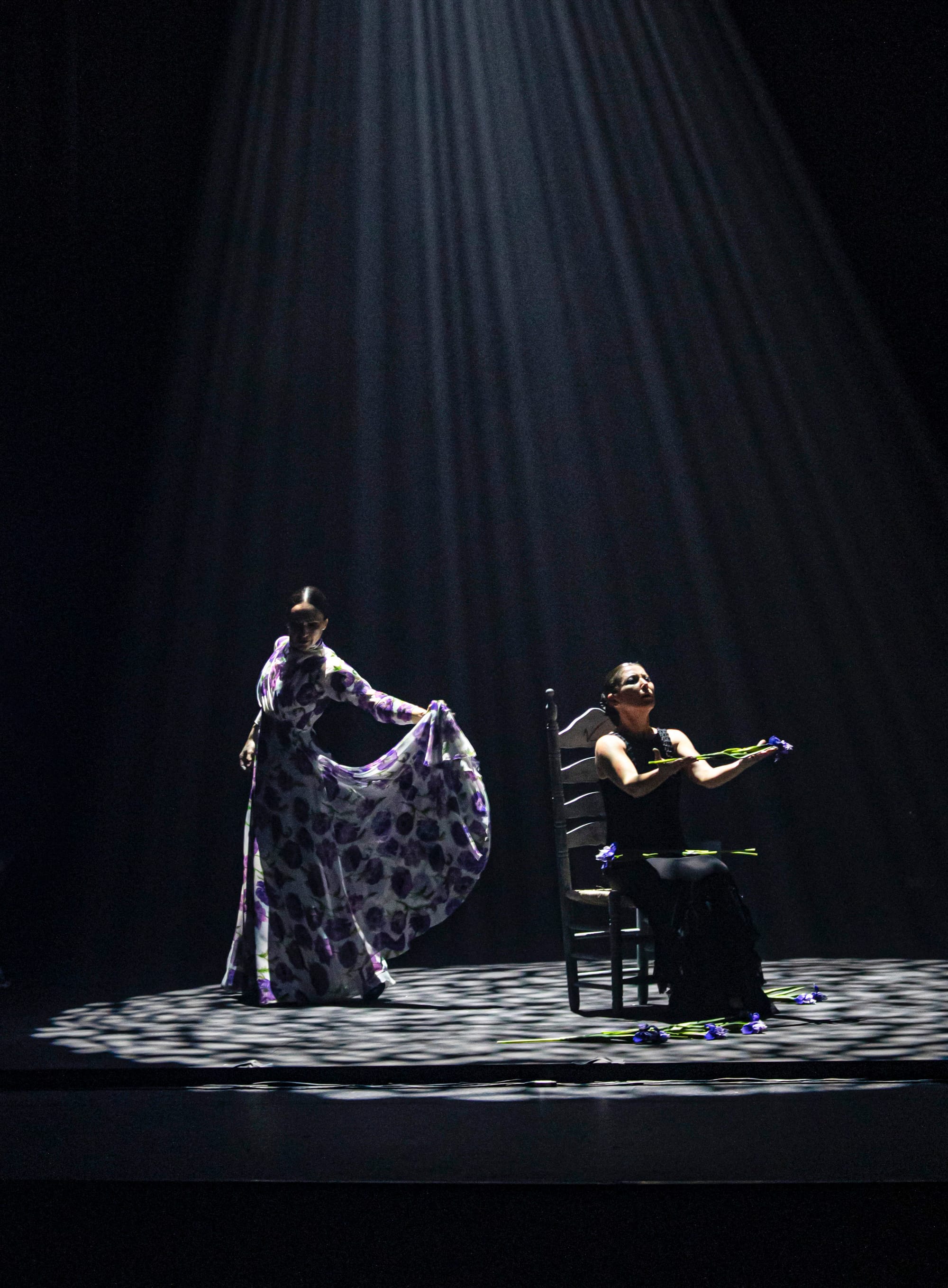
The dance then shifted to another section (“Root”), where Baras’s dancing with singer May Fernández allowed more of the grief. It was a dialogue, and Baras would stop, as the musician would approach her, gently tapping, the rhythm intensifying and slowing, like a tortured beating heart. Although expressive, this story ended with her grabbing her own throat, as if stifling a scream or an emotion she dared not release despite all that was said. Then, just as the act seemed to reach its darkest point, the story shifted. Women drifted across the stage in stunning flowered dresses – a procession of mourners transformed into something blooming, romantic, and alive. It was one of the evening's most haunting images: grief rendered not as darkness but as flowers, the very moment death began its passage into flight.
"Fly" then released everything. The women flooded the stage in colorful dresses for this final chapter, hands moving like wings, then revealing fans. Baras, freer here than at any point in the evening, spun with the spontaneity of improvisation, watching her musicians the way a great jazz soloist watches the room — her hands almost counting the beat, waiting for exactly the right moment to answer a guitar phrase with a spin, a drum accent with a volley of heel-strikes. This energy lingered as the show formally ended, with many encore sections now feeling like the audience was part of this conversation, not just eager observers.
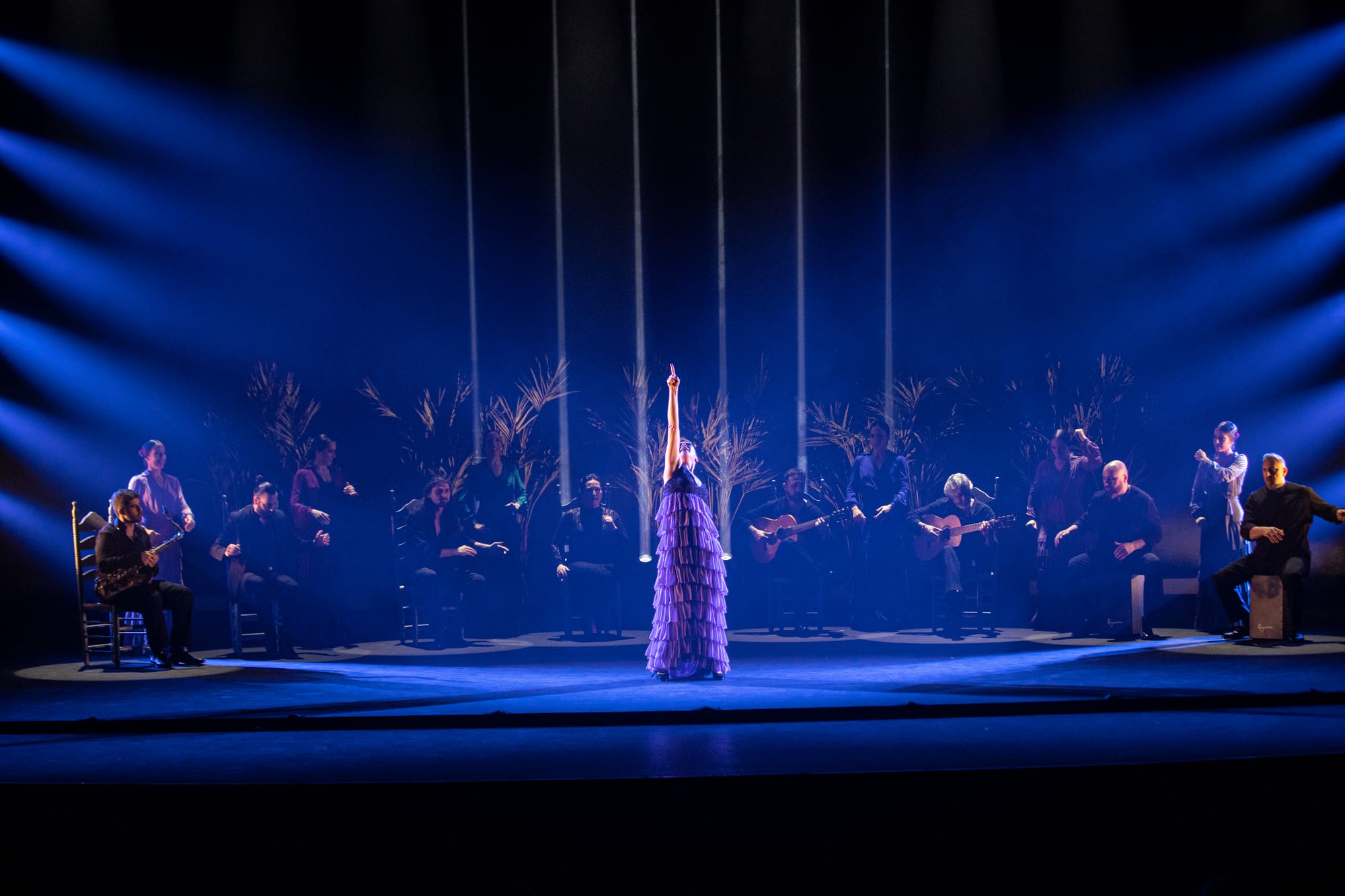
Without a doubt, Baras is, in every sense, the complete artist – a performer whose command of her form is so total that technique essentially disappears, leaving only feeling. “Vuela” proved to be a great testament to that mastery: a show that grieved and celebrated in equal measure, honoring a legend while affirming, unmistakably, that flamenco's greatest living practitioners are very much with us, and they are still finding new ways to fly.
copyright © 2026 by Marianne Adams



