Six Complete the Dozen
Program C: "Bespoke" "Your Flesh Shall be a Great Poem" "Guernica"
Program D: "The Infinite Ocean" "Let's Begin at the End" "Bjork Ballet"
San Francisco Ballet
War Memorial Opera House
April 24 and 26, 2018
Program C. The third evening of unbound’s premieres felt like an example of the direction contemporary ballet is taking. It also probably offered at least one example that everyone could like in this program. Beautifully danced, each of the works highlighted the excellence and versatility of these dancers who often had to radically switch gears more than their bodies might be comfortable with. Stanton Welch’s “Bespoke” showed him as a skilled and experienced choreographer who, hopefully, will be inspired by premieres from his more adventurous colleagues. Trey McIntyre’s slipper ballet “Your Flesh Shall be a Great Poem” is a tribute to his deceased father, and Annabelle Lopez Ochoa’s fiercely dramatic “Guernica” looked at Picasso’s painting as a specifically Spanish work of art.
Somewhat unusually “Bespoke” opened in silence with Angelo Greco – as if being in the class– with big port de bras, tendus, attitudes and quick changes in direction. Some of those brusque arm gestures return later in a work in which, initially at least, ended too obviously on Bach’s downbeat. Throughout I wished that the choreography were not so literally tied to the surface of the excerpts from the Bach Violin Concertos. Baroque music’s rhythms are very straight forward, not always a good source for choreography.
“Bespoke” pleased with its willingness to highlight ballet without a narrative that nevertheless portrays a sense of commonality that the art offers. Set on six couples the ensemble also interacted as a group in stately walks and playful serpentines. Duets came as heterosexual and gender-equal; in several the women appeared to be more assertive than their male partners. Were they spoken for? A quintet for women was followed by a quintet for men. The most adventurous moment came with Isabelle DeVivo’s lowering Ellen Rose Hummel into a kneeling cambré on the floor. It was all quite pleasant, reasonably musical, but “Bespoke” needed a more urgent creative impulse.
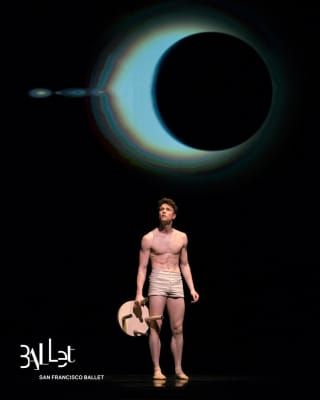
I wish I could have followed some of the lyrics in Chris Ganeau’s songs that McIntyre used for his wistful and engaging “Your Flesh Shall Be A Great Poem.” Its simple incidents resonated deeply; gently suggesting love and loss, sadness and healing. Its protagonist, Benjamin Freemantle, seemed to travel through memories. On a darkened stage he looked longingly at James F. Ingalls’ huge solar eclipse. Each of Ganeau’s songs introduced a different incident: DeVivo and Steven Morse in an air-embracing duet of youthful energy; Jennifer Stahl and Sasha de Sola, both of them in a possible but unsuccessful relationship with Freemantle, and a more physically committed one for Hernandez and the very young Alexandre Cagnat. McIntyre’s vocabulary was simple, clearly readable, distinguished in every sense.
Ultimately our hero was left with a stool which the women previously had used as a podium. It was solid, it was small, it was round. Freemantle made good use of that unusual prop, at first dancing on, over and under it about pain and loneliness. He ended with a beautiful folk-like waltz just as the sun re-emerged from the moon’s shadow.
Guernica is such an iconic work of art that it takes guts to engage it. Ochoa Lopez fearlessly trod into this perilous terrain with a feeling of what is part of the Spanish soul: death, violence, war, fractures; think of Lorca, Goya and, of course, Picasso.
Mark Zappone chose black and white colors for the soloist couples Dores André/ Vitor Luiz and Julia Rowe/Thatchert; for the corps he added yellow to the grey and black elements borrowed from the canvas. Channeling elements from Flamenco and the corrida -- the two couples wore bulls horns -- gave the choreography a mythic quality. The staccato feet and shooting arms, the sharp attacks and the abrupt quality of the lifts, suggested an almost superhuman yet fractured fierceness. The broken wrists, splayed fingers and pointed index shot the energy out of the body — one splattered, the other focused. I am not sure, however, whether the repeatedly falling bodies made the intended impact. But Ochoa Lopez gave SFB a theatrically effective, strongly performed new work. The audience welcomed it enthusiastically.
Alexander V. Nichols' startling set of exploding steam pipes hung threateningly over the stage while the musical sound collage became increasingly raucous but ended with a romantic piano piece. Did Ochoa Lopez feel the need for an uplifting finale? Here it seems odd. As E.M. Foster has written, surprises work best when they have been prepared for.
Program D’s triple bill should have pleased traditionalists and those with appetites for the novel. Tomasson made few programming errors in this festival. But scheduling the works by Edwaard Liang and Dwight Rhoden next to each other was not that good a choice. Both choreographers worked formally in a quasi-abstract territory with soloists supported by small corps; I would have preferred seeing both pieces in a different context. Maybe next season which will include four or five of this Festival’s premieres.
Liang’s “The Infinite Ocean” with a glowing sun just above the ascending horizon line was a well- structured neoclassical ballet that embraced symmetries and mirroring as if they had to hold the world together. Liang divided his dancers into identical trios, into men against women and the other way around. Duets on side of the stage were counterposed on the other side. It was all very orderly, looking almost preordained. Only after seeing “Infinite” did I learn from the program notes that this was a work about dying. I wish I had known. Maybe this is why this blood-red sunset spills its last light on a desert-like space after its inhabitants disappear over the horizon.
The piece opened in semi-darkness with a group of dancers slowly finding partners only to have these couples re-coalesce into a single ensemble. Raised arms looked like pleas, but perhaps also spoke of commonality. Oliver Davis’ appealing score for orchestra and piano puttered along a vaguely minimalistic trajectory but often seemed to serve more as a background than as choreographic inspiration. The Pas de Deux paired Tiit Helimet and Sofiane Sylve in a languid encounter while Yuan Yuan Tan and Vitor Luiz took full advantage of Tan’s still impressive versatility.
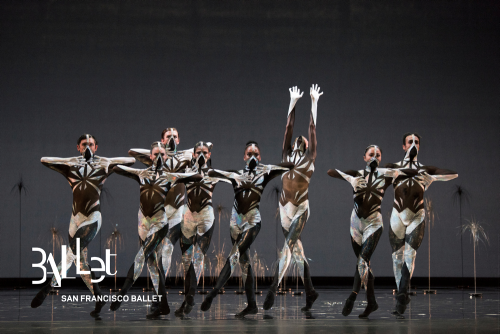
Perhaps it made sense that Dwight Rhoden’s “Let’s Begin at the End” opened with a horizontal line of dancers sitting cross-legged in front of colleagues. Together they looked like a final image, a tableau of ancient pillars guarding a huge “stone” wall. The wall, it turns out had doors through which the performers periodically entered and exited. What exactly happened off stage remained a mystery.
Using an oddly chosen collage of well known selections by Bach, Philip Glass and Michael Nyman, Rhoden focused this intelligent and appealing work on three couples and a chorus of eight who were engaged in an exploration of that universal emotion called love. Using ballet as an expansive vocabulary that would send the performers contracted along floor as well as sailing overhead, this was passion that drew its power from struggle, fatigue and very little contentment.
Frances Chung, by now a powerful experienced dancer, dived head on into a brilliant but almost adolescent looking Angelo Greco. No wonder that hotshot Esteban Hernandez balanced them into an effective trio. Sunny Sasha De Sola and Benjamin Freemantle emitted the sparks that sometimes occur in first-time partnering. The elastic pairing of mighty Jennifer Stahl with Ulrik Berkkjaer showed one more time how excellent an addition to the company this Danish dancer is.
The Festival’s Grand Finale — depending on your perspective — was the high energy, low interest “Bjork Ballet” by Arthur Pita. Last year he horrified/delighted the audience with his “Salome.” The new work partly masked, partly undressed the dancers in Marco Morante's spectacle costumes. Good to see was the short solo for the departing Principal Maria Kotchekova who, later dressed in tinsel and feathers, was carried out like a trophy. The Andres/Ingham couple performed a limb-curling number; Sarah Patten/Birkkjaer a slightly more sensuous one. Neither warrants rescheduling. A downtrodden masked, well performing Wei Wang went fishing with a gold pole but at the end seemed reconciled to the ghoulish freaks and circus environment that was his on-land home. I kept wondering whether Bjork’s “Anchor Song” had in mind the hordes of tourists that are invading this previously tranquil island nation. The audience welcomed this last program enthusiastically. SFB now has two Pita works. That should be enough.
copyright © 2018 by Rita Felciano



