Short Stories
"La Sonnambula", "The Prodigal Son", "Slaughter on Tenth Avenue"
New York City Ballet
David H. Koch Theater
New York, NY
October 9 and October 11, 2013
"All Balanchine Short Stories" was the somewhat cumbersome name the marketing department came up with for the triple bill. It is a bit misleading, since the ballets are really poetic examinations of events , not straightforward narratives. Nor are they "all Balanchine" since in each case, he was assigned the music and the libretto. (This is perhaps why they work so well, since stories were not Balanchine's strong point.) Stories are also not City Ballet's strong point, and none of the three works, despite some strong performances, had a consistent dramatic coherence.
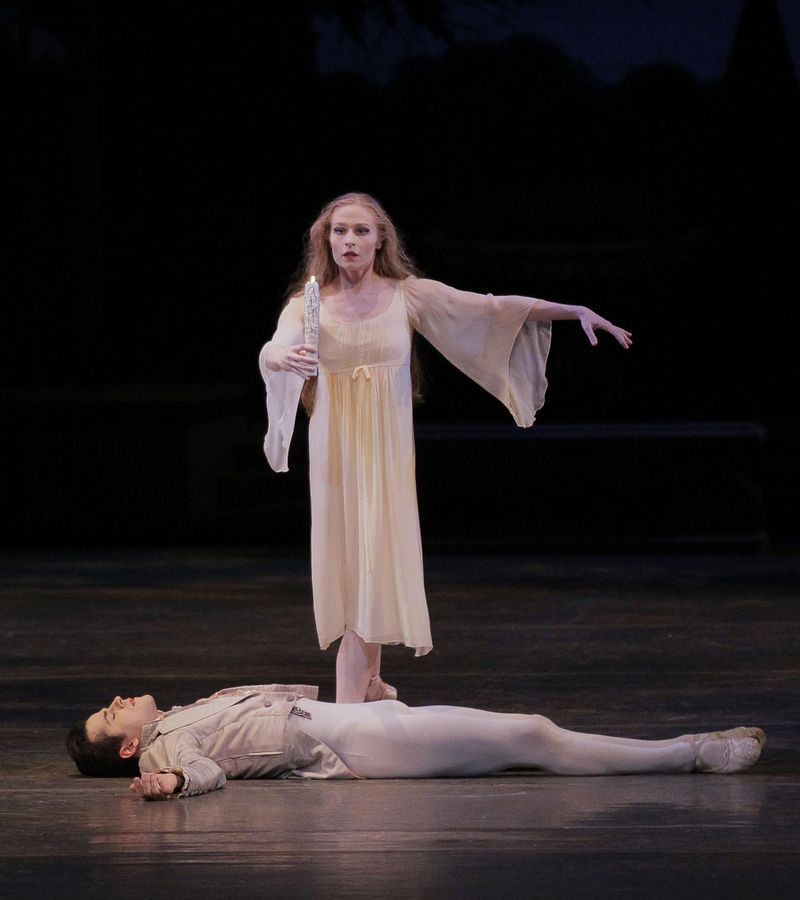
"La Sonnambula" is hampered by its somewhat prosaic set, which ignores the underlying unease and basic weirdness of the events. Of course the original surrealistic designs by Dorothea Tanning, for the original more evocatively entitled "Night Shadow" would probably look hopelessly dated now. Since the audience usually giggles during the haunting, mysterious moment when the Sleepwalker glides over the Poet's outstretched hand, they would probably guffaw at the sight of dancers wearing antlers or boats on their heads. But there is no reason for the Sleepwalker's light not to ascend to the sky during the powerfully simple ending.
The Coquette, Fay Arthurs, had some fine moments, as she was commanding and imperious, but her dancing was a bit choppy and she wasn't able to give the Coquette's various moods a through line. One moment she was snooty, the next in love with the Poet, then she whispered in the Baron's ear, and then she mimed tears. It was like watching a series of often beautiful but unrelated photographs. Her Baron on October 9 was Amar Ramasar, whose "Aw shucks" charm lacked menace. Justin Peck, on the 11th, was more dangerous but a bit lightweight, and the obviously fake mustache and grey streak in his hair looked like a Halloween costume.
Sebanstien Marcovici, the October 9th Poet, is a bit mature for the naive young man, but captured the eager gaucheness of the Poet. But the moment, when he is shut out of the dinner party, which can be wrenching, just slid by. However, the appearance of Janie Taylor, as the Sleepwalker, elevated the ballet to its proper hypnotic level. She swept on with a sense of urgency, her long hair almost tingling. There is something about the shape of her face that catches the light and she looked like alabaster lit from the inside, inhuman and unforgettable.
Sterling Hyltin made her debut, with Robert Fairchild as her poet, on the 11th. Fairchild, an intelligent and imaginative (and very handsome) dancer, looked as if he hadn't really been coached. He seemed assured and at ease, gesturing to the Coquette (Arthurs again) as if he owned the stars shining overhead. Hyltin is a more straightforward dancer than Taylor, and didn't have her otherworldly wildness, but her bourees were beautiful, as she seemed to float. The moment when she senses the Poet's body with the delicate shudder and stylized back bend was beautifully done.
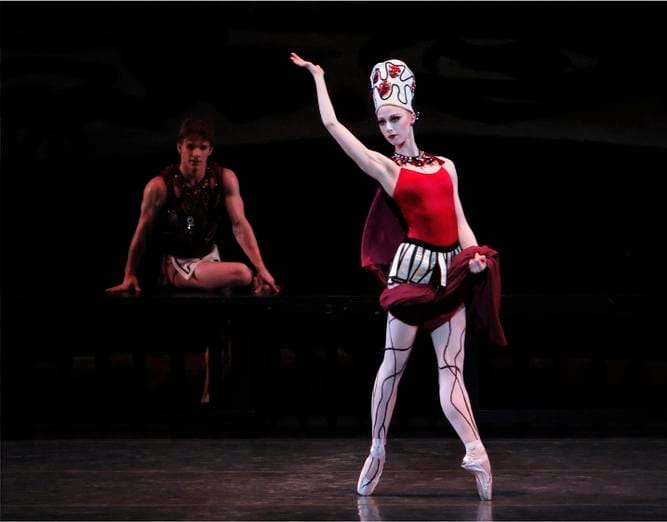
"The Prodigal Son" is another ballet that audiences often find dated, with its long mime sequences. But powerful performances can make the ballet soar. Daniel Ulbricht was the poor prodigal both nights. Maria Kowroski was originally to be his Siren, but Teresa Reichlin replaced her on October 9. This was a last minute change, announced from the stage, so it may be that she didn't get much rehearsal, though the tricky partnering in the pas de deux was flawless. But she seemed a bit dry, focused on not tripping on that cape, and the mime was sketchy. She just seemed to rub the floor gently rather than grab at the money, and was polite rather then domineering.
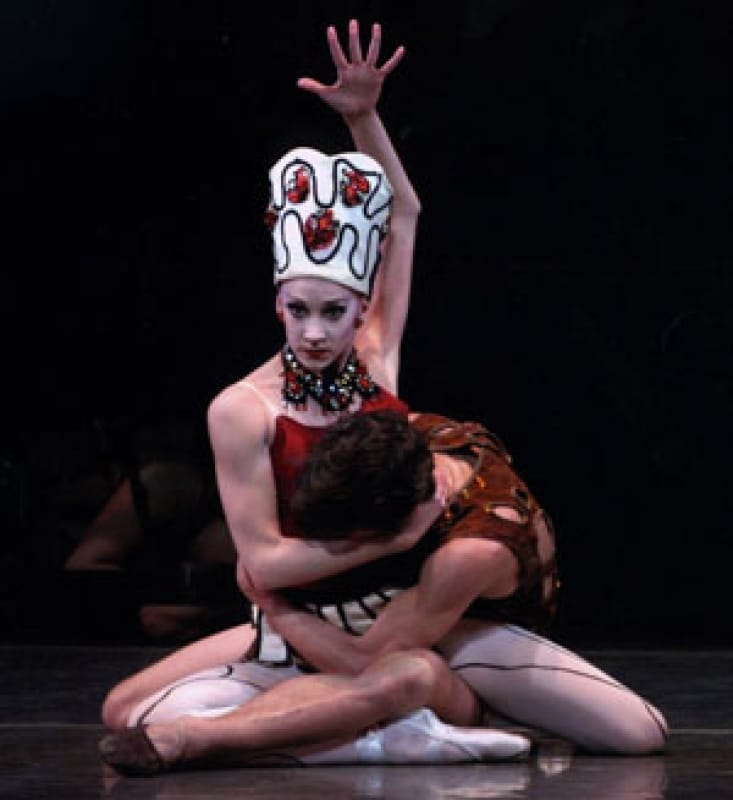
Kowroski did dance on the 11th. She had been Sirening for a number of years, and seemed more comfortable than Reichlin with the snaky, sensuous (but never vulgar) moves. She was able to be both stylized and individual; her hand, crawling up above her head, seemed to have a mind of its own, and she grabbed the money off the floor and clung to it, with her arms wrapped around her body, as if it could keep her warm.
Ulbricht was an eager, heedless Prodigal, and has a role where his dynamic and thrilling technique can make a dramatic point. He was particularly moving in the opening scene, as he yearned for freedom, jumping as if that were the only way he could express himself. The final crawl back was perhaps a bit overdone, though he wasn't helped by Jonathan Stafford's Father, who moved as if he were wearing platform shoes and was afraid of falling. The Father has a crucial role in the final tableaux, as he must radiate warmth and forgiveness, as the Prodigal earns his way back into grace. Stafford just stood there as if he didn't want to move towards his son, and Ulbricht had to generate all of the emotion on his own.
Sara Mearns, as the loyal Striptease Girl in "Slaughter on Tenth Avenue", generated a lot of emotion, and as always, was luxuriously watchable. But for me, she almost overwhelms the work--she is operatic in a what should be a Broadway musical. She has no vulnerability or poignancy; I remember Suzanne Farrell, another powerful dancer, giving the role a sweetness, as if the Striptease Girl had finally found love. Mearns was so enthusiastic that it seemed she would have been happy with anyone. Andrew Veyette was a loose-limbed, charming Hoofer, tapping desperately one more time. And David Prottas was very funny as the best Russian balleyet (he gave the word at least three syllables) dancer, preening and snooty.
copyright © 2013 by Mary Cargill



