Shepherd's Delight
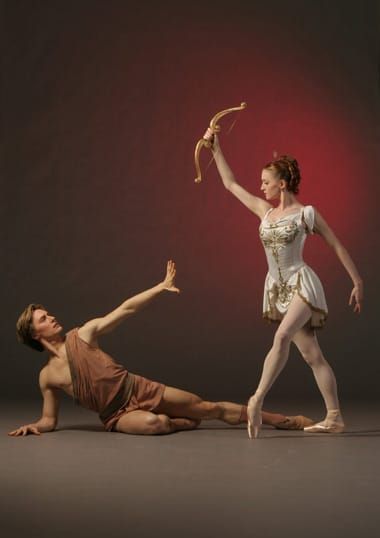
"Sylvia"
American Ballet Theatre
Metropolitan Opera House
New York, NY
June 29, 2009
With the emphasis on "today's audience" and the necessity of filling seats, ballets can sometimes seem to be a mirror, only capable of reflecting the audience's whims, and today's whims includes lots of males doing lots of jumps, or women as pretzel. But art is also a magical telescope with the ability to look both forward and backward, to what might be possible and also to bring the past to life. There is no astronomer through whose telescope I would rather view the past than Sir Frederick Ashton. "Sylvia" is his twentieth century take on Tasso's pastoral paradise, where love can conquer all, reflected through the nineteenth century prism of Delibes' luscious score. There are echoes of Ashton's beloved "Sleeping Beauty" in both the atmosphere and in the actual choreography. Like Petipa's Prince, the hero, Aminta, is guided and protected by a benevolent supernatural power, and he doesn't really have to do anything but be his loving and noble self. Evil exists, but is controllable; there is no feeling, as in the romantic sensibility of ballets like "Swan Lake", "Giselle", or "La Sylphide" that the hero is out of his place, that he wants something unattainable, or that some irrational force is against him. In Ashton's and Delibes' calm Attic world, love may be capricious but once it conquers, all is well.
Since the hero is, by nature, somewhat passive, Aminta is an enormous challenge, which Maxim Beloserkovsky met. The shepherd is not a character in the traditional sense, he is the distilled essence of noble innocence, and Beloserkovsky's classical reserve combined with a profound intensity created a memorable portrait. One of the most beautiful and moving moments in the ballet was Sylvia's vision of him mourning her at the temple of Diana, where he just stood there, a Greek statue come to life.
Sylvia, created for Margot Fonteyn, is more versatile, and, like Aurora, gets to show off several different facets, from the heroic nymph of the first act, to the wily temptress avoiding Orion, and finally to the pure classical ballerina of the final scene. Gillian Murphy was most at home as the first act nymph, defying love with the shake of a bow. Her transformation after being shot by Cupid's arrow (such a lovely metaphor for the inexplicable nature of love) was gentle and moving. She didn't quite get all the seductive wit of the grotto scene, and looked a bit uneasy in the fast and delicate choreography Ashton devised for the final pas de deux, though its beauty was clear.
The various naiads, dryads, fauns, and peasants looked very well rehearsed, and the elegant little footwork was exhilarating. Gennadi Saveliev was menacing as the the evil hunter Orion, and Carlos Lopez was an elegant Eros. Kristi Boone was a dynamo of fury in the small but crucial role of Diana, and meltingly tender when reminded of Endymion, her own shepherd lover. (These stories would not have been completely Greek to Ashton's original audience.) In other roles, Grant DeLong and especially Arron Scott, with his elegant musicality, were great fun as Orion's slaves in what must be the most fun orgy in ballet. It is a shame that the gods can't donate a few horn players to the orchestra, but the ballet is a gentle breeze on a warm day, and welcome anytime.
copyright © 2009 by Mary Cargill



