Serving Two Masters
“Bright,” “Bartók Ballet,” “Tschaikovsky Suite No. 3”
New York City Ballet
Spring Gala
David H. Koch Theater
New York, New York
May 2, 2019
Positive sentiments were very much in evidence when New York City Ballet’s new co-directors Wendy Whelan and Jonathan Stafford opened their first gala with remarks about their dedication to the institution that had nurtured them and to its core values: on the one hand preserving the company’s incomparable Balanchine/Robbins repertory and on the other its continued dedication to new work. And the air in the theater really did seem to have cleared when you looked around at a gala crowd studded with former dancers, from Jacques D’Amboise and Edward Villella (representing the founding generation) to many of Whelan’s contemporaries from the 1990s. Yet the program that followed – where the new work was represented both by an opening bit of fluff from resident choreographer Justin Peck and then an ambitious new ballet by Pam Tanowitz; and the Balanchine repertory by “Tschaikovsky Suite No. 3” (with its “Theme and Variations”) that closed the evening – revealed an uncomfortable tension between the company’s twin goals.
When Tanowitz’s modern dance-inspired “Bartók Ballet” proved unstructured and difficult to watch, while “Theme and Variations” looked under-rehearsed and challenging for the company to dance, you had to wonder whether the two impressions weren’t connected. After ten days where the company danced William Forsythe, Mauro Bigonzetti, Matthew Neenan and Alexei Ratmansky repeatedly and also prepared this gala program, maybe this is how you’d expect Balanchine to look?
But more precise description is called for.
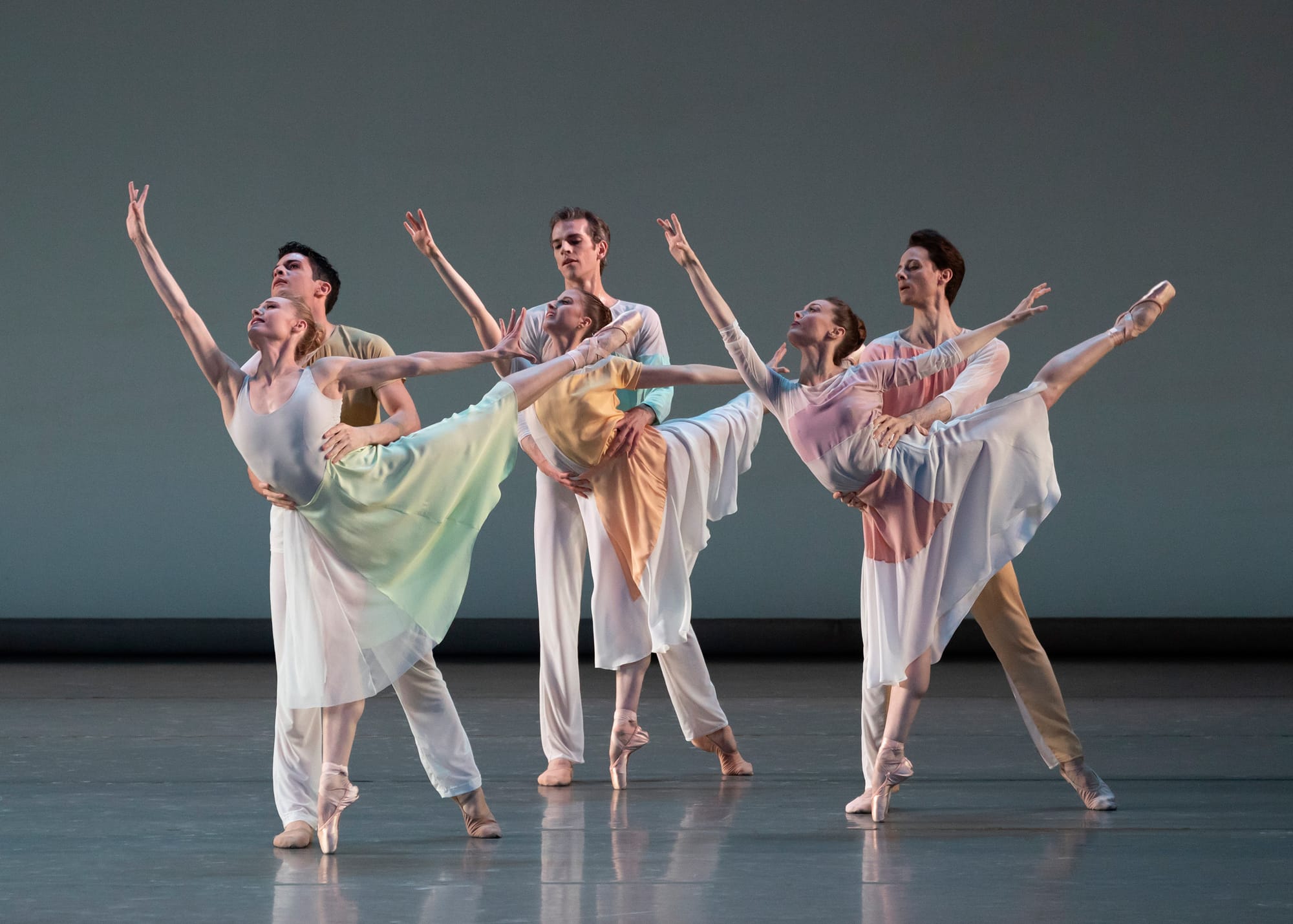
To call Justin Peck’s “Bright,” the evening’s opener, a full-fledged ballet would be a reach. At six minutes long, its score by Mark Dancigers was more a series of orchestral fanfares than an independent composition and Peck’s choreography followed suit. The wave-like music was the kind you’d expect to hear opening the Oscar ceremonies and Peck’s choreography what you’d expect to see there as he deployed three attractive couples in various decorative poses and actions, none of which amounted to much. Dressed by Reid Bartelme and Harriet Jung (who also costumed Pam Tanowitz’s ballet later in the evening) in loose chiffon clothing of pastel shades, and clearly lit by Brandon Sterling Baker, Sara Mearns and Russell Janzen were briefly a leading couple, doing some generic arabesques and promenades. Emilie Gerrity (a most promising soloist we see too little of) did some similarly formulaic moves with Andrew Scordato. But then abruptly the curtain came down. “What, that’s it?” said the person sitting next to me. “Why would Peck have done this?” one wondered. But when the lengthy Tanowitz composition then took the stage the question was answered. Time seemed to be the issue. If the evening had opened with “Bright” and Whelan and Stafford had only then taken the stage to speak, Peck’s number would have seemed appropriate.
Pam Tanowitz of course is a name being touted right now in choreography. With new works performed, or about to be performed this year by the Martha Graham Company, Paul Taylor’s Modern American Dance and NYCB, and another new ballet commissioned by NYCB for next year, it’s hard to think of a hotter name in contemporary theater dance. And truly there is substance behind the reputation. “Bartók Ballet” (named for its music, the composer’s “String Quartet No. 5”) was intricately worked, packed with thoughtful choreographic content and rehearsed to the nines. The trouble was it was also a fantastic miscalculation.
At about 35 minutes, the music is long, squeaky, dissonant and structurally difficult to decipher because the sections aren’t much differentiated from each other. The stringed instruments saw away. Things slow down, speed up and slow down again but no discernible melody ever emerges. Towards the end a hint of a ghostly mazurka is heard for perhaps five bars. This is not the sort of thing that readily lends itself to dance, although it can be the base for a strong dramatic mis-en-scène of the kind, for example, that Paul Taylor made for “Orbs,” a piece that Tanowitz’s ballet superficially resembles.
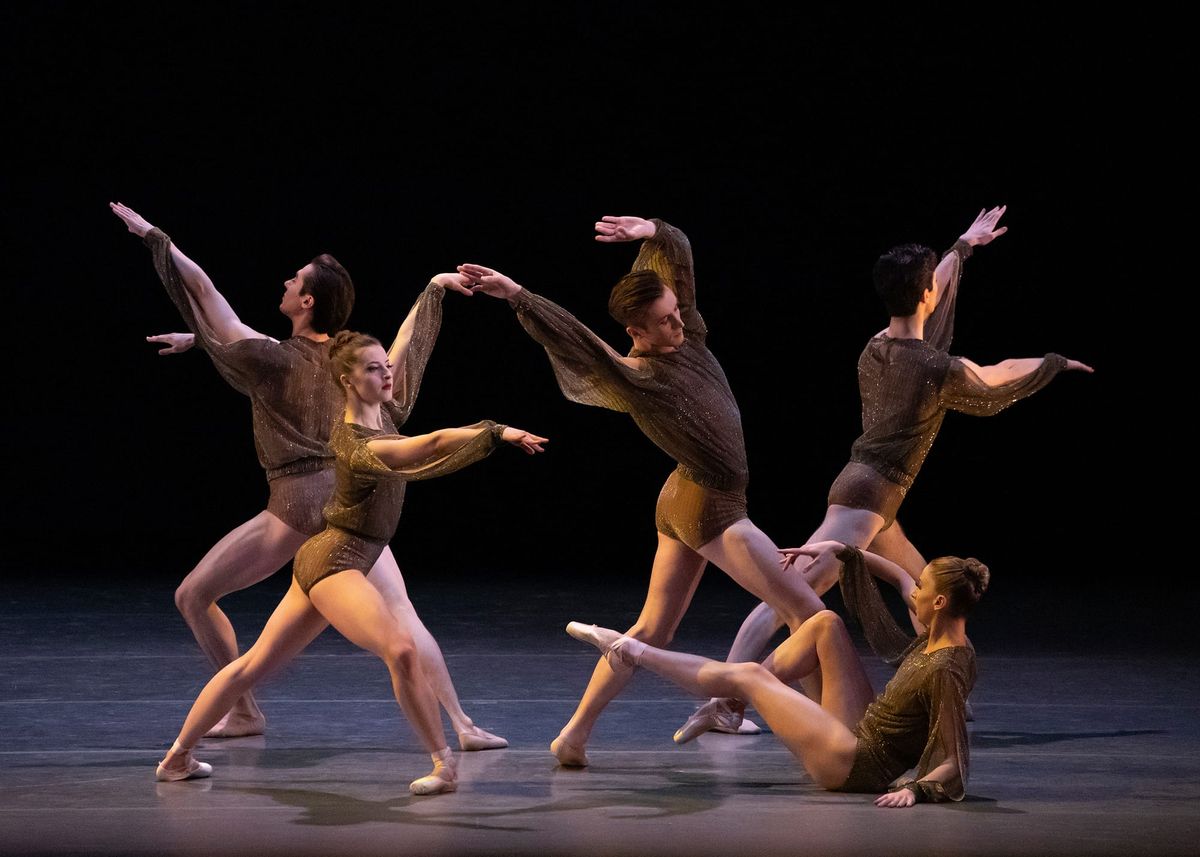
But unfortunately, instead of providing a clear thematic scenario or a well defined series of dances to supply the structure the score lacked, Tanowitz chose to free associate choreographically, having her dancers do small twitching or hopping sequences of five or six measures before stopping and alternating mechanical-looking ballet moves. Resembling insects trying to do ballet, the dancers skittered about the stage, stopped and did battements to the side or relevés, all as if responding to automatic control and then repeated those motions. Against the incessant sawing of the music, the idea of emphasizing everything that’s repetitive and mechanical in how ballet dancers move was an interesting idea. But was it a good one? Beating one interesting idea to death does not make a successful work for the stage.
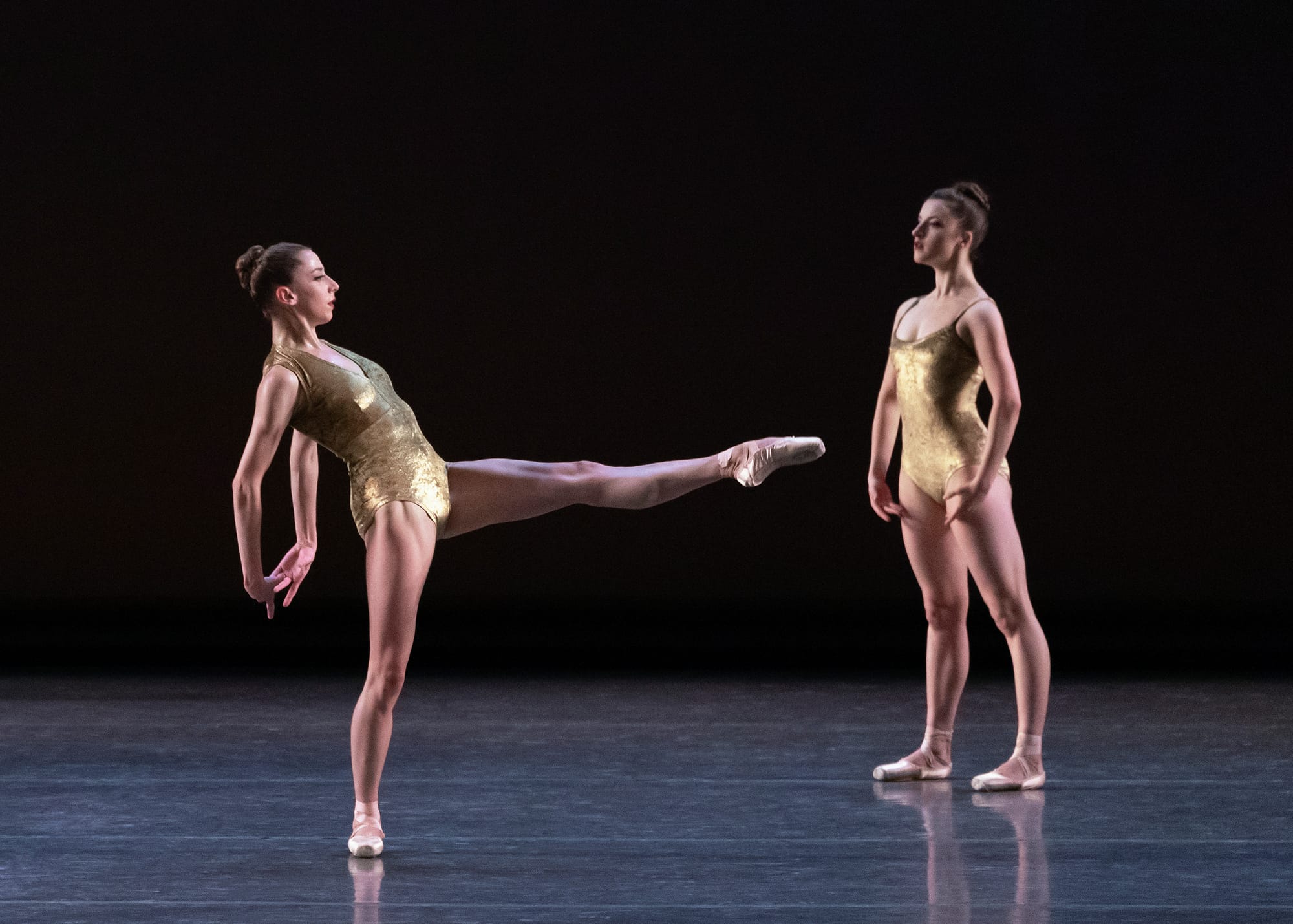
Attempting to give some dramatic structure to the work, Tanowitz did break the dance into a number of distinct sections by successively changing the color scheme of Mark Stanley’s lighting so that the opening sequences were bathed in golden brown, while later ones were floodlit more in a greenish and then a maroon tonality. Bartelme and Jung’s costumes also created progression by first dressing the cast in modernized brown Robin Hood tunics with open blouse-y sleeves and then gradually having all but two of the dancers exchange these costumes for gold lamé, circa 1960’s Miss America contest swim suits (for both men and women) for the final scenes. Ideas of metamorphosis came to mind and it briefly occurred to one that the ballet portrayed primates (as in Taylor’s “Orbs”) trying to become human, but trapped in instinctive movement, and for whom the potential of doing classical ballet steps represented both a possibility of evolution or, perhaps more intriguingly, the instinctive obstacle that was preventing these creatures from evolving. Ballet in the one reading would be the evolutionary goal; in the other the limitation.
In service to all of this, the dancers did heroic duty. Gretchen Smith and Devin Alberda (two fabulous performers) were particularly memorable for an intricate duet that had them throwing almost impossibly difficult extensions off to the sides, holding them, and then repeating the motions. Miriam Miller, trying to climb one of the proscenium side walls during a sequence, then balancing in arabesque penchée, was stunning. But the dance overstayed its welcome well before it ended.
“Suite No. 3” ending the gala program was a welcome non-sequitur to this and the audience accordingly gave both Tchaikovsky and Balanchine a rousing reception. Teresa Reichlen and Adrian Danchig-Waring danced the Élégie, Ashley Laracey and Jared Angle the Waltz, with Erica Pereira and Daniel Ulbricht performing the Sherzo. All gave standard and workmanlike performances, except for Laracey and Angle who were truly superlative.
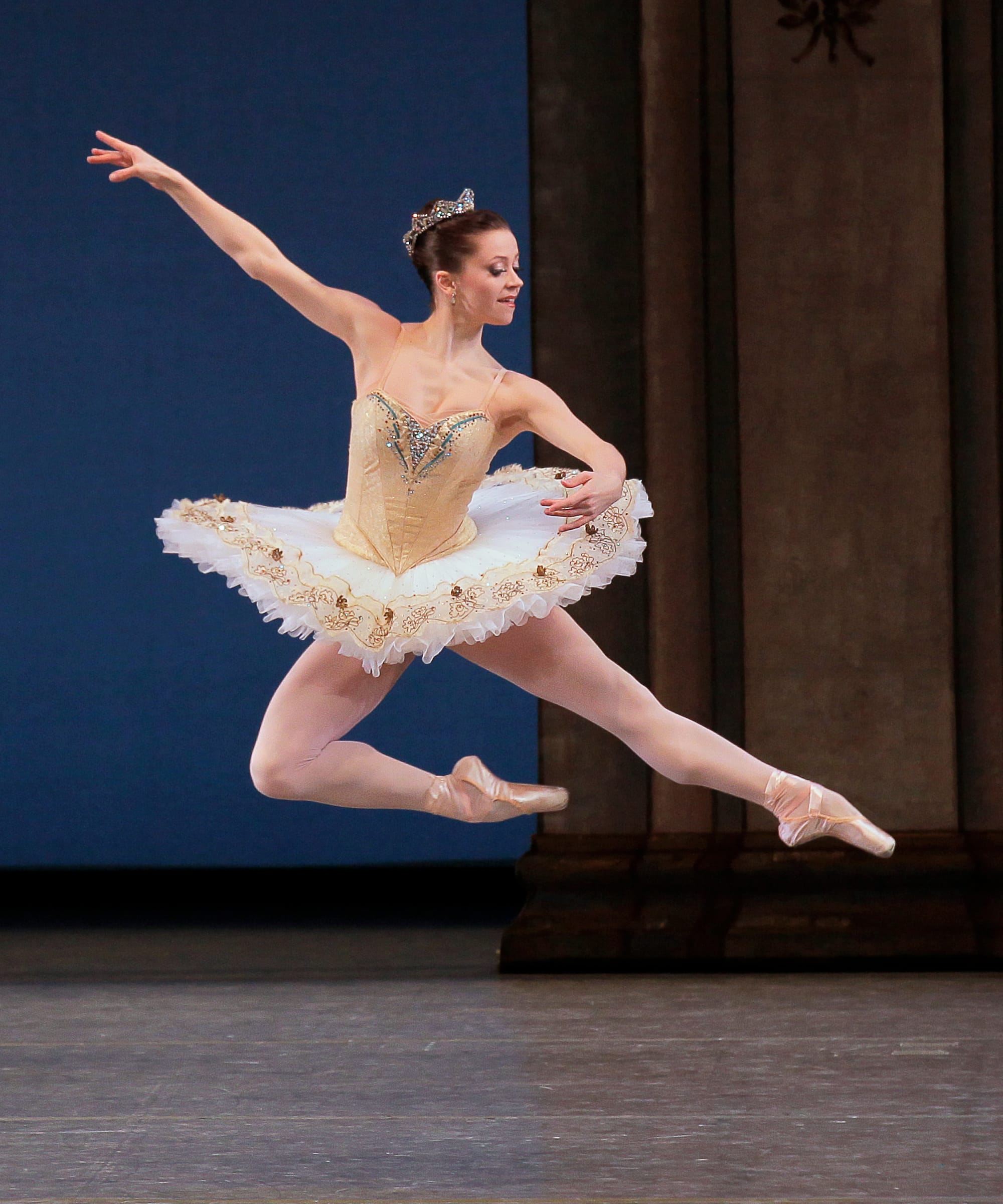
Megan Fairchild and Gonzalo Garcia led “Theme and Variations.” Fairchild, who has just returned from maternity leave, looked good in the costume, danced her solos cleanly with speed and articulation, and showed beautiful lines and extensions in arabesque. She has lengthened herself amazingly over the course of her career. Garcia danced his first solo variation cleanly but had to muscle his way through the double tours in his second entrance, managing to conceal a number of sketchy fifth position landings. But as the ballet proceeded both dancers increasingly seemed to not completely finish their steps to some degree. The pas de deux looked under-rehearsed, and when the larger ensemble joined for the concluding Polonaise, the company dancing as a whole was choppy.
Which led, as posed above, to a certain involuntary question. Maybe this is what Balanchine is going to look like when the company spends a great deal of its rehearsal and creative time and energy dancing things like Pam Tanowitz? Whelan and Stafford can say what they want, there’s only so much classroom, studio and rehearsal time available. Sooner or later a company may have to decide which master it’s serving. Classical ballet is a technique you have to fight for every day in the studio over a long career. The other stuff you do impacts it. By doing too much modern dance-derived work outside of the classical vocabulary, the company may be risking the very core repertory it hopes to preserve.
copyright © 2019 By Michael Popkin



