Seesawing
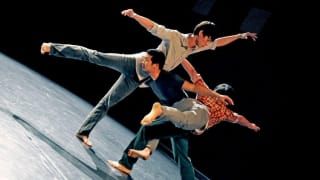
"Balance and Imbalance"
Bereishit Dance Company of Seoul, Korea
Millennium Stage South
The John F. Kennedy Center for the Performing Arts
Washington, DC
November 7, 2017
Words that indicate opposites - "traditional" and "contem- porary" – appear in the printed program for choreographer Soon-ho Park's piece for a pair of drummers, a vocalist and five dancers. Indeed, what the eyes see on stage, and on the huge overhead video screen, is quite diverse in terms of dress, age and action, and yet it is also clear. The drummers, who become visible first, are young men in simple white outfits that seem a timeless fashion. They sit on the floor, to the right of center, insistently beating their hourglass drums to produce metallic and organic sounding rhythms. The singer, and presumably storyteller, is a mature woman wearing a gown of heirloom design. Its voluminous bell-shaped skirt flares out from just under the breasts. She gesticulates with not just her arms but also with a fan to give her words emphasis. To my Western ears, this chanting sounds like Schoenberg's "speaksing". The dancers, three men and two women, look like casually dressed young people from just about any country now. They engage each other in leaning and balancing and, by themselves, they hop or slouch and do so not without emotion.
The first extended dance was a duet for two men. Were they waltzing together or wrestling each other or didn't they want us to know? Lifts were involved that were more than mere leans. A third man joined in the action so that sometimes there were two lifters or, on occasion, attempts to have just a single man simultaneously support both someone leaning and someone being lifted. Eventually the two women, first one and then the other, also appeared and took part in the leans and lifts. Their participation, though, was more decorative than structural. Choreographically, Park's most interesting moves are for two bodies. These pas de deux, and the ambiguous feelings they express, generate sensations of shifting, of shuttling, without there being an actual seesaw board involved.
One long dance was for a goon: topless, one of the men - his muscular torso tense and his shoulders hunched - assumed that role. Yet he hybridized it with the part of a hunk. This strapping specimen, though, could be made to shrivel by a tap from the vocalist's fan. I wonder what secrets about the character her commentary disclosed. While some of the dancing was to the narration, and some to just the drumming, other passages were done during spells of silence. Koreans in the audience started clapping rhythmically for one passage in the hunky goon's dance.
The motions Park prefers to give his five dancers are abrupt and often abrasive. They vary much in degrees of speed, but don't seem to really explore space. Except for a couple of soaring lifts, this choreographer avoids lyrical flow or anything balletic in favor of jiggling, tumbling and in-place jogging. Is an understanding of the words, the stories, essential in order to appreciate how Park manipulates dance or even guess what he has abstained from doing with Korean tradition and with international modernity?
Names of the performers were not in the printed program. The director, founder and choreographer of the Bereishit troupe was usually listed as Soon-ho Park but in one instance as Myeongsun Park.
copyright © 2017 by George Jackson



