See the Music
Lydia Johnson Dance
"Barretts Mill Road: A Remembrance", "What Counts", "Untitled Bach", "Giving Way"
The Ailey Citigroup Theater
New York, NY
June 11, 2015
by Mary Cargill
copyright © 2015 by Mary Cargill
Finances being what they are, Lydia Johnson's small company danced to recorded music. Even so this ballet-based, contem- porary-inflected company is musically incisive and nuanced. Johnson's tastes are eclectic and this performance had music ranging from Bach and Mozart to modern jazz. Her company wears its ballet training lightly, with soft, rounded arms, controlled movements and unmannered, unexaggerated lower bodies. This program was less overtly dramatic than some I have seen (no real narratives going on) but the dancers moved through unusual geometric, off-center formations with shifting moods.
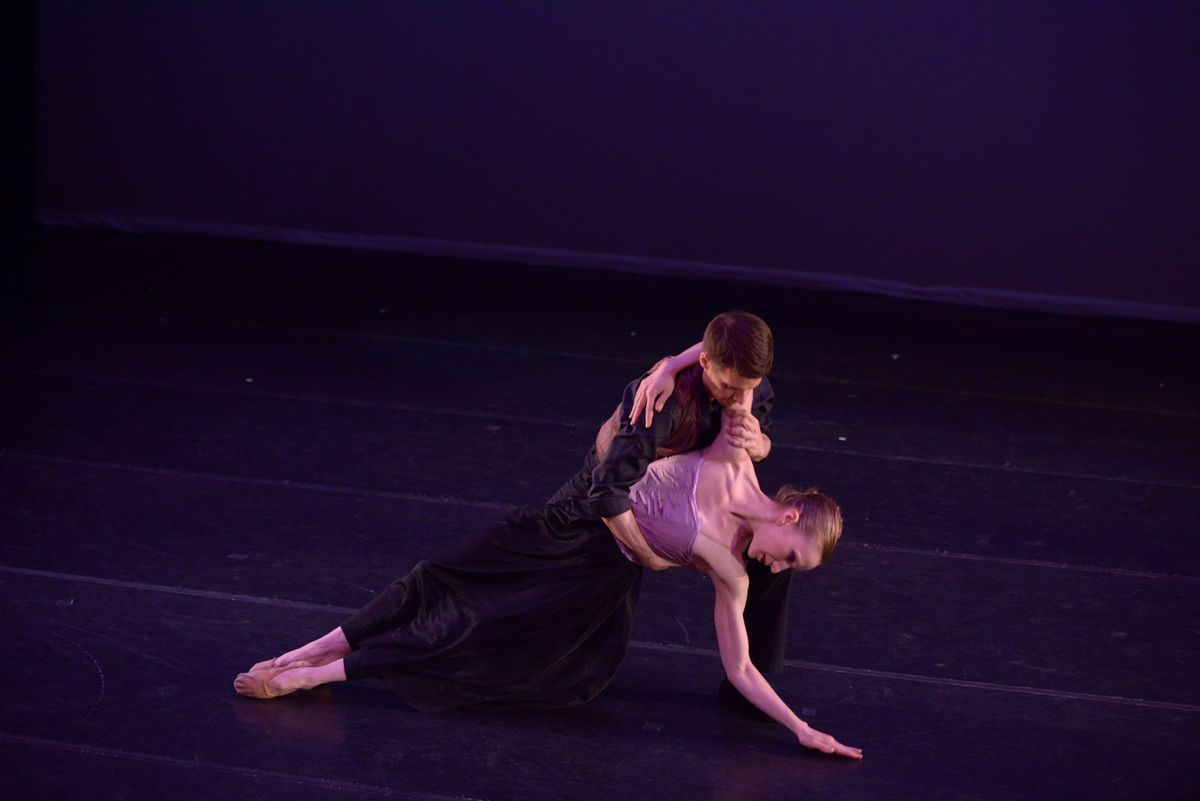
The 2014 "Barretts Mill Road: A Remembrance" to Mozart came with no program notes (where is Barretts Mill Road and why is it being remembered, one might ask) but this ambiguity makes the mauve-infused air of regret and nostalgia more universal than a defined libretto would. Three men (Grant Dettling, Chazz Fenner-McBride and Blake Hennessy-York) and five women (Katie Keith Dettling, Laura Di Orio, Min Seon Kim, Katie Martin-Lohiya and Sarah Pon) were rather formally dressed, with the men in dark vests and the women in long black skirts (changing to shorter ones in the middle). The work was anchored by Katie Martin-Lohiya, a tall, willowy blonde who opened and closed the piece alone on the stage; she joined in the group dances, but remained somehow apart, often looking into the distance. These dancers may have been her memories of earlier selves or lost friends--her presence was illusive and haunting. The dancers looked as if they were being blown by the music and the dance was full of vague longing, backward falls, and small bursts of energy.
"What Counts", a premiere, was set to a bouncy, jazzy, percussive score by the trio The Bad Plus. It opened with two men (Fenner-McBride and Hennessy-York) exploding on the stage, joined by three women (Pon, Di Orio, and Martin-Lohiya) moving with self-absorbed, model-like arm movements, luxuriating in the joy of movement. The waif-like Pons and Hennessy-York separated for a push-pull pas de deux, wary and then more passive. What counts, apparently, besides effortless musicality, is making a connection.
There was yet another connection to the music in "Untitled Bach", from 2010, as Johnson avoided the cliche of rigorous, note-for-note steps. The dancers moved with an improvisational air and a combination of formal and informal moves through the music. The casual costumes with mirror image colors (black tops and short maroon skirts for the women and black shorts and maroon tops for the men) created formal shards of color as the dancers merged and separated.
The final piece "Giving Way" was also a premiere. It was set to a combination of music by Marc Mellits and Osvaldo Golijov. The first section, a string octet by Mellits, was rhythmic, repetitive and strident, with various pongs and groans and the second one by Golijov (to cello and marimba) has a restless lyricism. The choreography wandered through the sounds with overlapping patterns and rushing waves. The dancers were continually moving, sometimes dancing on their own and sometimes leaning on each other, with ambiguous, ever-changing moods. At one point the men raised the women up with their arms outstretched, crucifix style, with a definite but not belabored symbolism. Like all her dances, one view is not really enough to absorb the subtle musical nuances and underlying dramatic grace notes.
copyright © 2015 by Mary Cargill



