Second Week, Second Casts : Balanchine at NYCB
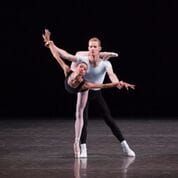
“Divertimento No. 15,” “The Four Temperaments,” “Chaconne”
New York City Ballet
The David H. Koch Theater
New York, New York
January 30, 2018
The winter 2018 season of the New York City ballet opened with two all-Balanchine programs back to back. During that first week the air in the Koch Theater was suffused with a combination of relief and jubilation. The company was back, having lived through the retirement of Peter Martins, its longest serving artistic director, and Balanchine ballets were leading the charge. The second week again opened with Balanchine: second casts in “Divertimento No. 15,” “The Four Temperaments,” and “Chaconne” under the prosaic tag "Balanchine no. 2". It was back to business as usual with veterans returning to their parts, scheduled debuts and last minute cast changes, planning for the future as young dancers got their chances while the laurels for the evening went to the company's senior ballerina.
“Divertimento No. 15”, Balanchine's ode to Mozartean good manners, rococo filigree and modern day dynamics, is a tough ballet to pull off, as it requires that the leading dancers (three men and five women) dance as one, a feat of self-abnegation and interpersonal awareness. Here, the dancers seemed sealed off from each other. Consequently, the solos came off best. The first rushed by like the clearest water in a burbling brook, reflecting Indiana Woodward's pleasure in dancing and fleet feet. Ashley Bouder's sixth variation hurtled by – she's a veteran of the part – but she stopped the flow of her solo in the finale to show how securely, and how long, she could hold an extension, then continuing on at top speed. It was a moment of "Look at this" in a ballet that calls for "Look at us". Unity Phelan, in her debut, was the glamorous new girl at the garden party. Once she can knit together the space-swallowing sweeps of the legs, already luxurious, with their petite allegro connective tissue now laborious and a little lost, she'll be the belle of the ball.
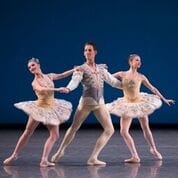
The curtain rose on "The Four Temperaments" with Olivia Boisson and Lars Nelson (both debuts) facing front in the first theme. Boisson is an elegant, authoritative and scrupulous dancer. It has been decades since extensions in this role were kept to ninety degrees but Boisson did so. What risked seeming under powered or old fashioned, looked instead like a conscious choice and wholly refreshing. Boisson and Nelson looked good together, and, as partners, at ease with each other. It was easy to believe that whatever the choices made in their dancing were made together.
In Balanchine ballets, Russell Janzen has spent most of his career standing behind the ballerina and making her look (very) good. So his first performance of 'Phlegmatic' was also a notable change of pace; the spotlight was all his. Yet the elegant danseur noble didn't disappear completely. This Phlegmatic was calm cool and collected but also, thanks to Janzen's long limbs and their reach in space, creaturely and as such, disconcerting.
Harrison Coll is short with a plush jump. He has made his name while dancing on his own, so his debut in the soloists' pas de deux in"Chaconne" was another change of pace. This duet is full of fast, split-second partnering, and through it all, Coll's partner Lauren King was delicate, serene and carefree, as befits a resident of Elysium. Ashley Hod, Isabella LaFreniere, both new to their roles, and Andrew Scordato as the lute player and his attendants, were all cast to type long legged and elegant, greyhounds of the gods.
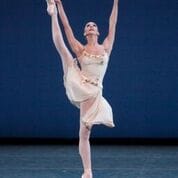
All of these debutants have the steps down. All still need to turn those steps into phrases and into dancing, the expression of the world that they and Balanchine have found in the alchemy between music and movement. It can be done, with time, work, more performances and smarts. Once upon a time, Maria Kowroski gave her first performance in the lead role of "Chaconne" but what was on view here was the fruits of experience, not just the oval head straight out of Brancusi, the endless legs or inimitable carriage but the use of the eyes, focused on the unworldly, the sense of transparency and weightlessness, far beyond the early realm and probably worked on, and worked out, in hours of rehearsal, and the confidence and authority which comes with time, that informed this performance of "Chaconne'".
copyright © 2018 by Carol Pardo



