Second to None
"Aureole", "3 Epitaphs", "Company B", "Esplanade"
Taylor2
Joyce Theater
New York, NY
April 16, 2010
Taylor2, a group of six young dancers established by Paul Taylor in 1993 to bring his works to broader audiences, is in residence at the Joyce, sharing a season with other Two's, Ailey and ABT. Taylor2 has provided many dancers to the larger company, but this is is no sense a student venture; the dancing was spectacular, warm, gracious, and daring. The repertoire is one to make a Taylor fan salivate, four great and very different works in one evening. The ones choreographed for larger casts ("Company B" and "Esplanade") were reworked for the smaller group, but there was no sense of a Reader's Digest version. In fact, the more intimate Joyce stage enhanced many of the more dramatic moments.
The evening opened with "Aureole", one of Taylor's heavenly excursions, set to Handel. The dancers are gracious sprites, and the cast showed a complete commitment to the music, to each other, and thus to the audience. Nic Ceynowa danced the difficult male solo; he gave it an air of a lesson well-learned, but as yet wasn't able to convey all its secrets.
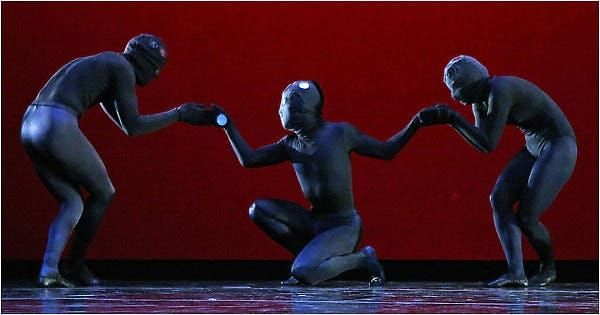
There are a number of secrets in "3 Epitaphs", a dance for five set to, as the program describes it, an early form of jazz. The dancers are covered head to foot in grey body suits with bits of mirrors which catch the light. There is something primeval about their movements, as they lope around, arms almost touching the ground. At times the movements, keyed so closely to the music, generate laughter, and at times almost fear, as these mysterious creatures try to be human.
The dancers in "Company B" don't have to try to be human; this is one of Taylor's most vibrant works. Set to gloriously danceable songs by the Andrews Sisters, it is an homage to the Americans of World War II, with their youth, their innocence, their joy and their losses. The smaller cast meant that some of the roles had to be doubled up, and Justin Kahan was both the comic glasses-wearing Johnny, irresistible to women, and the dynamo Bugle Boy. All six dancers were terrific, but Madelyn Ho, as the dreamer whose soul mate was overseas (or killed in combat), was a piquant powerhouse. Latra Wilson gave a sly and knowing edge to "Rum and Coca-Cola", and Christina Lynch Markham a powerful stillness to the final moments of "Another you".
And then we got "Esplanade", a technical tour de force to Bach, where all six dancers walked, ran, jumped, and rolled. Taylor choreographed to the warm undercurrents of the music, ignoring the obvious formality, and it is one of his most musically imaginative works. But life is never relentlessly sunny, and in the adagio, he has his dancers try but fail to connect, both physically and emotionally, until all is released in the bounding finale. The dancers glowed, and their enthusiasm was all the more impressive considering the workout they had already been through; the main company's dancers certainly do not dance as many times in a single evening. By anyone's standards, this company is schön.
copyright © 2010 by Mary Cargill



