Salute to Yesterday
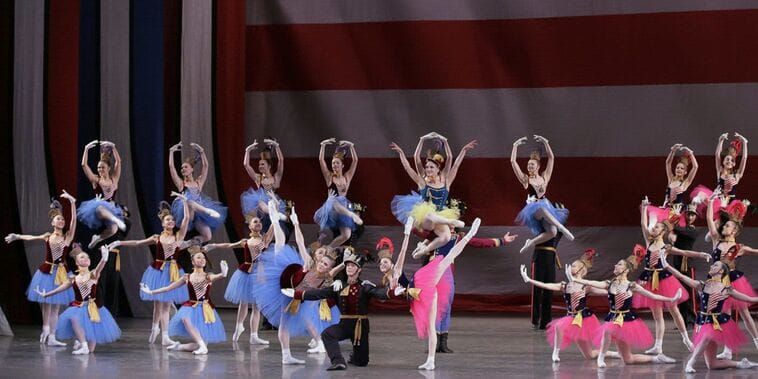
"Serenade", "The Magic Flute", and "Stars and Stripes"
New York City Ballet
Koch Theater
Lincoln Center for the Performing Arts
New York, NY
September 30, 2010
New York City Ballet took various looks backward in its programming. "Serenade" is Balanchine's gloriously romantic hymn to femininity, a direct descendant of those pale vision scenes so beloved of nineteenth century audiences, "The Magic Flute" is Peter Martins' take on a lost Ivanov one-act ballet full of nineteenth-century comedic idioms, and Balanchine's "Stars and Stripes", for all of its mid-twentieth century cheer leading ambiance, is one of the most impeccably classically composed of Balanchine's works, and all those drum majorettes would feel quite at home chatting with Raymonda.
Rebecca Krohn made her debut as the Dark Angel figure in "Serenade", with the more experienced Jenifer Ringer as the Waltz Girl, and Ashley Bouder in the Russian variation, a perfect pair to accompany any debut. Ringer's radiant innocence made the waltz, with the fine support of Jonathan Stafford, seem a lyrical dance of joy; there was no hint of the loss to come, which she gave an urgent but not overwrought drama. Bouder was a fine foil for Ringer's sweetness, and she gave the part a true romantic poise with soft, gently curving arms. (She recently danced "Giselle" in Carla Fracci's production, and it seems as if she has absorbed some of the style.) This new elegant polish has not interfered with her old authority, and she flew through the jumps triumphantly. Bouder has developed from an astounding technical phenom into an artist who can create a world of her own and let the audience share it. Krohn as yet does not have the majestic individuality of Ringer or Bouder, and her upper body can be a bit stringy, but she was able to project an authority as she led the man away from Ringer. Ask La Cour was the man who left Ringer, and he gave the role a gentle sorrow as he reluctantly, but definitively left her for his new love.
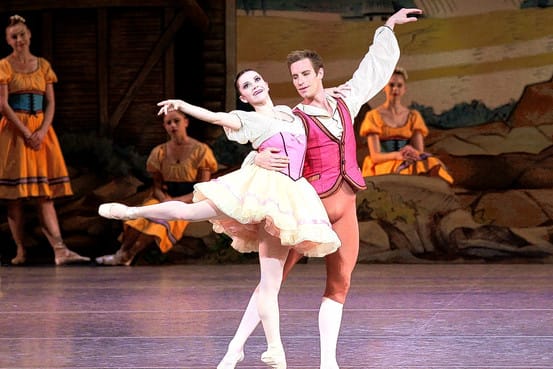
"The Magic Flute" is a comedy, which in nineteenth-century ballet generally means that a rich old fop with the encouragement one or more parents blinded by gold, foolishly wants to marry a spunky girl who is in love with a poor but handsome man. Since it is a comedy, the entrechats win, often with the help of some supernatural power. Variations of this conventional story had produced some of the greatest works in the ballet world, from Bournonville's "Kermesse in Bruges" to Ashton's La Fille Mal Gardee, not forgetting Petipa's "Don Quixote". "The Magic Flute" has no choreography to equal those great masters, but it is a serviceable, inoffensive work, though the emotional high point, as the goddess Oberon (whom the hero Luke had been kind to when she was disguised as an old crone) over rules the Judge, who had condemned Luke to death for dabbling in magic was played simply for laughs, and the ballet seemed more of a dutiful exercise than an inspired recreation. Yes, a story mocking decadent, lustful aristocrats created for the Imperial court may be as hard to take seriously as all those anacreontic works celebrating peasant simplicity to the courtiers of Versailles, but the significance of a moral doesn't depend on the audience it was designed for, and fairy tales, even comedies, need a grounding of iron, or they become inconsequential farces.
Which is what Martins by and large has choreographed, as his comic characters are only characterized by silly walks; his Marquis (a game Adam Hendrickson) makes Gamache look subtle. Megan Fairchild, the heroine Lise, was charming; she is a very good soubrette, which means that she doesn't spend time vamping the audience showing them how cute she is. Her solos emphasized sharp, clear footwork, but despite her best efforts, the choreography didn't really bring her character to life. Luke, Andrew Veyette, also had some thrilling moments, but again the choreography was just steps.
There are a lot of steps in Balanchine's "Stars and Stripes", but they are tied indelibly to the music. Unfortunately, Savannah Lowery, leading the second campaign, fell, and didn't return for her solo, so the proceedings didn't really get started until Daniel Ulbricht bounded on leading the men. He is simply wonderful in that role, chipper but elegant, and has some of the most amazing landings, as he seemed to float down to his knees and just bounce up. Sara Mearns and Charles Askegard were Liberty Bell and El Capitan; like Fairchild, Mearns knows that being witty does not involve making goo-goo eyes and the audience, and she gave the rigorous pas de deux every classical nuance she could, with subtlety and elegance. The little head flicks were musical grace notes, not I'm so cute exclamation points, and her dancing, with fast turns and high jumps, was exhilarating. Askegard was equally thrilling, throwing in all the witty accents, but basically playing it straight and letting the audience simply enjoy great choreography heroically danced.
copyright © 2010 by Mary Cargill



