Running the Gamut
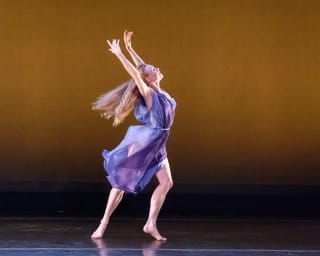
“Set and Reset,” “Dances of Isadora,” “Esplanade”
Trisha Brown Dance Company, Sara Mearns, Paul Taylor Dance Company
Paul Taylor Modern American Dance and The American Dance Festival
David H. Koch Theater
New York, New York
March 18, 2018
On the second Sunday evening of its Lincoln Center season, Paul Taylor showcased the rebranding of his organization as Paul Taylor American Modern Dance. While the program called Icons – also sponsored by the American Dance Festival – started in cool Zen mode with the Trisha Brown Dance Company presenting a revival of its 1983 “Set and Reset,” the program built steadily in energy and force. New York City Ballet’s superb ballerina Sara Mearns was then unforgettably dramatic performing barefoot in a series of dances that claimed to be recreations of works by Isadora Duncan, before the Taylor company – as the home team - wound things up with a rendition of “Esplanade” of more startling attack than anything seen here for years in that particular work.
“Set and Reset” began with famed artist Robert Rauschenberg’s original décor at the center of an unpopulated stage - a box of fabric, about twelve feet long by eight feet wide and eight feet high, flanked by pyramids of the same material. When Laurie Andersen’s music started, the set piece was hoisted up above the action, to hover over the dancers throughout the work’s half hour duration; meanwhile fragmented bits of unintelligible black and white newsreel footage were continually projected on its many surfaces. Eight or ten of these tracks were playing at once. Andersen’s soundscape consisted of an endlessly repeated twelve bar loop of musical gongs, punctuated by occasional synthesizer chords. This is all a Zen riddle, the montage seemed to say: an unanswerable question meant to disorient the senses and prime the pump for an unexpected experience.
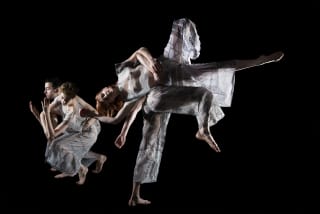
Into this bizarre stagescape thereafter wandered the four women and two men of the cast, dressed in loose, vaguely batik patterned gray costumes, who proceeded to engage in thirty minutes of shimmying, swaying, leg levitating and kicking, starting and stopping, often in circular patterns, with the body moved through arcs and then returned to rest. Duets, trios and quartets of women entered from between drops of gossamer fabric at the sides of the stage, performed snippets of movement and then scattered. The men, stripped to the waist in harem pants, from time to time joined in, or didn’t, as the case might be. Very occasionally two or more performers did something in unison.
The dance was weightless as the ensemble seemed to swim ecstatically in an ocean of light. Yet the effect was like watching a group of people on an acid trip, without having taken acid oneself. The dancers went places that the audience didn’t. In a much smaller space (such as the old Dance Theater Workshop where the Brown company so successfully performed), the immediate physical presence of the performers, seen close up, would have swept the audience up in the collective experience. But in the vast reaches of the Koch Theater, it didn’t project.
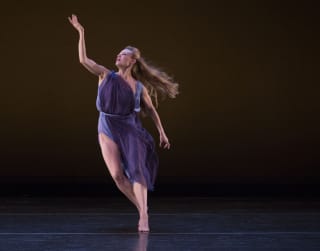
Failing to project was, on the other hand, the very last thing Sara Mearns was guilty of. Just the contrary, dancing solo in material that either may or may not be truly Isadora Duncan’s (about which more below), the ballerina filled her home theater to the rafters in a series of ten discrete entrances to solo piano. With NYCB pianist Cameron Grant sensitively interpreting the romantic scores (seven works by Chopin, then two by Brahms sandwiched around Liszt’s “Les Funérailles”) Mearns appeared in Duncan-esque flowing drapery that floated opened to show her bare legs, beautifully stretched at the knee, and eloquent arms and shoulders, and utterly transcended the kitschy aspects of the dance material by fully letting herself go both emotionally and physically (indeed in her dancing the two aspects were one) in her own belief in what she was doing. Perfectly timed and weighted barefoot phrases of terre-à-terre footwork led into diagonals of jumps with a bent forward leg, that she ended in gestural poses to the knee, where she held the disappearing final chords of the music with her outwardly yearning arms. Unexpectedly and beautifully, Mearns’ gorgeously arched feet (out of toe shoes) proved as eloquent and musically sensitive as her hands. Captivated by this dancer’s imagination, the audience swallowed whole entire tracts of artistic material that in lesser hands would have been ineluctably trite, including the ritual scattering of rose petals that ended the piece at the conclusion of, you guessed it, Brahms’ “Rose Petal Waltz.” I can’t think of another dancer today who could have pulled this off. Diana Vishneva might have tried it a decade or so ago when she was moonlighting in Martha Graham’s material, but never had the knack of fully letting herself go that made Mearns’ tour de force possible.
The dances, reconstructed by Duncan specialist Lori Belilove, purport to have been handed down to her from Duncan’s sisters through a generation of subsequent performers, and one doesn’t doubt the sincerity of the assertion. But truly, nobody knows today how or just what Duncan actually danced. Probably no one’s even left alive who ever saw her. (A few seconds of film exist in old Dance in America footage, from a private performance, but even that is controversial as to whether it’s actually Duncan). Mearns as a ballet dancer here, with the strongest contemporary technique, delivered an unabashedly balletic performance, and not just that: as an NYCB ballerina bred to dance Jerome Robbins to Chopin, her style recalled Robbins more than anything else.
But who cares? It was perfect material for her, and in channeling her idea of Isadora, Mearns’ immense stage imagination found its métier. Surely her animal hunger for the music, audience and stage had to be where she resembled the great Isadora the most.
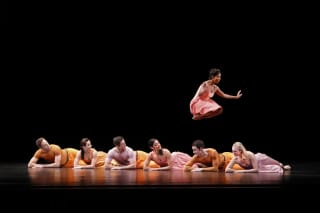
The energy of Mearns’ performance was such that it clearly carried over to fuel the Paul Taylor Company’s conclusion of the program in “Esplanade” by a cast that had an unusual number of powerful senior dancers in a company where seniority matters. Full of vernacular running and sliding and based on an epiphany he had watching children and adults on the Brooklyn Heights Esplanade in 1975, Taylor’s masterwork, with its allegro movements carefully balanced by hauntingly mysterious adagio numbers set to Bach, is of course a company warhorse. Taken on tour all year long, it can get danced four times a week in town after town, wherever the company performs, here and abroad, and can thus at times feel a bit rote. Yet this one was special for its focus, commitment, and the sense that the bar was set high by what came before. Mearns threw down the gauntlet and the home team responded. From a re-energized and healthy Michelle Fleet (and what an extraordinary Lincoln Center season she’s enjoying) leading the ensemble in the opening hopscotch jumps, to Parisa Khobdeh’s life and limb-defying jumps into her partners’ arms at the end, the entire cast swung for the proverbial fence.
copyright © 2018 by Michael Popkin



