Revisiting a home-made Trio
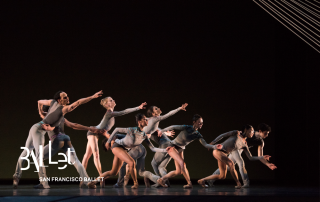
"On a Theme of Paganini" "Ibsen's House" "Ghost in the Machine"
San Francisco Ballet
War Memorial Opera House
San Francisco, CA
February 15, 2018
Helgi Tomasson has an astute sense for programming. After an evening of works that were brought in, he followed it with pieces created in-house: “On a Theme of Paganini” (Tomasson), “Ibsen’s House (Val Caniparoli) and “Ghost in the Machine” (Myles Thatcher). The first two were created in 2008; corps member Thatcher’s first work on the company dates from 2017. Together the trio made an informative, above all well-danced, evening of perspectives on how ballet inspires even today.
Tomasson’s “On a Theme” benefitted from its creator’s intelligence and sensitivity, with a bow or two to his Balanchine inheritance. Despite Tomasson's occasional modernisms (read “athleticism”) the classical vocabulary received respect. Perhaps it needed less of that in favor of more passion. The Rachmaninoff Concerto (Rhapsody on a Theme of Paganini Op. 43) had more than enough to spare. I find its excesses and easy post-romanticism lugubrious, difficult to sit through even though Martin West took excellent control of his musicians, and to hear Roy Bogas as part of the ensemble and as a soloist was such a pleasure.
Tomasson started on playful note. Maria Kotchekova, who spooled off every gesture with nonchalance, and Sasha De Sola faced each other in light-footed unisons when Max Cauthorn, Vitor Luiz and Wei Wang joined them in sprightly hops. Kotchekova and Cauthorn (new to the role) found enough interest in each other to suggest more than a touch of romance. De Sola, Luiz and Wang treated their fine trio as an opportunity for easy competition. The ensemble also excellently showcased Tomasson’s fluidity with the many options that an ensemble of twelve dancers offers. But as a whole “On a Theme” felt excessively cautious
Caniparoli’s “House” received its premiere during SFB’s last festival of world premieres, on the occasion of the company’s 75th anniversary. Rare among contemporary -- particularly American ballet choreographers -- Caniparoli has a talent for creating characters; he also embraces music of just about every kind. Still a character dancer with SFB, he has choreographed over a hundred works in the last forty years.
“House” is a challenge even if you are familiar with Ibsen’s plays. This performance, however, dispelled some of that anxiety, perhaps because of a change in perspective on my part. Even though the choreography identifies each character with individual gestures, “House’s” thrust is more inclusive, looking on the suffocating effect on women, and to a lesser extent men, that social demands, marriage in particular, imposes. Ibsen’s plays highlight differences in that oppressive way of life; Caniparoli really suggests a quasi contemporary “house” in which some still live. Sandra Woodall’s huge dark drape offers a view of the outside; the women’s heavy brocade costumes make you want to run outside for some air. This a dark piece about a way of life whose contemporary echoes are impossible to ignore.
Fine performances were offered by everyone. The fierceness with which Dores André’s stiff-necked Hedda Gabler rejected her husband (Vitor Luiz) was almost frightening. André seemed to add a foot to her height. Sofiane Sylve’s mother is helplessly ambivalent, physically enchained but so was her equally pitiful husband Tiit Helimet as he desperately stumbled off stage. A ravenously conflicted Kimberly Marie Olivier — in a career-making performance — just about overpowered Luke Ingham’s Stranger. Ellen Rose Hummel/Sean Orzo and Jennifer Stahl/Myles Thatcher also people this house of misery.
Thatcher’s avalanche of ideas at times almost overpowered the structural backbone of his “Ghost in the Machine.” It’s a piece whose sense of frantic disjointedness gradually gives way to something like a community, fragile as it is. Set on five couples and driven by Michael Nyman’s propulsive score (energetically conducted by Ming Luke) the stage explodes with a mix of yanking, shoving and embracing, duets, trios and solos, but also simple walks. The sense is one of hectic ambivalence, where people are propelled in every direction at the same time. The shift in Frances Chung and Jaime Garcia Castilla's dynamics seemed unrelenting. Their counterpart, with André and Di Lanno’s reaching out to each other, gradually drew in the rest of the fine cast. Thatcher is still a corps member; one wonders for how much longer.
copyright © Rita Felciano 2018



