Refresh and Rewind
“Beloved Renegade,” “Death and the Damsel,” “Esplanade”
Paul Taylor’s American Modern Dance
David H. Koch Theater
New York, NY
March 13, 2015
Paul Taylor’s American Modern Dance, née Paul Taylor Dance Company, in its opening season under the new name at Lincoln Center managed to preserve its gloried vintage amidst the fresh coloring of its reincarnation and the added texture of live music.
The evening’s main event was the evocative world premiere of “Death and the Damsel,” a work about a young woman’s nightmare landscape set to Bohuslav Martinů’s Sonata No. 2, which started lightly and then descended into a colorful world of fresh-looking clichés of female fear. The work’s subject and presentation could surely at first make it look like a crass, and at times carelessly painted, portrayal of misogynistic horrors, but those in the audience who took the time to read the program might have had cause to wonder what lay beyond that surface veiling, and would have been rewarded with the work’s concealed imports
The bill enticingly offered a quote from Scottish poet James Thomson’s famous, melancholy “The City of Dreadful Night,” picking from the myriad of poignant lines in the depression and urban horror-themed poem this one as the ballet’s lead-in: “The City is of Night; perchance of Death.” But whether Taylor’s ballet is about a real city, or the inner city of human psyche described by Thomson, its horrors actual or mere reflections of the subconscious, or a rich mélange of all of these representations, is a question for the viewer.
To begin the work, the lead heroine, Jamie Rae Walker, rose from a floor-bound mattress with an almost cubist-looking depiction of a high rise building’s room as the backdrop and joyfully danced across the room, doing cartwheels, fouettés, and jumping freely on the stage. But this introduction was quick and Walker soon returned to the bed for the ballet’s darker side. Her nightmares, dressed in tango/bondage styles of Santo Loquasto’s design, danced on the periphery, trapped in the endless flux of their own conflicts but without any access to the Damsel who obliviously slept on. Once the boundary of her bed was breached by one of them, Michael Trusnovec, the man smothered her with a pillow, then grabbed her in a tango-like embrace as everything faded to black.
When the Damsel's troubled reverie resumed, everyone was in tango poses and a giant backdrop with flamboyantly written “Dance Club” announced the next setting of the horrors. Locked in her unsolicited partner’s embrace, his mouth carnivorously pressed to her neck, this Damsel showed little distress as she watched the debauched dancing of others over her shoulder with acute interest. But Walker’s curiosity grew fear-colored, quickly succumbing to the gravity of horror as Trusnovec refused to let her go, dragging her against her will when she tried to escape, all of which culminated with her lying down, her legs making a V in the air toward the audience, with the many men on the stage taking turns in violating descents upon her. As each was done, they receded to the back of the stage, forming a lying down log line with women who so far had been only troubled bystanders. But ultimately, they were culprits too.
For the third scene, a cartoonish looking Chrysler Building adorned the back, the viciousness of its gargoyles somehow pronounced in caricature, and here Walker was now at the mercy of a woman’s power. Her domineering female partner passed a hand over Walker's head, either clouding her judgment, brainwashing or hypnotizing her. But Walker was more successful in her resistance here, grasping the female by the throat in a struggle and ultimately winning. When she ended up on the floor at the end of the piece the figures faded away, and Walker soon stirred to find herself awakened in her skyscraper bedroom. Shaking off the restless sleep almost too briskly, she was once more the happy-go-lucky lady of the first scene.
Choreographically, there may have been less refinement or detailing in these scenes than one is accustomed to seeing from Taylor, but for all its in-your-face qualities, the ballet challenges its viewer to query possible concealed interpretations. Despite the New York City decorations, and Walker's blonde hair, light pink dress and cartwheels implying innocence, giving some thematic placement, those elements only serve as jumping off points for more questions. Is the work a look at innocence in the big city? The city’s own lack thereof? The viciousness of modern decadence? Something else? With Thomson’s poem structured to recall the first stanza in the last, suggesting the recurrence and inescapability of the described world’s horrors, the ballet lets its heroine wake up happy once again. Thus, Taylor mimics the poem’s structure, but inverts the sentiment, providing his heroine with an escape from the tormenting city, even if only until the next night. And with that, Taylor created an enticing puzzle, inviting further analysis of the Damsel’s nightmares, and repeat viewing.
No such invitation would be necessary for the two Taylor classics that sandwiched the edgy premiere, as both “Beloved Renegade” which opened the evening and “Esplanade” that closed it, are audience favorites. But the new company profile gave both works live musical accompaniment, which refreshed and enriched them and made them shine like new.
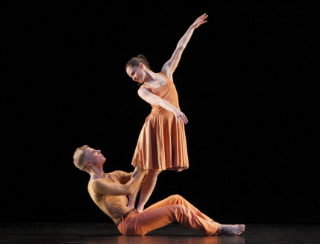
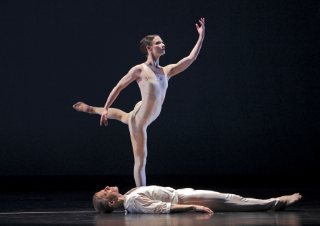
The lyrical and poetic “Beloved Renegade” journeyed through Walt Whitman’s life and experiences toward his death with so much life, that the flurry of the ballet’s embraces, adjustment and discovery in duets, all with Trusnovec trusted ingenious portrayal of the poet, had a new dimension. Devon Guthrie’s luscious singing enhanced the ballet’s broad stroke painting of Whitman’s experience of love, death, muses and interests with a dreamy quality, making the ballet itself appear lyrical until the very last tour lent by Laura Halzack over Trusnovec’s recumbent body.
Even more powerful was “Esplanade,” which, performed to live orchestration, gave the nectar of the Bach Violin Concertos a particularly rich sweetness. As the dancers assembled and reassembled, did court-style dancing, ran freely, crawled, slid and jumped into each others arms, their expression gave Bach’s structured music so liberating a feel it was almost palpable. The work made the music feel velvety and ethereal, and the evening proved Taylor’s new vision to be of admirable new vintage.
copyright © 2015 by Marianne Adams