Reflecting Language
"Serenade," "The Chairman Dances-Quartet For Two," "Rodeo: Four Dance Episodes"
San Francisco Ballet
San Francisco War Memorial Opera House
San Francisco, CA
February 13, 2018
The first of this season’s repertory programs was called “Bright Fast Cool Blue”. You probably could find at least one of these qualities in the magnificently performed “Serenade”, “The Chairman Dances — Quartet for Two” and “Rodeo: Four Dance Episodes.” George Balanchine’s name only appeared in his early masterpiece but his spirit hovered in works in which musicality, speed, clarity of design and a gravity defining sense of ease could not be missed. Tchaikovsky, John Adams and Aaron Copeland, admirably conducted by Martin West, helped. A mid-program video plug for “Unbound,” SFB’s festival of twelve world premieres in four programs (April 20-May 6) will probably be with us in every upcoming performance. Helgi Tomasson is determined to push his audiences beyond the ever-popular bread and butter full-length ballets.
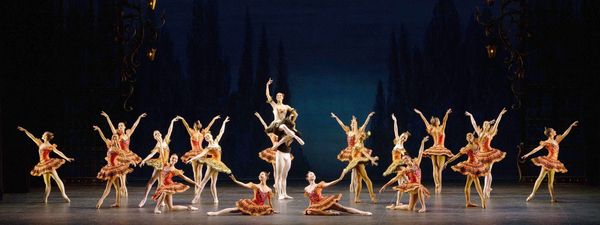
“Serenade” here set a standard for everything that came later. Whether it will ever have a competitor in a program in which it is shown remains to be seen. Better performed than I can remember having seen it at SFB, it struck me more than anything else as tribute to the company women’s ability to work together. Tchaikovsky carried along the unisons, small shifting ensembles, fleeting exits and assertive entrances. Maybe because of the times we live in, for the first time, “Serenade struck me with a note of darkness, perhaps even a sense of fatality. Mesmerizing and enchanting as they were to look at, this corps also appeared engaged in a common effort of pushing against a threat, holding the inevitable in abeyance.
Yuan Yuan Tan and Carlo Di Lanno’s waltz suggested a delicate and evanescent intimacy. Di Lanno entered her sphere with reserve and as well as tender solicitousness. And yet how strange that their encounter started in a minor key. Tan joined SFB in 1995; she danced as well as ever all evening. Mathilde Froustey’s Russian girl’s lovely pacing and her clear sense of a trajectory within her variation spoke of her refined and detailed French training. Jennifer Stahl partnered Luke Ingham in the ever-mysterious Dark Angel section.
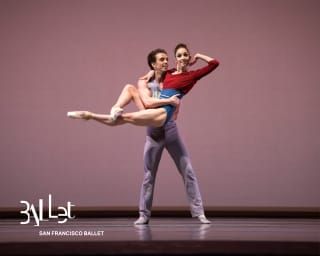
Benjamin Millepied’s “The Chairman Dances – Quartet for Two,” an SFB commission to two of John Adams’ scores, featured an ensemble of ten. It’s a lively, spirited, well-structured work that smoothly throws jazzy moves into partnership with ballet's lifts and leaps. In some ways the piece could have been conceived as a tribute to Millepied’s time at NYCB. Maria Kotchekova and Di Lanno’s playful pas de deux sparkled with a teasing spirit spiced with dollops of competition between the two. “Chairman” also featured what must be a first: Tan and Stahl, unceremoniously but gustily rotating each other to the ground like an ice-skating double.
But what on earth was Millepied thinking by adding a coda to “Chairman”, based on an early Adams’ score containing repetitive fundamentalist exhortations. Tan, Ulrik Berkkjaer, Stahl and Benjamin Freemantle, dressed in long white robes, emerged on a spot light two by two in every possible gender combination. The close to the body vocabulary changed little as each got swallowed up by black outs. Was Millepied trying to say something about fluid genders, and if so what, and why here?
Peck’s “Rodeo: Four Dance Episodes” looked just as fine as it did on the Gala. In some ways these leaping and affable lads could have seen in the light of Agnes De Mille’s cowboys. Their shorts and knee-length socks suggested buddies of a soccer team. Perhaps the rambunctious trio of Esteban Hernandez, Hansuke Yamamoto and Wei Wang, who showed some spectacular leaps, was younger brothers or eager fans.
Peck’s ability to spread out and gather phrases, play with space and above all with the music, is impressive. As the lone woman, Dores André brilliantly veered between flirtation and rejection of an intrigued Birkkjaer. The more she dances, the more André acquires dimension. "Rodeo’s" heart, however, is in the 2nd episodes quintet in which Jaime Garcia Castilla leads his companions in what almost looked like a search for something ephemeral.
copyright © Rita Felciano 2018