Pushing the Limits
“I hunger for you”
Kimberly Bartosik/daela
BAM Fisher (Fishman Space)
Brooklyn, NY
November 3, 2018
Like the zone inhabited by whirling dervishes, Kimberly Bartosik’s passionate “I hunger for you” reaches for moments of mystical power through relentless motion. In its New York premiere in the capacious black box of BAM Fisher, her work for five dancers (plus a brief observer) offers passion and intensity that often finds that ecstatic zone; even the act of reaching offers many of its own rewards.
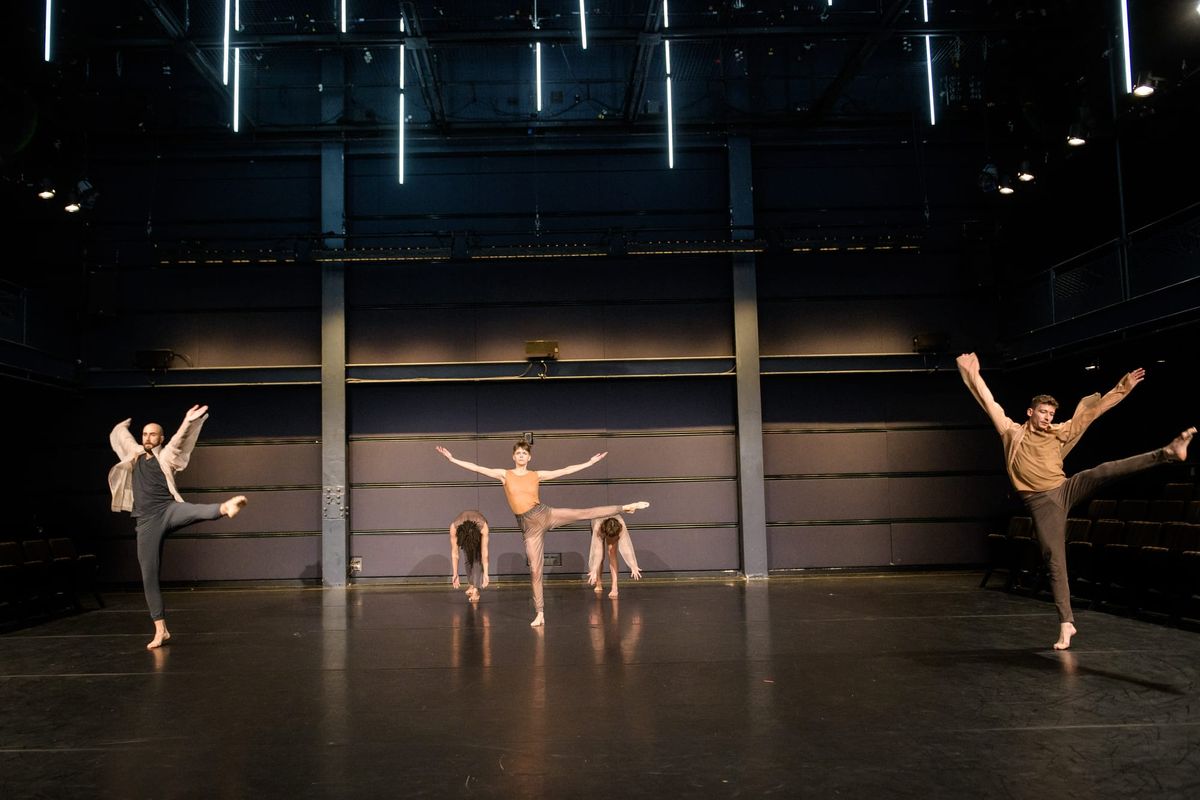
Bartosik, like several of the dancers who perform in “I hunger for you,” learned her trade with Merce Cunningham, and all the athletic power, precision, and randomness the master offered. That training was evident from the start, as Burr Johnson and Dylan Crossman in an early parallel duet, entered from opposite corners and stretched their legs back into perfect arabesques, then crumpled with arms wide to scoop large chunks from the air. If the Cunningham discipline offered a platform, it was not the destination. Bartosik’s goal was to lean not toward pure movement, but toward almost boundless feeling.
The work started in silence, as Christian Allen and Lindsey Jones leaned against the back wall, their arms very slowly rising and opening wide in welcoming gesture. Johnson and Crossman joined in their parallel duet, and Joanna Kotze joined them as the central line of a symmetrical pattern on-stage, five dancers who moved forward and backward in lines of deep, parallel leg lifts, arm swoops, turns and tumbles, in staggered lines, a cascade of roiling bodies. This was no slow burn: they started with power, and never backed down.
The dancers were costumed (by Harriet Jung) in layers of diaphanous, earth-toned material, their bodies clearly visible through the translucent coverings. Some wore or put on jackets of the same fabric, some took them off. They shed the layers as if skin; the levels of vulnerability were an apt metaphor for layers of emotional nakedness, continually peeling away.
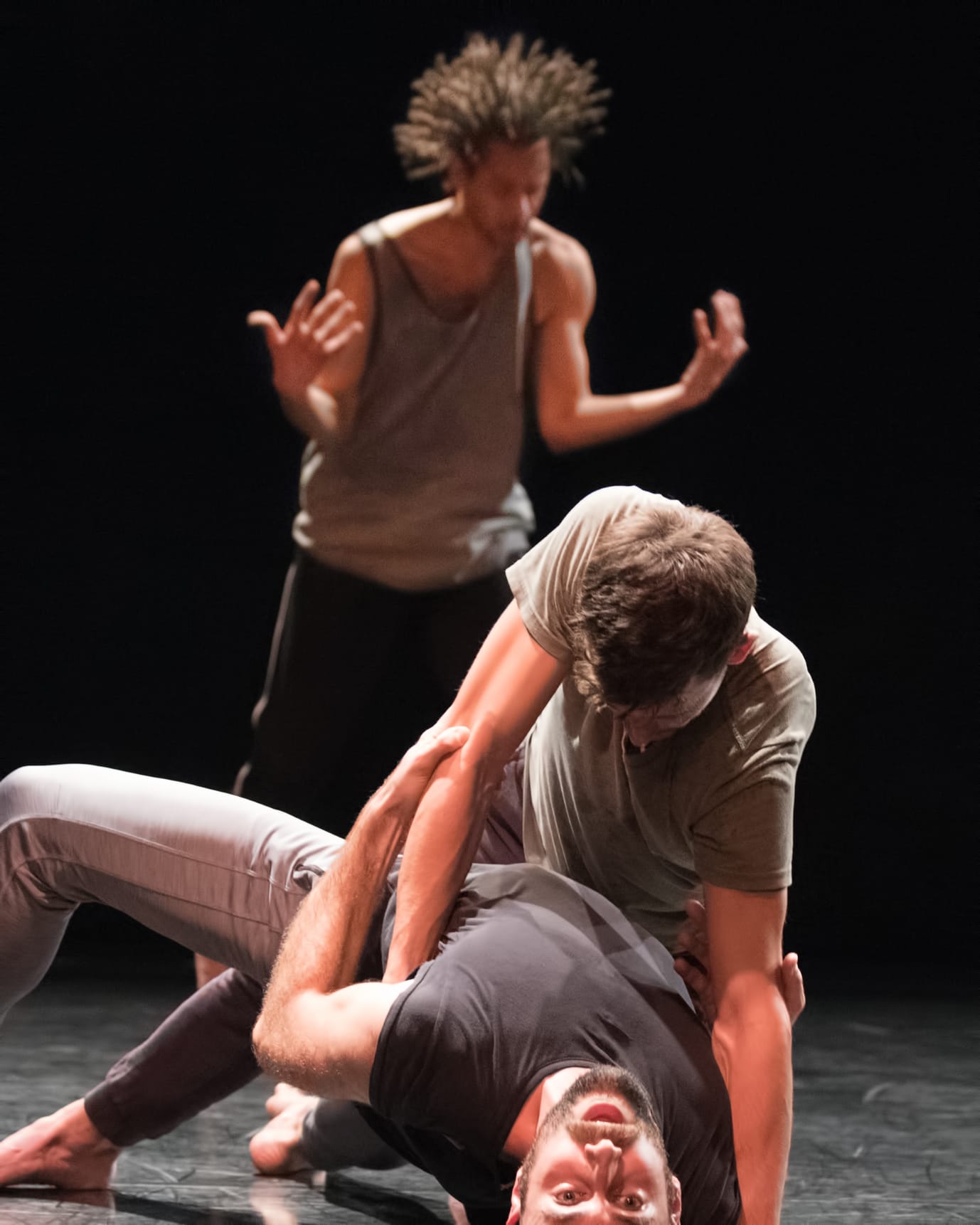
The dancers reeled from paired intimacy to solo obsessions, repeating movements to exhausting extremes. The duets were the most beautiful, sometimes cringingly intimate. Crossman and Kotze were the first to partner, approaching each other with intention – and with Kotze’s hands held up, as if to hold off, just as she approached. With their bodies close, Crossman leaned his face in, but instead of a kiss, his head found the shape of Kotze’s long, swan-like neck and curled his neck around hers, not touching. Their shared heat was palpable.
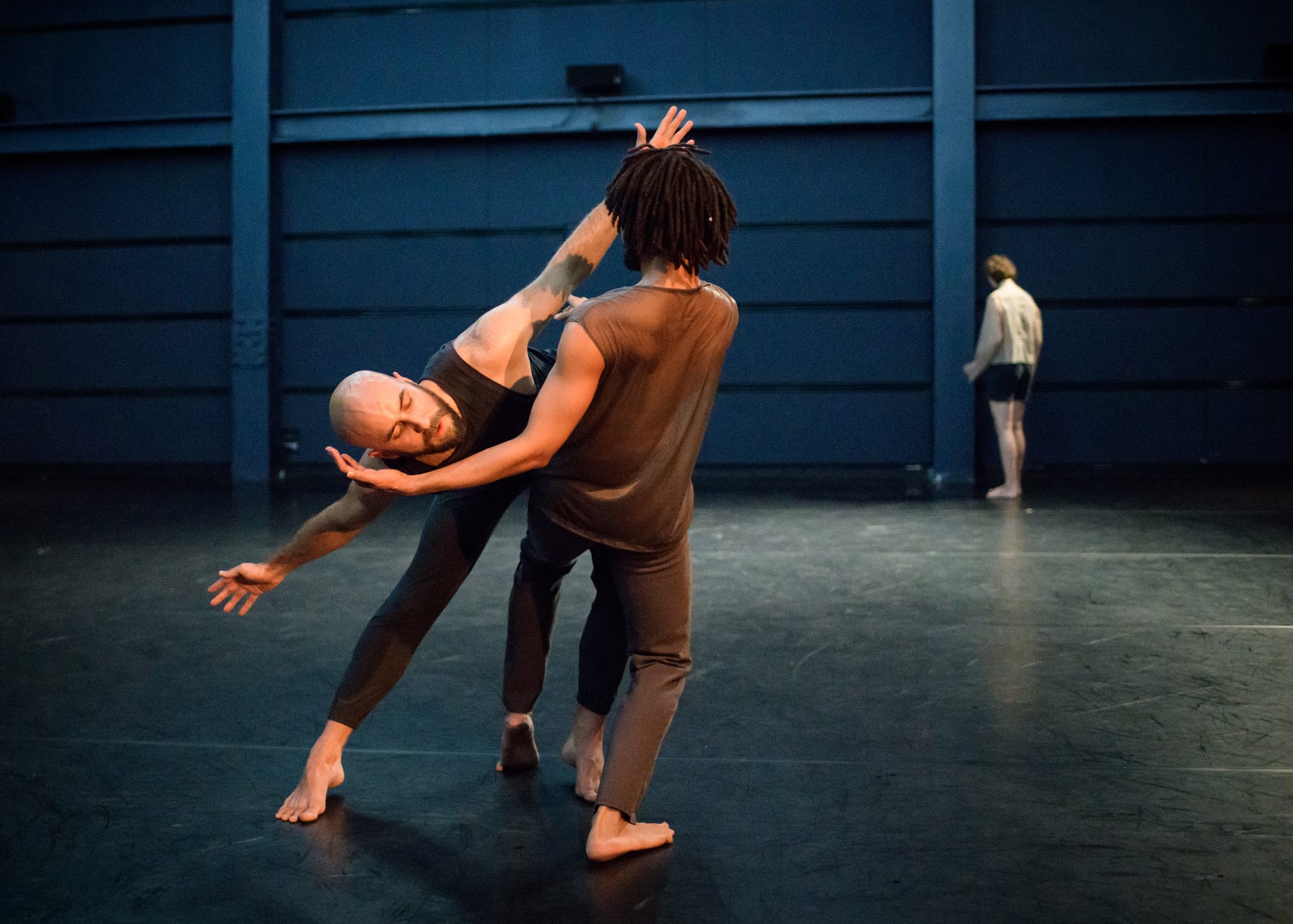
In a later duet, Johnson and Allen filled the stage in a frantic search, like approach/ avoidance personified. As they connected (again, not quite touching,) they looked like skaters, with wide arms and legs meeting in matched arabesques; their heads, too, came perilously, deliciously close – but didn’t connect.
The duets intersected and competed with solos of obsessive movement – Crossman’s shivering torso, Kotze endlessly curling and re-curling her arms, Jones’ pattern of arm thrusts and bent knees. Jones’ repetitive meme was the most dervish-like in its meditative power. Starting slowly, her long solo sequence built to a relentless pattern of arms thrust down as her knee bounced her torso downward to most closely evoke a trance of religious ecstasy. Because the stage is so large, the audience was often faced with multiple patterns to look at – and often had to choose. Depending on where one sat in the three-sided audience, one dancer or one duet was likely to be in the foreground, the others’ frantic movement just background noise to whatever was holding immediate attention.
Kotze opened an extended solo by releasing her long hair, which flew along with her repetitive head and neck contractions like sharp punctuation. As she stood, doing her repetitive arms curls, Bartosik’s young daughter, Dahlia Bartosik-Murray, walked casually onto the stage in sneakers and work-out clothes, to quietly observe, sitting in a soft spotlight. In a later scene, on a dark stage, Bartosik-Murray returned to run determinedly around the stage in several loops, another familiar repetitive movement meme – that of joggers on a track. The brief appearances of this appealing teenager made the piece a true family affair, since Bartosik’s lighting designer is her husband, (and Dahlia’s father,) Roderick Murray.
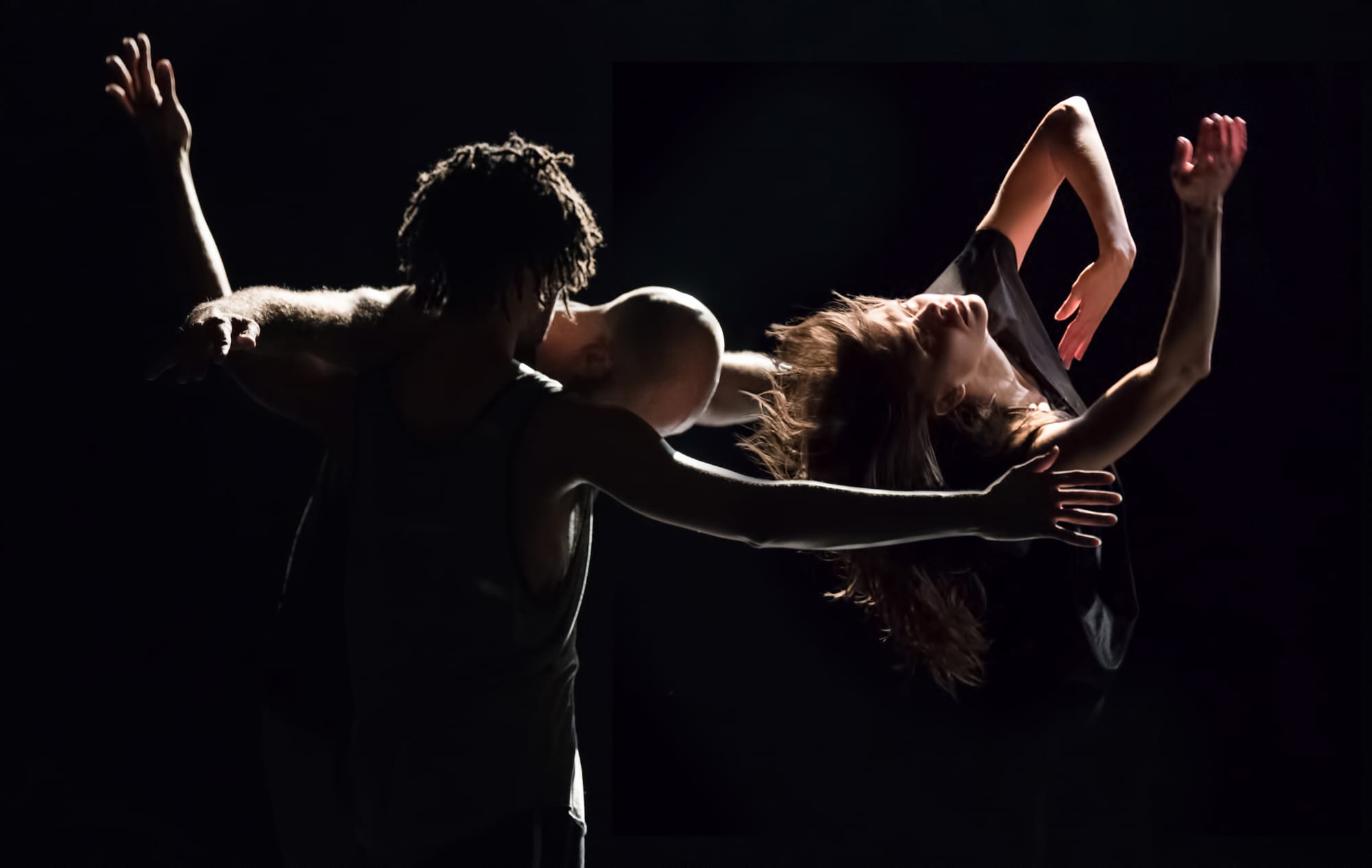
Murray’s lighting choices matched the choreography in their stark contrasts, though the harshness wasn’t always successful. At the start, and periodically through the work, the theater was entirely bright, including house lights, ensuring that the viewers were not separated from the stage. Being in the light can be an awkward experience for the audience, and when the houselights dimmed, it was a relief. The darker configuration also allowed us to see the most intriguing lighting element: several long shafts of light that fell from the ceiling like daggers of illumination.
Finally, the score was the underlying mediator of Bartosik’s vision. Composer Sivan Jacobovitz mixed silence with waves melodic and electronic lines. The sounds included bubbling water, pounding rhythms, techno buzzing. In one especially exhausting sequence, Crossman moved to an electronic rumble; as the rapid rhythm became inhumanly quick Crossman’s physical jerks moved to an inhuman level, too.
By the program’s end, it almost hurt to hear the dancers’ panting, as they moved in pools of sweat. Bartosik and her dancers were relentlessly hungry; she seemed to suggest that we not expect to be sated, that the hunger itself is what counts.
copyright © 2018 by Martha Sherman



