Prismatic
“Chroma,” “Suspended Women,” “Revelations”
Alvin Ailey American Dance Theater
New York City Center
New York, NY
December 12, 2014
Alvin Ailey American Dance Theater’s premiere of Jacqulyn Buglisi’s 2000 work “Suspended Women,” carefully wedged between the no longer new for the company “Chroma” and the classic “Revelations,” offered a moving glimpse of the atemporal elements of the female experience, and the evening’s program as a whole provided a perspective on the company’s artistic dimension.
Buglisi’s ballet was her first work to enter Ailey’s repertory after she’s been teaching at the Ailey School for over 20 years, and in the words of artistic director Robert Battle before the evening began, was a “way to welcome Buglisi into the Ailey family in a different way.” And what a welcome it was.
From the outset, the fifteen women that drifted on stage to Daniel Bernard Roumain’s interpolations on Maurice Ravel’s “Piano Concerto in G Major” were as distressed and beautiful as the period dresses in which they were clad. Their countless stories were concealed in the elegant folds of the dancers’ restrained movements, and they took turns to tell them in small solo phrases and by intermittently staying still, spinning and falling.
Buglisi’s intent with the work was to present the commonality of the female experience over time, the struggles, challenges and strengths, and certainly unity and sisterhood as well, and the Ailey dancers proved to be an excellent vehicle for that expression. The depth of emotional range of the cast made their experiences seem real and ever-present: even when the women were standing in one spot, treading ground but not going anywhere, their eyes betrayed deep hidden narratives.
The choreographer’s history with the company’s dancers, some of whom she’s known since their time at the school, must have helped make the ballet more nuanced and personal, adding to its softness and otherworldly feel. There was emotional richness in the overall work and the details of the more descriptive scenes: the all-consuming mourning as they carried “dead” women off stage, the caring comfort as they cradled each other in enveloping arms. The beautiful costumes with layered and hooped skirts by A. Christina Giannini served not only as the anchors for the representation of the women across the time periods, but also as props, as the dancers expertly maneuvered them left and right, sometimes violently, sometimes gracefully, leaning away from the skirts, dropping to their knees surrounded by their folds, all adding to the particular expression of the dance’s passage.
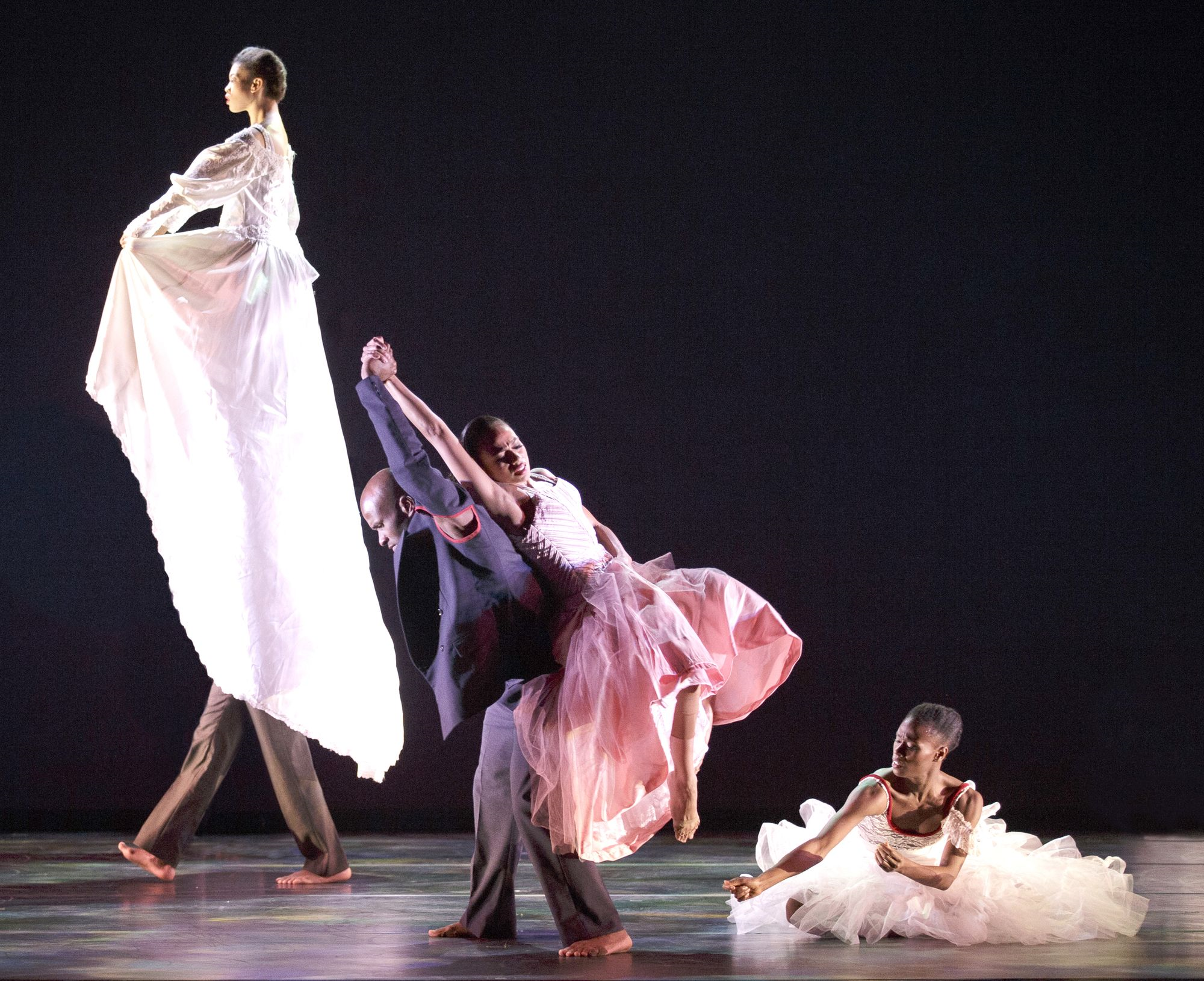
The entrance of four men on stage introduced the aspect of the work that touches on the complexity of gender relations. One man reached to wrap his arm around a woman, but by her throat not her shoulders, transforming the move from protective to violent and sparking alarm in the woman’s eyes even if her movements offered no resistance. Later the men would carry women onstage from the wings in different poses, some looking comfortable, some not, as though carried against their will; one of the women appeared twice as tall as everyone else as a result of a full body lift, her long dress concealing the man supporting her, making her look like a queen. Duets had romance and rejection, with one leaving a woman on the floor looking at a mesmerizing dancing couple with despair. At the end of the ballet, the men walked through the rows of women, taking off their jackets and offering them to women with varying degrees of care. The conflicts embedded in the piece remained unresolved, but now felt more personal and intimately familiar.
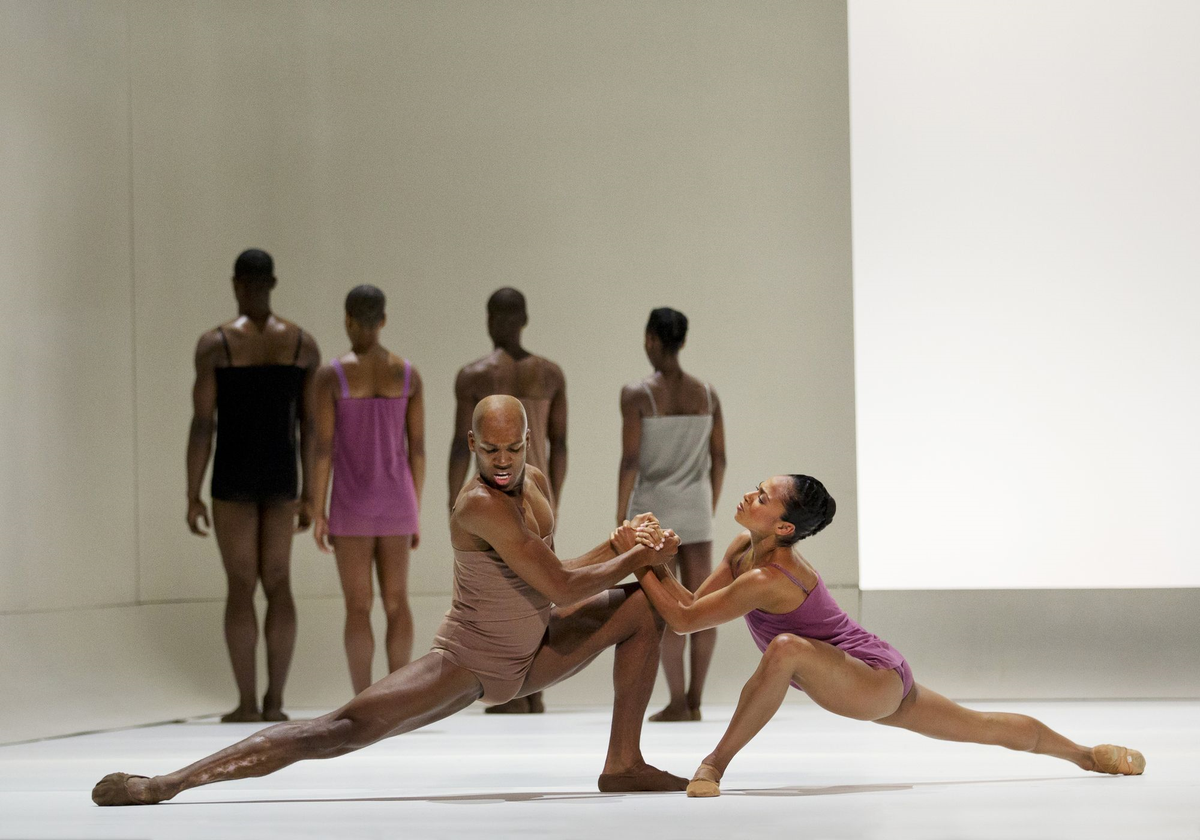
The company’s performance of Wayne McGregor’s 2006 work “Chroma” looked less natural, mostly because the dancers seemed torn between chasing the supple aesthetic that classical ballet companies bring to the work and dancing the ballet in their own, Ailey way. A year since entering the company’s repertory in 2013, the movements in the work had the power but not the fluidity and range, and the lack of extensions, particularly in the feet, often broke the lines of McGregor’s abstract choreography. Unfortunately, without plasticity bringing the steps into a flow, this ballet’s quirks and weaknesses quickly become apparent, as is all that can be annoying about the choreography, and something has to fill that hole to bring the piece back together.
The redeeming moments, and perhaps the key to still making “Chroma” work for this company, came in the male trio which had sass and a very Ailey spunk. Jacqueline Green also stood out in her treatment of the choreography, leaving her face emotionless, but saying so much with each punctuated and accented throw of the leg, and dead-still pause. To me, “Chroma” works best when performed with such emotional detachment, focusing on the accents in the music and on the physicality and plasticity of the abstract choreography rather than emotions, and Green seemed particularly in tune with the work in that regard. As non-classical dancers, this ensemble may never make McGregor’s ballet look the way it does at the Royal Ballet or elsewhere, but the dimension these dancers could bring to the work, as evidenced by Green’s performance, is apparent. It’s just a question of getting there.
Always a crowd pleaser, the Alvin Ailey classic “Revelations” ended the program, as it is scheduled to do 28 out of 39 times of the company’s winter season. The dancers looked good in some of it, but it also showed signs of what may be the onset of performance fatigue, with certain sections looking less inspired. “Didn’t My Lord Deliver Daniel” felt like work, and “Wade in the Water” was in need of better synchronicity. At the same time, “Fix Me, Jesus” was very moving and the dancers performed it with excellent control, and “Sinner Man” bristled with incredible athleticism and power. The ending “Rocka My Soul in the Bosom of Abraham” was danced with energy, but looked even better when the company performed it again for an encore, really letting loose and feeling the music. No doubt, these great dancers look best when they let their individuality shine through the works.
copyright © 2014 by Marianne Adams



