Potpourri
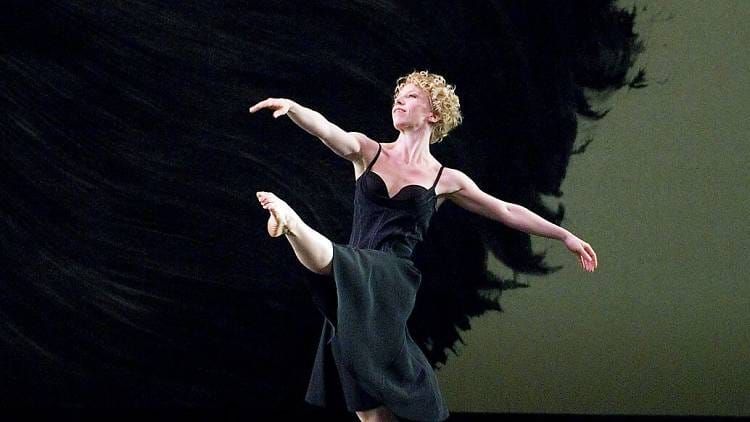
"Eleven", "Dans l'Engrenage", "Shadow Lands", "Salvaje"
Fall for Dance, Program 2
New York City Center
New York, New York
October 3, 2019
The second program of Fall for Dance opened and closed with live music, a rare luxury nowadays. Mark Morris' women dominated the opening dance and the final performance was an all male affair from the Argentine group Malevo. The two middle pieces had mixed casts, (very loud) recorded music, a lot of energy, and some fairly directionless choreography.
"Eleven" is the first section of Mark Morris' three part work "Mozart Dances" from 2006, and it is set to his "Piano Concerto No. 11" (hence the title). It opens with a line of bare chested men who gallantly leave the stage to eight women, who walked, turned, and spun with glorious musical abandon combined with a dignified formality. Lauren Grant, an ageless powerhouse with an elegant, grounded, gripping quality of movement, emerged from the group and danced a free-spirited solo, neither really part of the group nor completely isolated from it. More group dances followed in a slightly darker mood, as their walk echoed the little hesitations in the music.
The work was abstract, alluding to Mozart's era without imitation – the occasional little Dresden shepherdess hands seemed to salute the music, and though there were underlying shifts of mood the dancers seemed to be moving within the music, not pushed by some external emotions. I did miss the resolution the complete work has, since the men seemed a bit of an afterthought, but it was radiant and bracing.
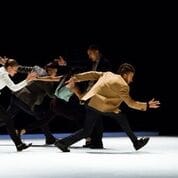
There was nothing radiant about "Dans L'Engrenage" (in the gear), danced by the French hip hop company Dyptik, led by choreographers Mehdi Meghari and Souhail Marchiche. According to the company's website, Meghari sees the work as examining "the frantic social race of our infinite appetite (“never enough”), the going adrift of the common norm. This play questions social climbing without meaning, devoid as it often is of human values" and so on for several more paragraphs. There was some French text read during the dance, not translated in the program, which may have expressed similar sentiments.
The opening is striking, as the group stood around a large table, which one dancer pounded dogmatically to some throbbing electronic music. There seemed to be some angry negotiating going on — very reminiscent of "The Green Table", of course, but effective. However, after that the piece seemed to drift, as various dancers emerged to dance some hip hop moves, pausing now and then to encourage applause. The dancing, though fierce, seemed a bit tame, as even the subway dancer on my ride to the theater was more adventurous.
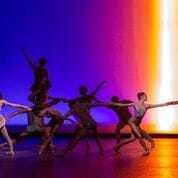
Washington Ballet's 2019 "Shadow Lands", choreographed by Dana Genshaft, a former soloist with the San Francisco Ballet, also trades in abstract ideas, as the program explains that it is designed "to show that when broken pieces come together, the whole is better and stronger than when it is apart", though what is broken is somewhat opaque. The music, by Mason Bates, is alternately stridently electronic and soaringly lush, like some melodramatic film score, but its lack of rhythm or style seemed to defeat the choreographer, as the work seemed to go from pose to pose with little connection or phrasing.
The dancers looked attractive and strong, dancing with a graciously understated and pure style. Katherine Barkman, as the woman in white who seemed to be observing, leading, or wandering through the anonymous group, looked particularly impressive, a dark-eyed, expressive beauty.
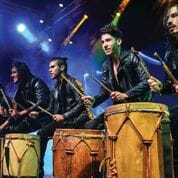
There were lots of dark eyes in the Malevo company's "Salvaje", a world premiere. The company specializes in Malambo, an Argentine dance for men, combing drums, guitars, gaucho boots, and seething masculinity (lots of black leather and decorative chains). The competitive folk element got a Riverdance treatment, with spotlights roving through the audience (and sometime blinding them) as the thirteen dancers poured on. The dancing itself was spectacular, as their feet flew through the complicated rhythms while their upper bodies remained quiet as the combinations grew ever more complex. The finale had the group whipping narrow ropes anchored by a metal ball which hit the floor in a synchronized snap as their arms (and eventually their mouths) controlled the movement. It was stunning, but for actual dancing, Mark Morris took the prize.
Copyright © 2019 by Mary Cargill



