Poetry in Motion
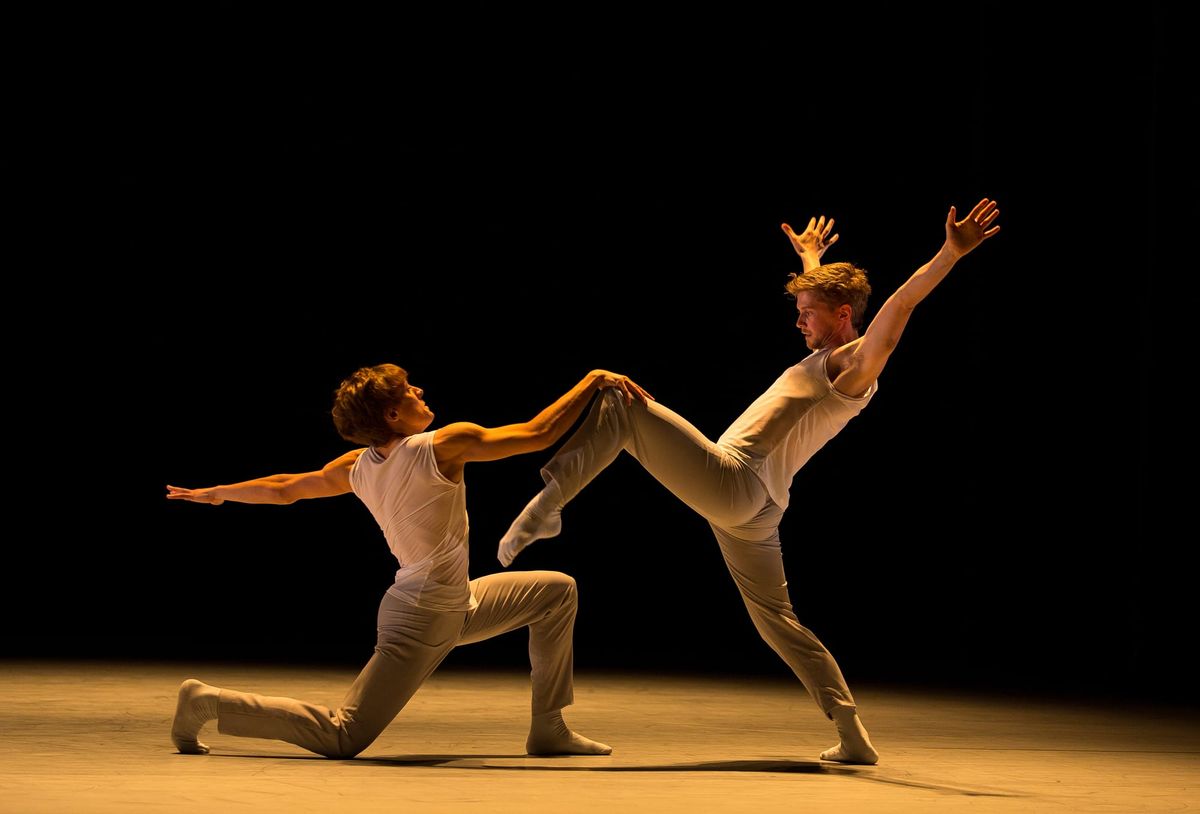
"Sinfonietta Giocosa", "Motion of Displacement", "Ten Poems"
Scottish Ballet
Joyce Theater
New York, New York
April 16, 2017, matinee
The Scottish Ballet brought fourteen of its dancers and three works for its New York debut, a week-long season at the Joyce Theater. The dancers and the repertoire were not especially Scottish – this was no tourist-eye view of the country. Christopher Hampson, the British born Royal Ballet trained choreographer who has directed the company since 2012, selected one Puerto Rican and two British choreographers to show off the clear and unmannered technique of his vigorous and attractive company.
The most impressive work was Christopher Bruce's 2014 "Ten Poems", set, not to music but to Richard Burton's 1955 recording of poems by Dylan Thomas evoking life in a small Welsh village. This gave the company a chance to show that they are fine and subtle actors with a distinctive stage presence. Burton's sonorous voice celebrated the musical rhythms of Thomas' poetry which Bruce's choreograph transformed into movement, showing the poet (Victor Varallo) interacting with his creations as he moved in and out of the vignettes.
The choreography was most effective in the poems celebrating youth, both its joys, its thoughtlessness, and its disappearance. (The costumes suggest the early twentieth century, with World War I looming.) The boys of summer with their light cat-like jumps seemed to float through Burton's voice. Thomas' Welsh village wasn't a picture postcard, as the hunchback in the part (danced with a grotesque sympathy by Jamiel Laurence) was taunted with casual cruelty by those same boys.
The most successful dances were the least literal and "Do Not Go Gentle into that Last Good Night" had two men pounding their fists, no match for the bitterness of the poem. But the work overall was haunting and powerful; one view was not enough to absorb its daring details.
The opening ballet, Hampson's "Sinfonietta Giocosa", set to three movements of the Bohuslav Martinu music of the same title, was originally choreographed for the Atlanta Ballet in 2006. It was inspired, the program says, "by the energy and attack of the American ballet technique". It was an energetic display of black and white costumed dancers, enthusiastically exploring geometry. The two straight lines of the opening (men in white on one side and women in lacy black leotards on the other) broke out into some rather generic turns and a twisty pas de deux which didn't give the dancers a chance to react to each other. There was a great deal of rushing from wing to wing showing off high-flying jumps with some soulful arms added in occasionally, but the dancing didn't really connect with or explore the music. The dancers looked sharp and eager to please but the piece had more adrenaline than heart.
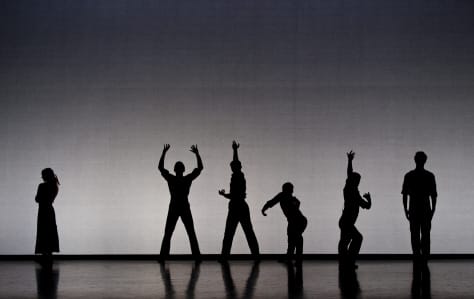
There was a great deal of heart in Bryan Arias' "Motion of Displacement", which, according to the program, "explores the causes and effects of storytelling, inspired by Arias' own childhood memories of his mother's journey from her native land in pursuit of love". The music, following the current trend, was an uneasy combination of modern and classical, this time matching John Adams and Bach. The work opened and closed with a tableau of the ten dancers crouched in a line, presumably in the process of being displaced. In between, they seemed to be miming the experience of skating through mud which trying to tie themselves up in knots; the same repetitive movements were danced to both Adams and Bach. Linking this meandering work to the story of his mother may be sincere, but it felt like emotional blackmail, something this fine company doesn't need to use.
Copyright © 2017 by Mary Cargill



