Pirate Treasure
"Le Corsaire"
Boston Ballet
Boston Opera House
Boston, Massachusetts
October 29, 2016, matinee
"Le Corsaire" originally set sail in Paris in 1856 and moved to Russia with Marius Petipa in 1858, where it went through several revisions. The last Petipa version was done in 1899 and it has added a lot of cargo since then. Unlike "The Sleeping Beauty" the swashbuckling tale, tangentially related to Byron's poem, has no definitive version and its melodramatic plot is basically a plank to support some great (and not so great) choreography. The Boston Ballet presented Anna-Marie Holmes' version based on the 1992 Bolshoi production in 1997, and was the first American company to dance the full-length "Corsaire". (This is essentially the version that American Ballet Theatre dances.)
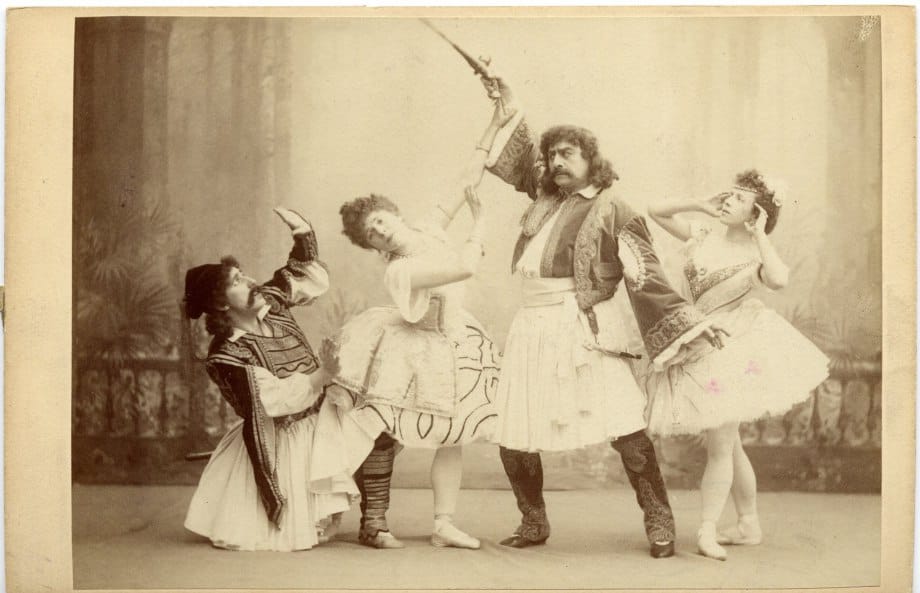
This year Boston acquired the Bavarian State Ballet's 2006 version produced by Ivan Liška, which, though it does not attempt to reproduce one of the many nineteenth century versions (this photograph from the 1899 production helps explain why), it does use choreography derived from the notations based on late nineteenth and early twentieth century Petipa choreography, incorporating the research of the dance scholar Doug Fullington.
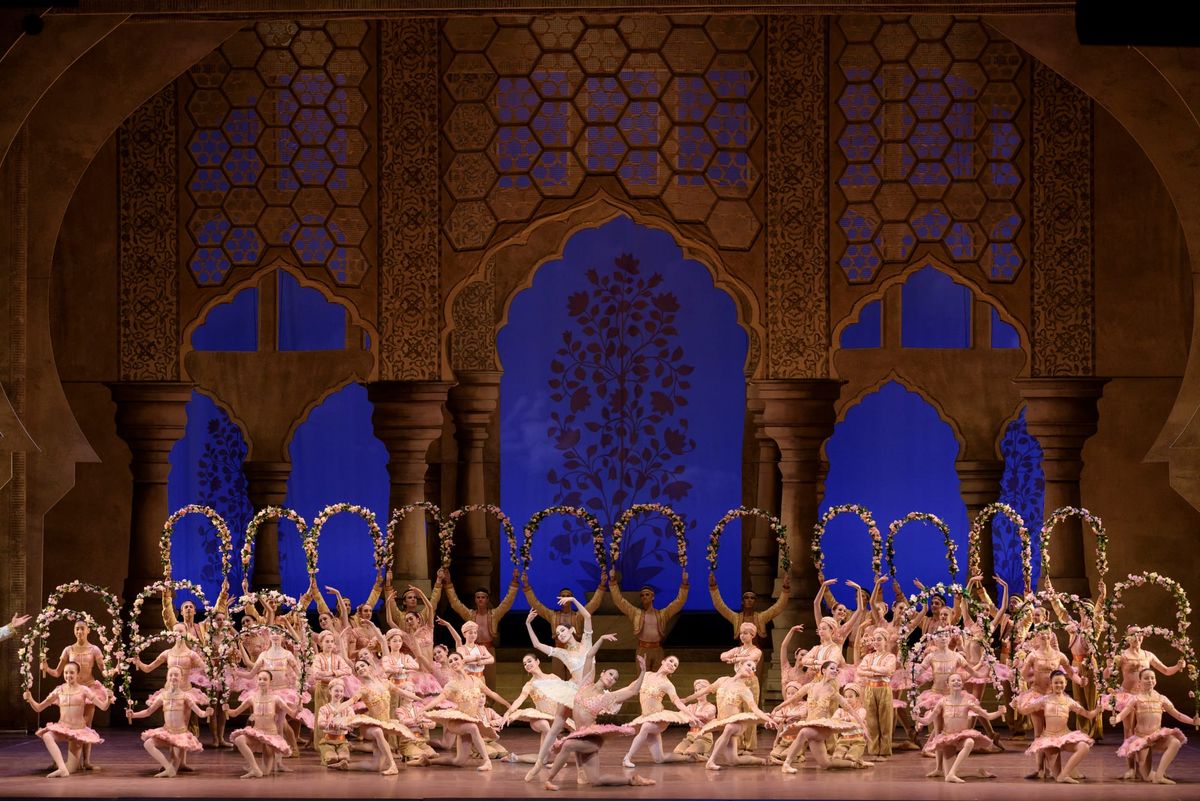
Petipa loved choreographing for women and the famous Jardin Animé, choreographed in 1899, is basically an abstract ballet to Delibes ("Le Corsaire" is a musical wish-mash) celebrating female beauty, which is usually shoe-horned into the story by pretending to be the lecherous Pasha's dream of his garden of women. In this production, it turns into the Pasha's entertainment for his guests; whatever the excuse it is one of the most elegant, refined, and beautiful fifteen minutes in ballet. The older version is more detailed and filigreed than the modern ones, with well-trained children as delightful accents (though the originals would have worn longer, more flattering skirts) and men politely holding garlands in the background, framing the complex, kaleidoscopic shapes. There was more demi-point than we currently see, giving the lead dancers (Maria Baranova and Anaïs Chalendard) a soft, bouncy look.
Fullington also reconstructed Petipa's pas des odalisques, a dance for three women, again with no bearing whatever on the plot. ABT, following the Bolshoi version, puts it in Act I, and in Boston they show up in the last act; wherever they appear, they are another of Petipa's glorious explorations of female beauty. The reconstructed dances are softer and more flowing than the flamboyant versions currently danced and Diana Albrecht, Rie Ichikawa, and Dalay Parrando were utterly captivating. I especially enjoyed Parrando's third variation, where the modern multiple pirouettes (often danced through clinched teeth) were replaced by little hops into a single air turn: bouncy, joyful, and musical.
Liška did not try to recreate or imitate the nineteenth century style and there was plenty of male dancing, none, I suspect, choreographed by Petipa. This did mean that the mutinous villain Birbanto, originally a mimed role of menacing and sullen power, has retained his energetic but rather generic jumps and scowls; Roddy Doble jumped and scowled with abandon.
Liška also reworked some of the plot, though the outline of the dashing pirate Conrad (Paul Craig) and his frequently abducted girlfriend Medora (Maria Baranova), her friend the slave girl Gulnara (Anaïs Chalendard) and the slave Ali (Florimond Lorieux) remain. Ali now has two jobs; in Act I he worked for the slave trader Lankedem and got a solo with Gulnara in the pas d'exclave. He switched owners for the grotto scene and danced in the familiar Corsaire pas de deux (a twentieth century addition), though Conrad helped himself to most of Ali's dances. Lorieux danced cleanly with some sparkling split leaps, though not quite managing the jumps into deep plié in his pas d'exclave solo. He did get a moment of heroism, though, since Liška has Ali stab Birbanto at the end of the grotto scene, a sensible solution since it saves Conrad from looking like a deluded dolt for trusting Birbanto through the end of the final act.
But this does mean that Conrad has little do to except leap energetically and look longingly at Medora. Craig played it straight, without condescending to the ballet. He gave a lighthearted performance without placing his tongue in his cheek and supported Medora generously.
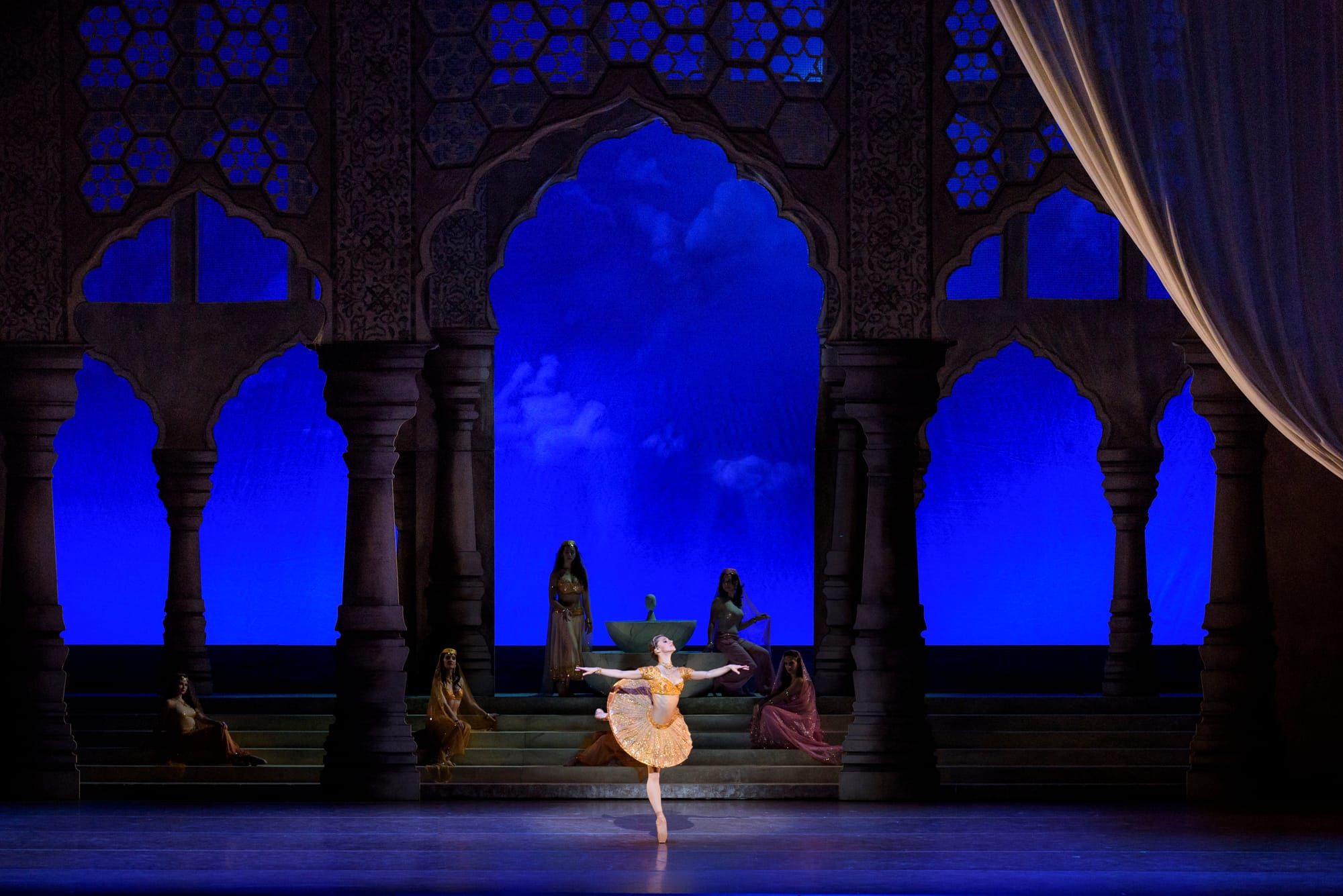
Medora has now become the adopted daughter of the slave merchant Lankedem (a fine, lowering, greedy John Lam) and he is the person who devises the poison flower trick to knock Conrad out and recapture Medora for the Pasha; obviously he isn't in the running for Father of the Year. Baranova was a sweet, playful and very natural Medora, dancing without any extraneous mannerisms, though the fouettés did look like work. The swooning, Soviet bedroom pas de deux has been replaced by a charming, mimed interlude, though she did wear a modern nightgown. She also gets the wonderful Petite Corsaire variation (from 1863), where traditionally Medora dons male clothing and character shoes, imitating a sailor, complete with big mustache, to cheer Conrad up. Baranova didn't have time to change out of her nighty or her point shoes, though she made the dance, with its chipper little hornpipe, absolutely captivating.
Her buddy Gulnara is now perfectly happy as a slave in the Pasha's harem and doesn't run off with the happy couple at the end to (as in ABT) drown in the shipwreck. Boston does have a ship (a very impressive one), but it doesn't sink, it sails off into the sunset and everyone lives happily, including the audience.
Copyright © 2016 by Mary Cargill



